Ch. 3 - Cell Structure and Function
Bauman - Microbiology with Diseases by Taxonomy 6th Edition
Bauman6th EditionMicrobiology with Diseases by TaxonomyISBN: 9780134832302Non è quello che usi tu?Cambia libro di testo
Capitolo 3, Problema 7

Which of the following statements is true?


a. The cell walls of bacteria are composed of peptidoglycan.
b. Peptidoglycan is a fatty acid.
c. Gram-positive bacterial walls have a relatively thin layer of peptidoglycan anchored to the cytoplasmic membrane by teichoic acids.
d. Peptidoglycan is found mainly in the cell walls of fungi, algae, and plants.

Guida verificata passo dopo passo
1
Step 1: Understand the composition of bacterial cell walls. Bacterial cell walls are primarily made of a polymer called peptidoglycan, which provides structural strength and shape to the cell.
Step 2: Clarify what peptidoglycan is chemically. Peptidoglycan is not a fatty acid; it is a complex polymer consisting of sugars and amino acids forming a mesh-like layer outside the plasma membrane.
Step 3: Differentiate between Gram-positive and Gram-negative bacterial cell walls. Gram-positive bacteria have a thick peptidoglycan layer, whereas Gram-negative bacteria have a thinner peptidoglycan layer and an outer membrane.
Step 4: Understand the role of teichoic acids. In Gram-positive bacteria, teichoic acids are molecules that anchor the thick peptidoglycan layer to the cytoplasmic membrane and contribute to cell wall maintenance and ion regulation.
Step 5: Recognize where peptidoglycan is found. Peptidoglycan is unique to bacterial cell walls and is not found in the cell walls of fungi, algae, or plants, which have other structural components like chitin or cellulose.

Risposta video verificata per un problema simile:

Questa soluzione video è stata consigliata dai nostri tutor come utile per risolvere questo problema.
Durata del video:
3m

Concetti chiave

Ecco i concetti essenziali che devi comprendere per rispondere correttamente alla domanda.

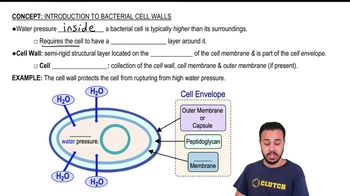
Structure and Composition of Bacterial Cell Walls

Bacterial cell walls are primarily composed of peptidoglycan, a polymer consisting of sugars and amino acids that provides structural support and shape. This layer is essential for bacterial survival and differs between Gram-positive and Gram-negative bacteria.
Video consigliato:
03:44
Introduction to Bacterial Cell Walls

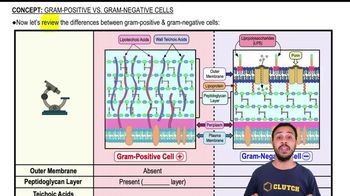
Differences Between Gram-Positive and Gram-Negative Bacteria

Gram-positive bacteria have a thick peptidoglycan layer containing teichoic acids that anchor it to the cytoplasmic membrane, while Gram-negative bacteria have a thinner peptidoglycan layer located between the inner and outer membranes. These differences affect staining properties and antibiotic susceptibility.
Video consigliato:
04:46
Gram-Positive vs. Gram-Negative Cell Walls

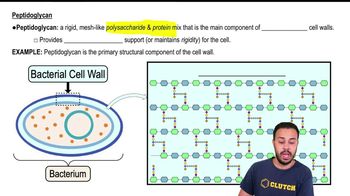
Composition of Peptidoglycan

Peptidoglycan is not a fatty acid but a complex polymer made of sugar chains cross-linked by short peptides. It is unique to bacterial cell walls and is absent in fungi, algae, and plants, which have cell walls made of chitin, cellulose, or other polysaccharides.
Video consigliato:
01:58
Peptidoglycan