Immersion oil ________(increases/decreases) the numerical aperture, which ________(increases/decreases) resolution because _______(more/fewer) light rays are involved.
Ch. 4 - Microscopy, Staining, and Classification
Bauman6th EditionMicrobiology with Diseases by TaxonomyISBN: 9780134832302Non è quello che usi tu?Cambia libro di testo
Capitolo 4, Problema 2
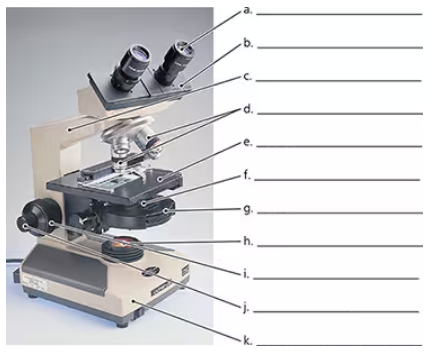
Label the microscope.

Guida verificata passo dopo passo1
Identify the main parts of the microscope that need labeling, such as the eyepiece (ocular lens), objective lenses, stage, light source, diaphragm, coarse focus knob, fine focus knob, and arm.
Start with the eyepiece, which is the lens at the top that you look through to see the specimen. Label it as 'Eyepiece (Ocular Lens)'.
Locate the objective lenses, which are the multiple lenses attached to the rotating nosepiece just above the stage. Label each objective lens according to its magnification (e.g., 4x, 10x, 40x).
Find the stage, the flat platform where the slide is placed. Label it as 'Stage'. Also, identify the stage clips that hold the slide in place.
Identify the light source located beneath the stage, which illuminates the specimen. Label it as 'Light Source'. Then, locate the diaphragm or iris, which controls the amount of light passing through the specimen, and label it accordingly.

Risposta video verificata per un problema simile:
Questa soluzione video è stata consigliata dai nostri tutor come utile per risolvere questo problema.
Durata del video:
2mConcetti chiave
Ecco i concetti essenziali che devi comprendere per rispondere correttamente alla domanda.
Parts of a Light Microscope
A light microscope consists of key components such as the eyepiece (ocular lens), objective lenses, stage, light source, diaphragm, and focusing knobs. Each part plays a specific role in magnifying and illuminating the specimen for observation.
Video consigliato:
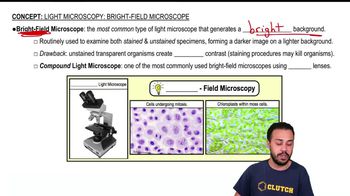
Light Microscopy: Bright-Field Microscopes
Function of Microscope Components
Understanding the function of each part is essential; for example, objective lenses provide different magnifications, the stage holds the slide, and the diaphragm controls light intensity. Proper use of focusing knobs adjusts clarity and sharpness.
Video consigliato:
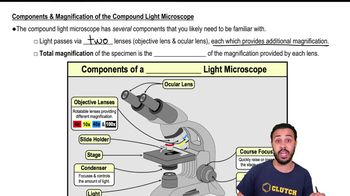
Components & Magnification of the Compound Light Microscope
Microscope Handling and Usage
Correct handling involves proper slide placement, adjusting light and focus gradually, and knowing how to switch between objective lenses. This ensures clear visualization of microorganisms or cells without damaging the equipment.
Video consigliato:
Light Microscopy: Bright-Field Microscopes
Pratica correlata
Domanda del libro di testo
1539
views
Domanda del libro di testo
A nanometer is _______ than a micrometer.
a. 10 times larger
b. 10 times smaller
c. 1000 times larger
d. 1000 times smaller
1609
views
Domanda del libro di testo
Label each photograph with the type of microscope used to acquire the image.
a. _______<IMAGE>
b. _______<IMAGE>
c. _______<IMAGE>
d. _______<IMAGE>
e. _______<IMAGE>
f. _______<IMAGE>
1513
views
Domanda del libro di testo
The type of fixation developed by Koch for bacteria is _______.
1860
views
Domanda del libro di testo
Resolution is best described as the ____________.
a. Ability to view something that is small
b. Ability to magnify a specimen
c. Ability to distinguish between two adjacent objects
d. Difference between two waves of electromagnetic radiation
1536
views
Domanda del libro di testo
Critique the following definition of magnification given by a student on a microbiology test: “Magnification makes things bigger.”
1678
views