Ch. 4 - Microscopy, Staining, and Classification
Bauman - Microbiology with Diseases by Taxonomy 6th Edition
Bauman6th EditionMicrobiology with Diseases by TaxonomyISBN: 9780134832302Non è quello che usi tu?Cambia libro di testo
Capitolo 4, Problema 4

Put the following substances in the order they are used in a Gram stain:
Counterstain
Decolorizing agent
Mordant
Primary stain

Guida verificata passo dopo passo
1
Understand the purpose of each substance in the Gram stain procedure: the primary stain colors all cells, the mordant fixes the stain, the decolorizing agent differentiates between Gram-positive and Gram-negative cells, and the counterstain colors cells that lost the primary stain.
Identify the first step: the primary stain is applied first to stain all bacterial cells, typically using crystal violet.
Next, apply the mordant, which is usually iodine; it forms a complex with the primary stain to help it adhere better to the cell wall.
Then, use the decolorizing agent, often alcohol or acetone-alcohol, to wash out the stain from Gram-negative cells but not from Gram-positive cells due to differences in their cell wall structure.
Finally, apply the counterstain, such as safranin, which stains the decolorized Gram-negative cells a different color, allowing differentiation under the microscope.

Risposta video verificata per un problema simile:

Questa soluzione video è stata consigliata dai nostri tutor come utile per risolvere questo problema.
Durata del video:
3m

Concetti chiave

Ecco i concetti essenziali che devi comprendere per rispondere correttamente alla domanda.

Primary Stain

The primary stain is the first dye applied in the Gram staining process, typically crystal violet. It penetrates all bacterial cells, coloring them purple initially, which sets the stage for differentiating bacteria based on their cell wall properties.
Video consigliato:
02:10
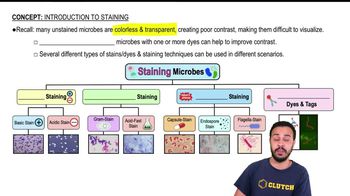
Introduction to Staining

Mordant

The mordant, usually iodine, is applied after the primary stain to form a complex with the dye inside the cells. This complex helps fix the primary stain, making it less soluble and enhancing the retention of the dye in Gram-positive bacteria.
Video consigliato:
04:57
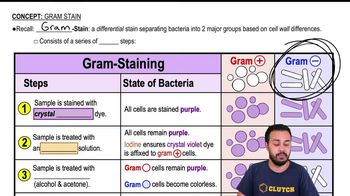
Gram Stain

Decolorizing Agent and Counterstain

The decolorizing agent, often alcohol or acetone, selectively removes the primary stain from Gram-negative bacteria due to their thinner peptidoglycan layer. After decolorization, the counterstain (commonly safranin) is applied to stain the now colorless Gram-negative bacteria pink/red, completing the differentiation.
Video consigliato:
04:14
Liquid Chemicals: Surface-Active Agents