Ch. 5 - Microbial Metabolism
Bauman - Microbiology with Diseases by Taxonomy 6th Edition
Bauman6th EditionMicrobiology with Diseases by TaxonomyISBN: 9780134832302Non è quello che usi tu?Cambia libro di testo
Capitolo 5, Problema 3

The initial catabolism of glucose occurs by glycolysis and/or the ________ and ________pathways.

Guida verificata passo dopo passo
1
Identify the main pathways involved in the initial catabolism of glucose besides glycolysis. Glycolysis is the most common pathway, but there are alternative pathways used by different microorganisms.
Recall that the Entner-Doudoroff pathway is an alternative to glycolysis found in some bacteria, which also breaks down glucose to pyruvate but via a different set of enzymes.
Recognize that the Pentose Phosphate pathway (also called the hexose monophosphate shunt) is another pathway that metabolizes glucose, primarily generating NADPH and pentoses rather than ATP directly.
Understand that the question asks for two pathways alongside glycolysis, so the answer should be the Entner-Doudoroff pathway and the Pentose Phosphate pathway.
Summarize that the initial catabolism of glucose occurs by glycolysis and/or the Entner-Doudoroff and Pentose Phosphate pathways.

Risposta video verificata per un problema simile:

Questa soluzione video è stata consigliata dai nostri tutor come utile per risolvere questo problema.
Durata del video:
2m

Concetti chiave

Ecco i concetti essenziali che devi comprendere per rispondere correttamente alla domanda.

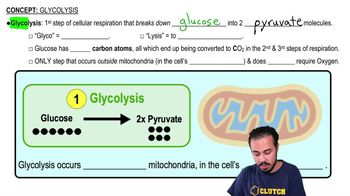
Glycolysis

Glycolysis is the metabolic pathway that breaks down glucose into pyruvate, producing ATP and NADH. It is the first step in cellular respiration and occurs in the cytoplasm of cells, functioning under both aerobic and anaerobic conditions.
Video consigliato:
05:04
Glycolysis

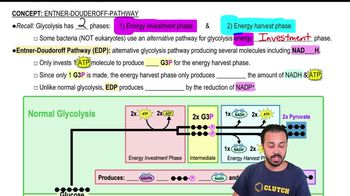
Entner-Doudoroff Pathway

The Entner-Doudoroff pathway is an alternative glucose catabolic route found in some bacteria. It converts glucose to pyruvate and glyceraldehyde-3-phosphate, generating ATP and NADPH, and is important in organisms lacking key glycolytic enzymes.
Video consigliato:
08:59
Entner-Doudoroff Pathway

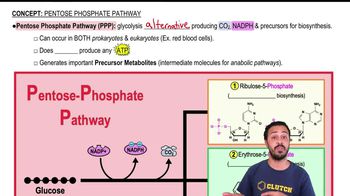
Pentose Phosphate Pathway

The Pentose Phosphate Pathway (PPP) is a metabolic route parallel to glycolysis that generates NADPH and pentoses. It plays a critical role in biosynthesis and oxidative stress response by providing reducing power and ribose sugars for nucleotide synthesis.
Video consigliato:
04:44
Pentose-Phosphate Pathway
Pratica correlata
Domanda del libro di testo

How do organisms control the rate of metabolic activities in their cells?

1585
views

Domanda del libro di testo

Two ATP molecules are used to initiate glycolysis. Enzymes generate molecules of ATP for each molecule of glucose that undergoes glycolysis. Thus, a net gain of _________ molecules of ATP is produced in glycolysis.

1281
views
Domanda del libro di testo

For the phrase given below, indicate the type of metabolism referred to, using the following choices:

a. Anabolism only

b. Both anabolism and catabolism (amphibolic)

c. Catabolism only


Is endergonic

780
views
Domanda del libro di testo

For the phrase given below, indicate the type of metabolism referred to, using the following choices:

a. Anabolism only

b. Both anabolism and catabolism (amphibolic)

c. Catabolism only


Is exergonic

791
views
Domanda del libro di testo

Indian tradition holds that storing water in brass pitchers prevents disease. Scientists have discovered that there is some truth in the tradition. The researchers collected river water samples and found fecal bacterial counts as high as 1 million bacteria per milliliter. However, they could detect no bacteria in the water after it had been stored for two days in traditional brass pitchers. Bacterial levels in plastic or earthenware containers remained high over the same period. How can brass, which is an alloy of copper mixed with zinc, make water safer to drink?

<IMAGE>

1231
views
Domanda del libro di testo

Examine the biosynthetic pathway for the production of the amino acids tryptophan, tyrosine, and phenylalanine in the figure. Where do the initial reactants (erythrose 4-phosphate and PEP) originate?

1305
views