Where specifically does the most significant production of ATP occur in prokaryotic and eukaryotic cells?
Ch. 5 - Microbial Metabolism
Bauman6th EditionMicrobiology with Diseases by TaxonomyISBN: 9780134832302Non è quello che usi tu?Cambia libro di testo
Capitolo 5, Problema 13
Which of the following does not affect the function of enzymes?
a. Ubiquinone
b. Substrate concentration
c. Temperature
d. Competitive inhibitors
Guida verificata passo dopo passo1
Step 1: Understand the role of enzymes and factors that influence their activity. Enzymes are biological catalysts that speed up chemical reactions, and their function can be affected by various factors.
Step 2: Analyze each option to determine if it affects enzyme function. Substrate concentration affects enzyme activity because it influences the rate at which enzymes bind to substrates.
Step 3: Temperature affects enzyme function by altering the enzyme's shape and activity; too high or too low temperatures can denature enzymes or reduce their efficiency.
Step 4: Competitive inhibitors affect enzyme function by binding to the active site, preventing substrate binding and thus reducing enzyme activity.
Step 5: Ubiquinone is a molecule involved in the electron transport chain, not directly related to enzyme activity modulation, so it does not affect enzyme function in the context of enzyme catalysis.

Risposta video verificata per un problema simile:
Questa soluzione video è stata consigliata dai nostri tutor come utile per risolvere questo problema.
Durata del video:
1mConcetti chiave
Ecco i concetti essenziali che devi comprendere per rispondere correttamente alla domanda.
Enzyme Function and Activity
Enzymes are biological catalysts that speed up chemical reactions by lowering activation energy. Their function depends on factors like substrate binding, environmental conditions, and the presence of inhibitors, which can enhance or reduce their catalytic efficiency.
Video consigliato:
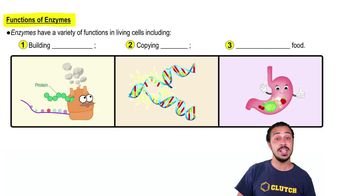
Functions of Enzymes
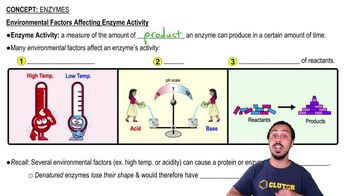
Factors Affecting Enzyme Activity
Enzyme activity is influenced by substrate concentration, temperature, pH, and inhibitors. Substrate concentration affects the rate until saturation, temperature affects molecular movement and enzyme stability, and inhibitors can block active sites or alter enzyme shape.
Video consigliato:
Environmental Factors Affecting Enzyme Activity
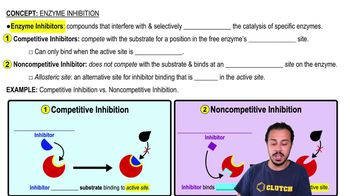
Competitive Inhibition
Competitive inhibitors resemble the substrate and bind to the enzyme's active site, preventing substrate binding. This type of inhibition reduces enzyme activity but can be overcome by increasing substrate concentration, distinguishing it from other inhibition types.
Video consigliato:
Enzyme Inhibition
Pratica correlata
Domanda del libro di testo
1220
views
Domanda del libro di testo
Under ideal conditions, the fermentation of one glucose molecule by a bacterium allows a net gain of how many ATP molecules?
a. 2
b. 4
c. 38
d. 0
1067
views
Domanda del libro di testo
Most oxidation reactions in bacteria involve the _______.
a. Removal of hydrogen ions and electrons
b. Removal of oxygen
c. Addition of hydrogen ions and electrons
d. Addition of hydrogen ions
1191
views
Domanda del libro di testo
How do yeast cells make alcohol and cause bread to rise?
1415
views
Domanda del libro di testo
Why are vitamins essential metabolic factors for microbial metabolism?
1579
views
Domanda del libro di testo
Which of the following statements best describes ribozymes?
a. Ribozymes are proteins that aid in the production of ribosomes.
b. Ribozymes are nucleic acids that produce ribose sugars.
c. Ribozymes store enzymes in ribosomes.
d. Ribozymes process RNA molecules in eukaryotes.
1439
views