Ch. 7 - Microbial Genetics
Bauman - Microbiology with Diseases by Taxonomy 6th Edition
Bauman6th EditionMicrobiology with Diseases by TaxonomyISBN: 9780134832302Non è quello che usi tu?Cambia libro di testo
Capitolo 7, Problema 7

Besides the fact that it synthesizes RNA, how does RNA polymerase differ in function from DNA polymerase?

Guida verificata passo dopo passo
1
Step 1: Understand the primary function of RNA polymerase, which is to synthesize RNA molecules by reading a DNA template during the process called transcription.
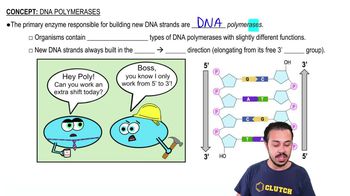
Step 2: Recognize that DNA polymerase synthesizes DNA molecules by adding nucleotides to a pre-existing DNA strand during DNA replication.
Step 3: Note that RNA polymerase can initiate RNA synthesis de novo, meaning it does not require a primer to start adding nucleotides, whereas DNA polymerase requires a primer to begin DNA synthesis.
Step 4: Consider the substrate differences: RNA polymerase uses ribonucleoside triphosphates (rNTPs) as substrates, while DNA polymerase uses deoxyribonucleoside triphosphates (dNTPs).
Step 5: Summarize that RNA polymerase is involved in transcription producing RNA from DNA, can start synthesis without a primer, and uses rNTPs, whereas DNA polymerase is involved in DNA replication, requires a primer, and uses dNTPs.

Risposta video verificata per un problema simile:

Questa soluzione video è stata consigliata dai nostri tutor come utile per risolvere questo problema.
Durata del video:
3m

Concetti chiave

Ecco i concetti essenziali che devi comprendere per rispondere correttamente alla domanda.

Function of RNA Polymerase

RNA polymerase is an enzyme that synthesizes RNA by reading a DNA template strand during transcription. It initiates RNA synthesis without needing a primer and adds ribonucleotides complementary to the DNA template, producing a single-stranded RNA molecule.
Video consigliato:
04:01
DNA Polymerases

Function of DNA Polymerase

DNA polymerase synthesizes DNA by adding deoxyribonucleotides to a pre-existing primer strand during DNA replication. It requires a primer to start and ensures high fidelity by proofreading newly synthesized DNA strands to minimize errors.
Video consigliato:
04:01
DNA Polymerases

Primer Requirement and Proofreading Differences

Unlike DNA polymerase, RNA polymerase does not require a primer to begin synthesis, allowing it to start RNA chains de novo. Additionally, RNA polymerase generally lacks proofreading ability, resulting in a higher error rate compared to DNA polymerase, which has proofreading functions to maintain DNA integrity.
Video consigliato:
05:32
Reviewing the Different Types of Microscopes