Ch. 7 - Microbial Genetics
Bauman - Microbiology with Diseases by Taxonomy 6th Edition
Bauman6th EditionMicrobiology with Diseases by TaxonomyISBN: 9780134832302Non è quello che usi tu?Cambia libro di testo
Capitolo 7, Problema 10

Which of the following methods of DNA repair involves enzymes that recognize and correct nucleotide errors in unmethylated strands of DNA?
a. Light repair of T dimers
b. Dark repair of P dimers
c. Mismatch repair
d. SOS response

Guida verificata passo dopo passo
1
Step 1: Understand the context of DNA repair mechanisms. DNA repair is essential for correcting errors that occur during DNA replication or due to damage from environmental factors.
Step 2: Review the options given: (a) Light repair of thymine dimers involves photoreactivation using light to directly reverse UV-induced damage, specifically thymine dimers.
Step 3: Dark repair (b) typically refers to nucleotide excision repair that removes bulky DNA lesions like pyrimidine dimers without the need for light, but it does not specifically target unmethylated strands.
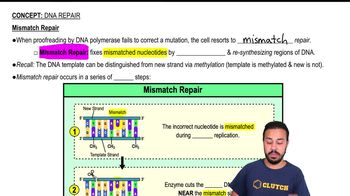
Step 4: Mismatch repair (c) is a system that identifies and corrects mismatched nucleotides in newly synthesized DNA strands by recognizing the unmethylated (new) strand, ensuring replication fidelity.
Step 5: The SOS response (d) is a global response to extensive DNA damage that induces error-prone repair mechanisms, not specifically targeting unmethylated strands for mismatch correction.

Risposta video verificata per un problema simile:

Questa soluzione video è stata consigliata dai nostri tutor come utile per risolvere questo problema.
Durata del video:
3m

Concetti chiave

Ecco i concetti essenziali che devi comprendere per rispondere correttamente alla domanda.

Mismatch Repair

Mismatch repair is a DNA repair mechanism that identifies and corrects base-pairing errors introduced during DNA replication. It specifically targets the newly synthesized, unmethylated DNA strand to ensure the correct nucleotide is incorporated, maintaining genetic fidelity.
Video consigliato:
04:30
Mismatch Repair

DNA Methylation and Strand Discrimination

DNA methylation involves adding methyl groups to specific bases, typically on the parental DNA strand. This methylation allows repair enzymes to distinguish the original (methylated) strand from the newly synthesized (unmethylated) strand, guiding accurate correction of replication errors.
Video consigliato:
05:15
Leading & Lagging DNA Strands

Types of DNA Repair Mechanisms

DNA repair includes various pathways like light repair (photoreactivation), dark repair (nucleotide excision repair), mismatch repair, and the SOS response. Each targets specific types of DNA damage or errors, using distinct enzymes and processes to maintain genome integrity.
Video consigliato:
04:30
Mismatch Repair