
Ch. 8 - Recombinant DNA Technology
Bauman - Microbiology with Diseases by Taxonomy 6th Edition
Bauman6th EditionMicrobiology with Diseases by TaxonomyISBN: 9780134832302Non è quello che usi tu?Cambia libro di testo
Capitolo 8, Problema 5

Which recombinant DNA technique is used to replicate copies of a DNA molecule?


a. PCR
b. Gel electrophoresis
c. Electroporation
d. Reverse transcription

Guida verificata passo dopo passo
1
Understand the purpose of each technique listed: PCR, Gel electrophoresis, Electroporation, and Reverse transcription.
Recall that PCR (Polymerase Chain Reaction) is a method used to amplify or make many copies of a specific DNA segment.
Recognize that Gel electrophoresis is used to separate DNA fragments based on size, not to replicate DNA.
Know that Electroporation is a technique to introduce DNA into cells by applying an electric field, not for DNA replication.
Understand that Reverse transcription is the process of converting RNA into complementary DNA (cDNA), not for replicating DNA molecules.

Risposta video verificata per un problema simile:

Questa soluzione video è stata consigliata dai nostri tutor come utile per risolvere questo problema.
Durata del video:
3m

Concetti chiave

Ecco i concetti essenziali che devi comprendere per rispondere correttamente alla domanda.

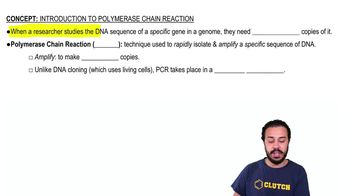
Polymerase Chain Reaction (PCR)

PCR is a technique used to amplify specific DNA sequences, creating millions of copies from a small initial sample. It involves repeated cycles of denaturation, annealing of primers, and extension by DNA polymerase, enabling rapid and precise DNA replication in vitro.
Video consigliato:
01:31
Introduction to Polymerase Chain Reaction

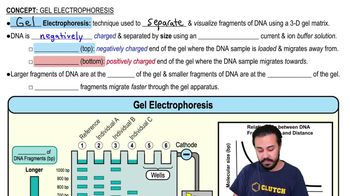
Gel Electrophoresis

Gel electrophoresis is a method for separating DNA fragments based on size by applying an electric field to a gel matrix. It is used to analyze DNA but does not replicate or amplify DNA molecules.
Video consigliato:
07:58
Gel Electrophoresis

Electroporation

Electroporation is a technique that uses electrical pulses to create temporary pores in cell membranes, allowing DNA or other molecules to enter cells. It facilitates DNA uptake but does not itself replicate DNA.