Ch. 11 - Innate Immunity
Norman-McKay- Microbiology: Basic and Clinical Principles 2nd Edition
Norman-McKay2nd EditionMicrobiology: Basic and Clinical PrinciplesISBN: 9780137661619Non è quello che usi tu?Cambia libro di testo
Capitolo 7, Problema 8

Label the following as granulocytes or agranulocytes and classify them as innate or adaptive cellular responders.
Basophil
Monocyte
Macrophage
Lymphocyte
Neutrophil
Eosinophil
Mast cell
NK cell
T cell

Guida verificata passo dopo passo
1
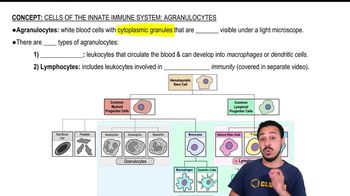
Step 1: Understand the difference between granulocytes and agranulocytes. Granulocytes contain visible granules in their cytoplasm and include neutrophils, eosinophils, and basophils. Agranulocytes lack visible granules and include lymphocytes and monocytes.
Step 2: Identify which cells are granulocytes or agranulocytes based on their characteristics: Basophil, Neutrophil, and Eosinophil are granulocytes; Monocyte, Lymphocyte, and NK cell are agranulocytes. Macrophages and mast cells derive from monocytes and have specific roles.
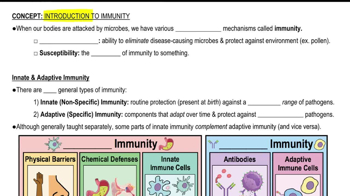
Step 3: Classify each cell as part of the innate or adaptive immune response. Innate responders act quickly and non-specifically, including neutrophils, eosinophils, basophils, monocytes, macrophages, mast cells, and NK cells. Adaptive responders are specific and include T cells and B cells (lymphocytes).
Step 4: Assign each cell to both categories: For example, Basophil is a granulocyte and an innate responder; Monocyte is an agranulocyte and innate responder; Macrophage (derived from monocytes) is agranulocyte and innate; Lymphocyte is agranulocyte and adaptive; Neutrophil is granulocyte and innate; Eosinophil is granulocyte and innate; Mast cell is granulocyte-like and innate; NK cell is agranulocyte and innate; T cell is agranulocyte and adaptive.
Step 5: Summarize the classification in a table or list format to clearly show each cell's granulocyte/agranulocyte status and whether it participates in innate or adaptive immunity.

Risposta video verificata per un problema simile:

Questa soluzione video è stata consigliata dai nostri tutor come utile per risolvere questo problema.
Durata del video:
2m

Concetti chiave

Ecco i concetti essenziali che devi comprendere per rispondere correttamente alla domanda.

Granulocytes vs Agranulocytes

Granulocytes are white blood cells containing visible granules in their cytoplasm, including neutrophils, eosinophils, and basophils. Agranulocytes lack visible granules and include lymphocytes and monocytes. This classification helps in identifying cell types based on their morphology and function in immune responses.
Video consigliato:
03:43
Agranulocytes

Innate vs Adaptive Immune Response

The innate immune response is the body's first line of defense, involving cells that respond quickly and non-specifically to pathogens, such as neutrophils, macrophages, and NK cells. The adaptive immune response is specific and involves lymphocytes like T cells and B cells, which provide long-lasting immunity through memory.
Video consigliato:
05:52
Innate vs. Adaptive Immunity

Functions of Specific Immune Cells

Each immune cell type has distinct roles: neutrophils and eosinophils combat infections and parasites; basophils and mast cells mediate allergic reactions; monocytes differentiate into macrophages for phagocytosis; lymphocytes (T cells, B cells) coordinate adaptive immunity; NK cells target infected or cancerous cells as part of innate immunity.
Video consigliato:
05:33
Cell Junctions