Ch. 15 - Antimicrobial Drugs
Norman-McKay- Microbiology: Basic and Clinical Principles 2nd Edition
Norman-McKay2nd EditionMicrobiology: Basic and Clinical PrinciplesISBN: 9780137661619Non è quello che usi tu?Cambia libro di testo
Capitolo 11, Problema 17

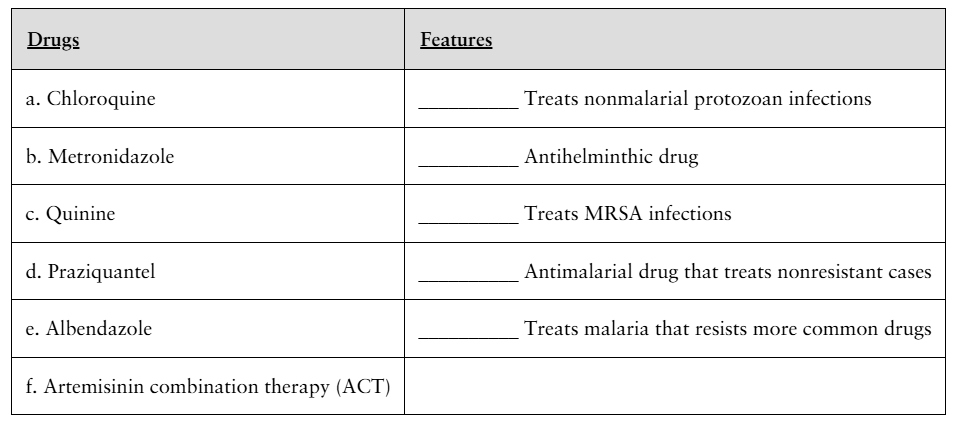
Match the antimicrobial drug to its feature. Some features may be used more than once, and some may not be used at all.
Table listing antimicrobial drugs with blank spaces to match each to its specific feature or treatment use.

Guida verificata passo dopo passo
1
Step 1: Understand the drug classes and their primary uses. For example, Chloroquine is known as an antimalarial drug but is also used to treat some nonmalarial protozoan infections.
Step 2: Identify the drug that is an antihelminthic (anti-worm) agent. Albendazole and Praziquantel are common antihelminthic drugs, so match the antihelminthic drug feature to one of these.
Step 3: Recognize that Metronidazole is primarily used to treat protozoan infections and some anaerobic bacterial infections, but it is not an antihelminthic drug, so it should be matched accordingly.
Step 4: Quinine is historically used to treat malaria but is not effective against MRSA (methicillin-resistant Staphylococcus aureus). MRSA infections are treated with specific antibiotics, so Quinine should be matched with its antimalarial role or another appropriate feature.
Step 5: Artemisinin combination therapy (ACT) is a modern antimalarial treatment used for malaria resistant to older drugs like Chloroquine and Quinine, so match ACT with the feature describing treatment of resistant malaria cases.

Risposta video verificata per un problema simile:

Questa soluzione video è stata consigliata dai nostri tutor come utile per risolvere questo problema.
Durata del video:
2m

Concetti chiave

Ecco i concetti essenziali che devi comprendere per rispondere correttamente alla domanda.

Antimicrobial Drug Classification

Antimicrobial drugs are classified based on the type of pathogen they target, such as antibacterial, antiprotozoal, anthelmintic, or antimalarial agents. Understanding these classifications helps in matching drugs to their specific uses and mechanisms of action.
Video consigliato:
02:45
Antimicrobial Peptides

Mechanism of Action and Drug Resistance

Each antimicrobial drug works through a specific mechanism to inhibit or kill pathogens. Some drugs are effective against resistant strains, such as MRSA or drug-resistant malaria, which is crucial for selecting appropriate treatments in clinical settings.
Video consigliato:
01:59
Introduction to Avoiding Host Defense Mechanisms

Treatment of Parasitic Infections

Parasitic infections caused by protozoa, helminths, or malaria parasites require targeted drugs like metronidazole, praziquantel, or artemisinin-based therapies. Knowing the drug's target parasite and resistance profile is essential for effective treatment.
Video consigliato:
03:52
Map of Lesson on Bacteriophage Infections