Show where airborne microbes ended up in Pasteur’s experiment.
Ch. 1 - The Microbial World and You

Tortora14th EditionMicrobiology: An IntroductionISBN: 9780138200398Non è quello che usi tu?Cambia libro di testo
Capitolo 1, Problema 10
Which of the following statements about E. coli is false?
a. E. coli was the first disease-causing bacterium identified by Koch.
b. E. coli is part of the normal microbiome of humans.
c. E. coli is beneficial in human intestines.
d. E. coli gets nutrients from intestinal contents.
e. None of the above; all the statements are true.
Guida verificata passo dopo passo1
Step 1: Understand the context of each statement about E. coli by recalling key microbiology facts about this bacterium.
Step 2: Evaluate statement (a): 'E. coli was the first disease-causing bacterium identified by Koch.' Recall that Robert Koch identified Bacillus anthracis as the first bacterium linked to a disease (anthrax), not E. coli.
Step 3: Review statement (b): 'E. coli is part of the normal microbiome of humans.' Confirm that E. coli is indeed a common and normal resident of the human gut microbiome.
Step 4: Consider statement (c): 'E. coli is beneficial in human intestines.' Recognize that many strains of E. coli contribute to vitamin K production and help maintain gut health, so this is true.
Step 5: Analyze statement (d): 'E. coli gets nutrients from intestinal contents.' Understand that E. coli obtains nutrients by metabolizing compounds present in the intestines, making this statement true.

Risposta video verificata per un problema simile:
Questa soluzione video è stata consigliata dai nostri tutor come utile per risolvere questo problema.
Durata del video:
1mConcetti chiave
Ecco i concetti essenziali che devi comprendere per rispondere correttamente alla domanda.
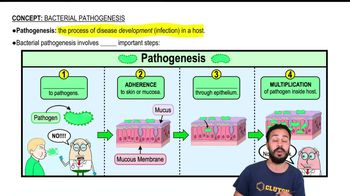
Historical Identification of Disease-Causing Bacteria
Robert Koch was a pioneering microbiologist who identified several disease-causing bacteria, but E. coli was not the first. Koch is credited with discovering the causative agents of tuberculosis and cholera, establishing the germ theory of disease through his postulates.
Video consigliato:
Intro to Bacterial Pathogenesis
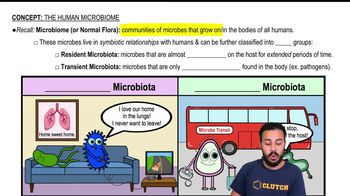
E. coli as Part of the Normal Human Microbiome
Escherichia coli is a common bacterium residing in the human gut as part of the normal microbiome. While some strains can cause disease, many E. coli strains coexist harmlessly and contribute to gut health by aiding digestion and preventing colonization by pathogens.
Video consigliato:
The Human Microbiome
Nutritional Role and Benefits of E. coli in the Intestines
E. coli obtains nutrients from the intestinal contents, such as undigested food and mucus. Beneficial strains help synthesize vitamins like vitamin K and support the immune system, illustrating their positive role in human intestinal health.
Video consigliato:
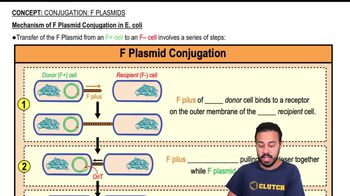
Mechanism of F Plasmid Conjugation in E. coli
Pratica correlata
Domanda del libro di testo
1480
views
Domanda del libro di testo
Spallanzani’s conclusion about spontaneous generation was challenged because Antoine Lavoisier had just shown that oxygen was the vital component of air. Which of the following statements is true?
a. All life requires air.
b. Only disease-causing organisms require air.
c. Some microbes do not require air.
d. Pasteur kept air out of his biogenesis experiments.
e. Lavoisier was mistaken.
1105
views
Domanda del libro di testo
Which of the following is an example of bioremediation?
a. Application of oil-degrading bacteria to an oil spill
b. Application of bacteria to a crop to prevent frost damage
c. Fixation of gaseous nitrogen into usable nitrogen
d. Production by bacteria of a human protein such as interferon
e. All of the above
1724
views