Why is it significant that Trichomonas does not have a cyst stage? Name a protozoan parasite that does have a cyst stage.
Ch. 12 - The Eukaryotes: Fungi, Algae, Protozoa, and Helminths

Tortora14th EditionMicrobiology: An IntroductionISBN: 9780138200398Non è quello che usi tu?Cambia libro di testo
Tutti i libri di testo
Tortora 14th Edition
Ch. 12 - The Eukaryotes: Fungi, Algae, Protozoa, and Helminths
Problema 8
Tortora 14th Edition
Ch. 12 - The Eukaryotes: Fungi, Algae, Protozoa, and Helminths
Problema 8Capitolo 8, Problema 8
By what means are helminthic parasites transmitted to humans?
Guida verificata passo dopo passo1
Understand that helminthic parasites are worms that can infect humans and cause various diseases.
Identify the common transmission routes for helminths, which typically include ingestion, skin penetration, and vector-borne methods.
Recognize that ingestion involves consuming contaminated food or water containing helminth eggs or larvae.
Know that skin penetration occurs when larvae in contaminated soil or water penetrate the skin, such as with hookworms.
Be aware that some helminths can be transmitted through intermediate hosts or vectors, like insects, which carry the parasite to humans.

Risposta video verificata per un problema simile:
Questa soluzione video è stata consigliata dai nostri tutor come utile per risolvere questo problema.
Durata del video:
2mConcetti chiave
Ecco i concetti essenziali che devi comprendere per rispondere correttamente alla domanda.
Helminthic Parasites
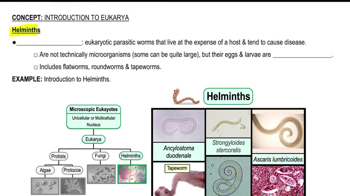
Helminths are multicellular parasitic worms, including nematodes, trematodes, and cestodes, that infect humans. They often have complex life cycles involving intermediate hosts or environmental stages, which are crucial for understanding their transmission.
Video consigliato:
Helminths
Modes of Transmission
Helminthic parasites are transmitted to humans through various routes such as ingestion of contaminated food or water, skin penetration by larvae, or via insect vectors. Recognizing these modes helps in identifying risk factors and prevention strategies.
Video consigliato:
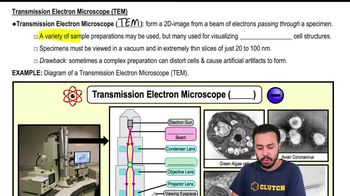
Transmission Electron Microscope (TEM)
Life Cycle and Environmental Factors
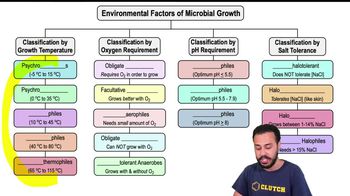
The life cycle of helminths often includes stages outside the human host, such as eggs or larvae in soil or water. Environmental conditions and sanitation play a key role in facilitating transmission and infection rates.
Video consigliato:
Reviewing the Environmental Factors of Microbial Growth
Pratica correlata
Domanda del libro di testo
1604
views
Domanda del libro di testo
Most roundworms are dioecious. What does this term mean? To what phylum do roundworms belong?
1631
views
Domanda del libro di testo
Which of the following neurotoxins are released by some species of dinoflagellates to protect themselves from predators?
a) Tetrodotoxin
b) Botulinum toxin
c) Maitotoxin
d) Ricin
1159
views
Domanda del libro di testo
The definitive host for Plasmodium vivax is
a. Human
b. Anopheles
c. A sporocyte
d. A gametocyte
1504
views
Domanda del libro di testo
Which of the following events follows cell fusion in an ascomycete?
a. Conidiophore formation
b. Conidiospore germination
c. Ascus opening
d. Ascospore formation
e. Conidiospore release
1503
views
Domanda del libro di testo
Use the following choices to answer questions 8–10:
a. Apicomplexa
b. ciliates
c. dinoflagellates
d. Microsporidia
These are obligate intracellular parasites that lack mitochondria.
808
views