Ch. 12 - The Eukaryotes: Fungi, Algae, Protozoa, and Helminths
Tortora - Microbiology: An Introduction 14th Edition
Tortora14th EditionMicrobiology: An IntroductionISBN: 9780138200398Non è quello che usi tu?Cambia libro di testo
Capitolo 8, Problema 8

Use the following choices to answer questions 8–10:
a. Apicomplexa
b. ciliates
c. dinoflagellates
d. Microsporidia
These are obligate intracellular parasites that lack mitochondria.

Guida verificata passo dopo passo
1
Step 1: Understand the key terms in the question. The problem asks for a group of organisms that are obligate intracellular parasites and lack mitochondria.
Step 2: Recall the characteristics of each group: Apicomplexa are intracellular parasites but typically have mitochondria; ciliates are mostly free-living and have mitochondria; dinoflagellates are mostly free-living photosynthetic organisms with mitochondria; Microsporidia are known as obligate intracellular parasites and notably lack mitochondria.
Step 3: Focus on the unique feature of lacking mitochondria, which is rare among eukaryotes and is a hallmark of Microsporidia.
Step 4: Match the description 'obligate intracellular parasites that lack mitochondria' to the correct group from the choices given.
Step 5: Conclude that the correct answer corresponds to the group with these defining features, which is Microsporidia.

Risposta video verificata per un problema simile:

Questa soluzione video è stata consigliata dai nostri tutor come utile per risolvere questo problema.
Durata del video:
3m

Concetti chiave

Ecco i concetti essenziali che devi comprendere per rispondere correttamente alla domanda.

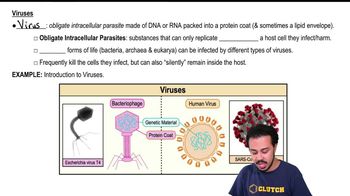
Obligate Intracellular Parasites

Obligate intracellular parasites are organisms that can only survive and reproduce within the cells of a host. They rely entirely on the host's cellular machinery for energy and nutrients, making them dependent on living cells for their life cycle.
Video consigliato:
03:22
Viruses

Mitochondria and Energy Metabolism

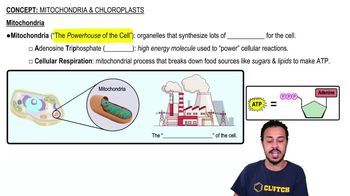
Mitochondria are organelles responsible for producing energy through aerobic respiration in most eukaryotic cells. Some parasites lack mitochondria, which affects their metabolism and means they must obtain energy through alternative pathways or directly from the host.
Video consigliato:
04:19
Mitochondria

Microsporidia

Microsporidia are a group of obligate intracellular parasites characterized by the absence of typical mitochondria. They infect a wide range of hosts and rely on host cells for energy, making them unique among eukaryotes and relevant to the question's description.