
Ch. 12 - The Eukaryotes: Fungi, Algae, Protozoa, and Helminths
Tortora - Microbiology: An Introduction 14th Edition
Tortora14th EditionMicrobiology: An IntroductionISBN: 9780138200398Non è quello che usi tu?Cambia libro di testo
Capitolo 8, Problema 3

Identify the structures of this eukaryote, which has an affinity for keratin.
<IMAGE>

Guida verificata passo dopo passo
1
Step 1: Understand the context of the problem. The question asks to identify structures of a eukaryotic organism that has an affinity for keratin. Keratin is a structural protein found in skin, hair, and nails, so organisms with affinity for keratin often colonize or infect these tissues.
Step 2: Recall that many fungi, especially dermatophytes, have an affinity for keratin. These fungi have specialized structures that allow them to invade keratinized tissues. Common structures include hyphae (filamentous structures), conidia (asexual spores), and sometimes specialized attachment structures.
Step 3: Identify typical fungal structures in the image (if available). Look for filamentous branching structures (hyphae), which are characteristic of molds, or yeast-like cells if the organism is dimorphic. Also, note any spore-producing structures such as conidiophores or arthroconidia.
Step 4: Match the observed structures to their biological function. For example, hyphae penetrate keratinized tissue to absorb nutrients, while spores help in reproduction and dissemination. Understanding these roles helps confirm the identity of the structures.
Step 5: Summarize the identification by naming the structures based on their morphology and function, such as hyphae, conidia, or arthroconidia, and relate them to the organism's keratin affinity.

Risposta video verificata per un problema simile:

Questa soluzione video è stata consigliata dai nostri tutor come utile per risolvere questo problema.
Durata del video:
2m

Concetti chiave

Ecco i concetti essenziali che devi comprendere per rispondere correttamente alla domanda.

Eukaryotic Cell Structure

Eukaryotic cells have membrane-bound organelles such as the nucleus, mitochondria, and endoplasmic reticulum. Understanding these structures helps identify the organism type and its cellular functions, distinguishing it from prokaryotes.
Video consigliato:
04:17
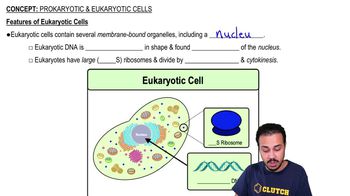
Features of Eukaryotic Cells

Keratin Affinity in Microorganisms

Some eukaryotic microorganisms, like dermatophytes (a type of fungi), have an affinity for keratin, a protein found in skin, hair, and nails. This affinity allows them to colonize and degrade keratinized tissues, causing infections.
Video consigliato:
07:27
Affinity Maturation

Fungal Morphology and Identification

Fungi exhibit distinct structures such as hyphae, spores, and conidia that aid in identification. Recognizing these morphological features under a microscope is essential for naming and classifying keratin-affine eukaryotes.
Video consigliato:
02:44
Types of Bacterial Cell Morphology