Ch. 12 - The Eukaryotes: Fungi, Algae, Protozoa, and Helminths
Tortora - Microbiology: An Introduction 14th Edition
Tortora14th EditionMicrobiology: An IntroductionISBN: 9780138200398Non è quello che usi tu?Cambia libro di testo
Capitolo 8, Problema 5

Which of the following statements about yeasts are true?
Multiple-choice question listing six statements about yeasts and five answer options with number combinations.

Guida verificata passo dopo passo
1
Step 1: Understand the nature of yeasts. Yeasts are a type of fungi, so statement 1 is true. This is a fundamental classification in microbiology.
Step 2: Consider yeast morphology. Yeasts can form pseudohyphae, which are chains of elongated yeast cells that resemble hyphae but are not true hyphae. Therefore, statement 2 is true.
Step 3: Review yeast reproduction. Yeasts commonly reproduce asexually by budding, where a new cell forms as a small outgrowth of the parent cell. Hence, statement 3 is true.
Step 4: Analyze yeast metabolism. Yeasts are facultatively anaerobic, meaning they can grow in the presence or absence of oxygen. This makes statement 4 true.
Step 5: Evaluate pathogenicity and dimorphism. Not all yeasts are pathogenic (statement 5 is false), and not all yeasts are dimorphic (statement 6 is false). Dimorphic fungi can switch between yeast and mold forms, but this is not a universal trait among yeasts.

Risposta video verificata per un problema simile:

Questa soluzione video è stata consigliata dai nostri tutor come utile per risolvere questo problema.

Concetti chiave

Ecco i concetti essenziali che devi comprendere per rispondere correttamente alla domanda.

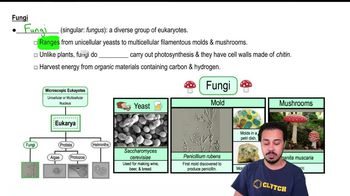
Yeasts as Fungi

Yeasts are unicellular fungi that differ from molds, which are multicellular. They belong to the kingdom Fungi and share characteristics such as chitin in their cell walls. Understanding their classification helps in studying their biology and ecological roles.
Video consigliato:
02:49
Fungi

Yeast Reproduction and Morphology

Yeasts primarily reproduce asexually by budding, where a new cell forms as a small outgrowth of the parent. Some yeasts can form pseudohyphae, chains of elongated cells resembling hyphae but not true fungal filaments. This morphological flexibility aids in adaptation and identification.
Video consigliato:
02:44
Types of Bacterial Cell Morphology

Metabolic and Pathogenic Characteristics of Yeasts

Many yeasts are facultative anaerobes, meaning they can survive with or without oxygen by switching metabolic pathways. Not all yeasts are pathogenic; while some cause infections, many are harmless or beneficial in food and biotechnology. Additionally, only some yeasts exhibit dimorphism, switching between yeast and mold forms.
Video consigliato:
02:17
Introduction to Metabolism