Label on the figure the following processes that result in phagocytosis: margination, diapedesis, adherence, and phagolysosome formation.
Ch. 16 - Innate Immunity: Nonspecific Defenses of the Host

Tortora14th EditionMicrobiology: An IntroductionISBN: 9780138200398Non è quello che usi tu?Cambia libro di testo
Tutti i libri di testo
Tortora 14th Edition
Ch. 16 - Innate Immunity: Nonspecific Defenses of the Host
Problema 7
Tortora 14th Edition
Ch. 16 - Innate Immunity: Nonspecific Defenses of the Host
Problema 7Capitolo 12, Problema 7
In 1884, Elie Metchnikoff observed cells collected around a splinter inserted in a sea star embryo. This was the discovery of
a. blood cells.
b. sea stars.
c. phagocytosis.
d. immunity.
e. none of the above
Guida verificata passo dopo passo1
Understand the historical context: Elie Metchnikoff is known for his pioneering work in immunology, particularly related to how certain cells respond to foreign bodies.
Recall that Metchnikoff observed cells surrounding a splinter in a sea star embryo, which led to the identification of a specific cellular process.
Recognize that the process observed was the engulfing and digestion of foreign particles by cells, a fundamental immune response.
Identify the term for this process as 'phagocytosis,' which is the mechanism by which certain cells (phagocytes) ingest harmful particles, bacteria, or dead cells.
Conclude that the correct answer corresponds to the discovery of phagocytosis, which is option c.

Risposta video verificata per un problema simile:
Questa soluzione video è stata consigliata dai nostri tutor come utile per risolvere questo problema.
Durata del video:
1mConcetti chiave
Ecco i concetti essenziali che devi comprendere per rispondere correttamente alla domanda.
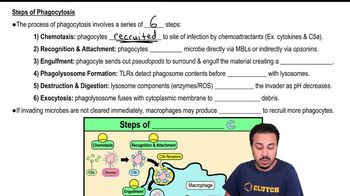
Phagocytosis
Phagocytosis is the process by which certain cells, called phagocytes, engulf and digest foreign particles, bacteria, or dead cells. Elie Metchnikoff discovered this mechanism when he observed cells surrounding a splinter in a sea star embryo, highlighting a fundamental immune response.
Video consigliato:
Steps of Phagocytosis
Innate Immunity
Innate immunity is the body's first line of defense against pathogens, involving non-specific responses like phagocytosis. Metchnikoff's observation contributed to understanding how organisms naturally protect themselves without prior exposure to a pathogen.
Video consigliato:
Introduction to Innate Immunity
Historical Contributions to Immunology
Elie Metchnikoff's work in 1884 was pivotal in immunology, as it identified cellular mechanisms of defense. Recognizing his discovery helps contextualize the development of modern immunology and the role of immune cells in protecting organisms.
Video consigliato:
pH Requirements for Microbial Growth
Pratica correlata
Domanda del libro di testo
1397
views
Domanda del libro di testo
Are the following involved in innate or in adaptive immunity? Identify the role of each in immunity:
a. TLRs
b. transferrins
c. antimicrobial peptides
1434
views
Domanda del libro di testo
Give several examples of how microbes evade the complement system.
1718
views
Domanda del libro di testo
A decrease in the production of C3 would result in
a. increased susceptibility to infection.
b. increased numbers of white blood cells.
c. increased phagocytosis.
d. activation of C5 through C9.
e. none of the above
1479
views
Domanda del libro di testo
Helicobacter pylori uses the enzyme urease to counteract a chemical defense in the human organ in which it lives. This chemical defense is
a. lysozyme.
b. hydrochloric acid.
c. superoxide radicals.
d. sebum.
e. complement.
1459
views
Domanda del libro di testo
Why does hemolysis of red blood cells occur when a person receives a transfusion of the wrong type of blood?
1626
views