
Ch. 18 - Practical Applications of Immunology
Tortora - Microbiology: An Introduction 14th Edition
Tortora14th EditionMicrobiology: An IntroductionISBN: 9780138200398Non è quello che usi tu?Cambia libro di testo
Capitolo 14, Problema 2

Use the following choices to answer questions 1 and 2:
a. Hemolysis
b. Hemagglutination
c. Hemagglutination inhibition
d. No hemolysis
e. Precipitin ring forms
Patient’s serum, Chlamydia, guinea pig complement, sheep red blood cells, and anti-sheep red blood cells are mixed in a tube. What happens if the patient has antibodies against Chlamydia?

Guida verificata passo dopo passo
1
Step 1: Identify the components in the mixture: patient's serum (which may contain antibodies), Chlamydia antigen, guinea pig complement, sheep red blood cells (RBCs), and anti-sheep RBC antibodies.
Step 2: Understand the role of each component: the patient's serum may have antibodies specific to Chlamydia; guinea pig complement can mediate lysis if antibodies bind to antigens; sheep RBCs serve as indicator cells; anti-sheep RBC antibodies can cause agglutination of sheep RBCs.
Step 3: Consider the immunological reaction if the patient has antibodies against Chlamydia: these antibodies will bind to Chlamydia antigens forming immune complexes.
Step 4: Recognize that the complement will be consumed (activated) by these immune complexes, reducing the amount of complement available to participate in other reactions such as hemolysis of sheep RBCs.
Step 5: Predict the outcome: because complement is used up by the antigen-antibody complexes, the anti-sheep RBC antibodies cannot cause hemolysis of sheep RBCs, resulting in no hemolysis (choice d).

Risposta video verificata per un problema simile:

Questa soluzione video è stata consigliata dai nostri tutor come utile per risolvere questo problema.
Durata del video:
2m

Concetti chiave

Ecco i concetti essenziali che devi comprendere per rispondere correttamente alla domanda.

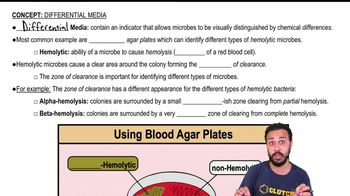
Hemolysis

Hemolysis is the destruction or lysis of red blood cells, releasing hemoglobin into the surrounding fluid. In immunological assays, hemolysis indicates activation of the complement system, often triggered by antigen-antibody complexes on red blood cells, leading to cell rupture.
Video consigliato:
04:34
Differential Media

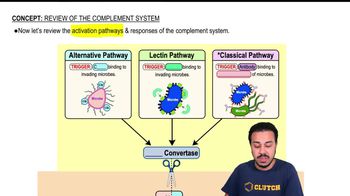
Complement System Activation

The complement system is a group of proteins that enhance immune responses, including lysing pathogens or cells. When antibodies bind to antigens, they can activate complement, resulting in processes like hemolysis, which serves as a marker for the presence of specific antibodies in diagnostic tests.
Video consigliato:
05:15
Review of the Complement System

Antigen-Antibody Interaction in Diagnostic Tests

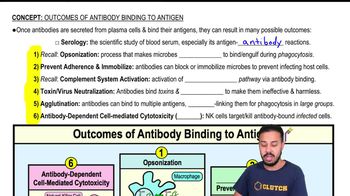
Diagnostic tests often rely on specific binding between antibodies and antigens to detect infections. In this scenario, if the patient’s serum contains antibodies against Chlamydia, these antibodies form complexes with Chlamydia antigens, which can then trigger complement-mediated hemolysis of indicator red blood cells.
Video consigliato:
09:16
Outcomes of Antibody Binding to Antigen