
Ch. 18 - Practical Applications of Immunology
Tortora - Microbiology: An Introduction 14th Edition
Tortora14th EditionMicrobiology: An IntroductionISBN: 9780138200398Non è quello che usi tu?Cambia libro di testo
Capitolo 14, Problema 3

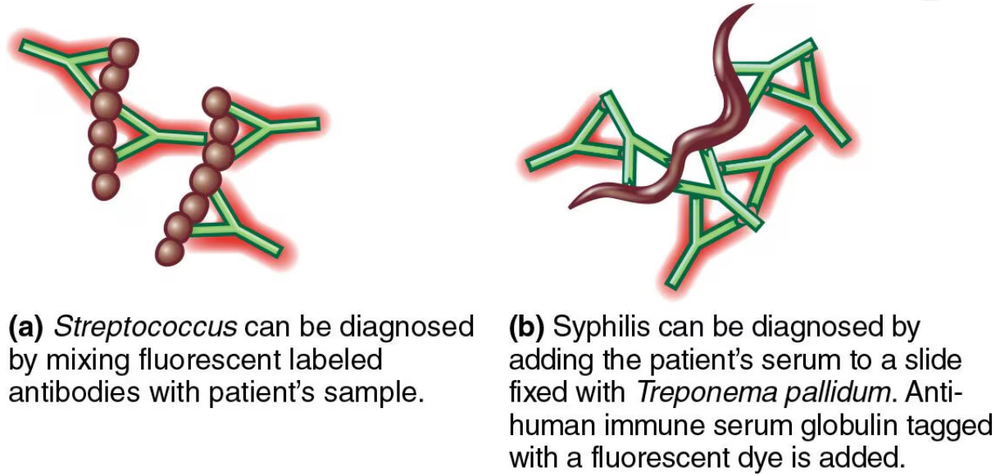
Label the components of the direct and indirect FA tests in the following situations. Which test is direct? Which test provides definitive proof of disease?
Diagram showing fluorescent antibody binding to bacteria: (a) labeled antibodies bind Streptococcus, (b) patient serum binds Treponema.

Guida verificata passo dopo passo
1
Step 1: Understand the principle of the Direct and Indirect Fluorescent Antibody (FA) tests. The Direct FA test detects the presence of antigen in a sample by using a fluorescently labeled antibody that binds directly to the antigen. The Indirect FA test detects antibodies in the patient's serum by using an unlabeled primary antibody and a fluorescently labeled secondary antibody that binds to the primary antibody.
Step 2: For the Direct FA test, label the components as follows: the fluorescently labeled antibody (primary antibody) binds directly to the antigen present in the sample. There is no secondary antibody involved in this test.
Step 3: For the Indirect FA test, label the components as follows: the primary antibody (unlabeled) binds to the antigen, and then a fluorescently labeled secondary antibody binds to the primary antibody. This amplifies the signal and allows detection of antibodies rather than antigens.
Step 4: Identify which test is direct and which is indirect based on the labeling: the test where the fluorescent label is on the primary antibody is the Direct FA test, and the test where the fluorescent label is on the secondary antibody is the Indirect FA test.
Step 5: Determine which test provides definitive proof of disease. The Direct FA test detects the actual antigen (pathogen) in the sample, providing direct evidence of infection, whereas the Indirect FA test detects antibodies, which indicate exposure but not necessarily active disease.

Risposta video verificata per un problema simile:

Questa soluzione video è stata consigliata dai nostri tutor come utile per risolvere questo problema.
Durata del video:
2m

Concetti chiave

Ecco i concetti essenziali che devi comprendere per rispondere correttamente alla domanda.

Direct Fluorescent Antibody (FA) Test

The direct FA test uses fluorescently labeled antibodies that bind directly to specific antigens on a pathogen in a sample. This test detects the presence of the microorganism itself, providing rapid identification. It is called 'direct' because the antibody is directly conjugated to the fluorescent dye.
Video consigliato:
06:59
The Ames Test

Indirect Fluorescent Antibody (FA) Test

The indirect FA test involves two steps: first, an unlabeled primary antibody binds to the antigen, then a fluorescently labeled secondary antibody binds to the primary antibody. This method amplifies the signal and is often used to detect antibodies in patient serum, indicating exposure rather than direct presence of the pathogen.
Video consigliato:
06:59
The Ames Test

Definitive Proof of Disease in FA Tests

Definitive proof of disease typically comes from detecting the pathogen itself, which is achieved by the direct FA test. While the indirect test shows immune response (antibodies), it does not confirm active infection. Therefore, the direct FA test provides conclusive evidence of disease by visualizing the actual microorganism.
Video consigliato:
06:59
The Ames Test