Ch. 27 - Environmental Microbiology
Tortora - Microbiology: An Introduction 14th Edition
Tortora14th EditionMicrobiology: An IntroductionISBN: 9780138200398Non è quello che usi tu?Cambia libro di testo
Capitolo 23, Problema 5

Identify where the following processes occur: ammonification, decomposition, denitrification, nitrification, nitrogen fixation. Name at least one organism responsible for each process.
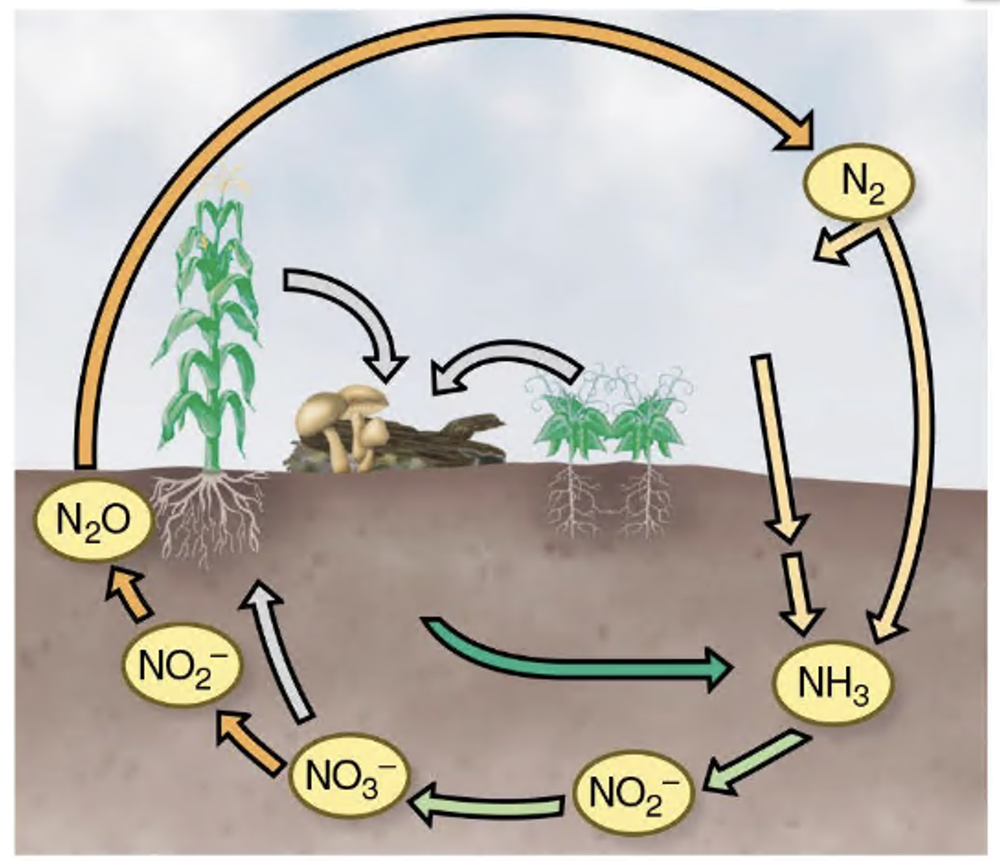
Diagram of the nitrogen cycle showing nitrogen transformations and locations of ammonification, nitrification, denitrification, and fixation.

Guida verificata passo dopo passo
1
Step 1: Understand the nitrogen cycle and the locations where each process occurs. Ammonification and decomposition generally occur in the soil where organic matter is broken down by microbes.
Step 2: Identify ammonification as the process where organic nitrogen compounds are converted into ammonia (NH₃) or ammonium ions (NH₄⁺) by decomposer organisms such as bacteria and fungi. This occurs in the soil.
Step 3: Recognize decomposition as the breakdown of dead organic material by decomposers like fungi and bacteria, releasing nutrients back into the environment, primarily in soil or aquatic sediments.
Step 4: Locate nitrification as a two-step aerobic process in the soil where ammonia is first oxidized to nitrite (NO₂⁻) by bacteria such as Nitrosomonas, and then nitrite is oxidized to nitrate (NO₃⁻) by bacteria such as Nitrobacter.
Step 5: Identify denitrification as the anaerobic process where nitrate is reduced to nitrogen gas (N₂), returning nitrogen to the atmosphere. This is carried out by bacteria such as Pseudomonas in oxygen-poor environments like waterlogged soils.
Step 6: Understand nitrogen fixation as the conversion of atmospheric nitrogen gas (N₂) into ammonia by nitrogen-fixing bacteria such as Rhizobium (in root nodules of legumes) or free-living bacteria like Azotobacter, occurring in soil or plant root nodules.

Risposta video verificata per un problema simile:

Questa soluzione video è stata consigliata dai nostri tutor come utile per risolvere questo problema.

Concetti chiave

Ecco i concetti essenziali che devi comprendere per rispondere correttamente alla domanda.

Nitrogen Cycle Processes

The nitrogen cycle involves several key processes that convert nitrogen into different chemical forms. Ammonification breaks down organic nitrogen into ammonia, nitrification converts ammonia into nitrites and nitrates, denitrification reduces nitrates back to nitrogen gas, decomposition breaks down organic matter, and nitrogen fixation converts atmospheric nitrogen into ammonia. Understanding these steps is essential to locate where each occurs in the environment.
Video consigliato:
01:37
Krebs Cycle

Microorganisms Involved in Nitrogen Transformations

Specific bacteria and archaea drive each nitrogen cycle process. For example, nitrogen fixation is performed by Rhizobium species in root nodules, ammonification by decomposer bacteria like Bacillus, nitrification by Nitrosomonas and Nitrobacter, and denitrification by Pseudomonas. Recognizing these organisms helps link biological activity to nitrogen transformations.
Video consigliato:
03:06
Bacterial Transformation

Environmental Context of Nitrogen Cycle Processes

Each nitrogen process occurs in distinct environmental niches: nitrogen fixation often occurs in soil or root nodules, ammonification and decomposition happen in soil or aquatic sediments, nitrification requires aerobic conditions, and denitrification occurs in anaerobic environments. Identifying these habitats is crucial for accurately placing each process on a diagram.
Video consigliato:
09:54
Phases of The Krebs Cycle