Ch. 28 - Applied and Industrial Microbiology
Tortora - Microbiology: An Introduction 14th Edition
Tortora14th EditionMicrobiology: An IntroductionISBN: 9780138200398Non è quello che usi tu?Cambia libro di testo
Capitolo 24, Problema 10

Van Leeuwenhoek was the first to see this budding microbe with a nucleus and cell wall; although humans have used it since before the beginning of recorded history, Louis Pasteur was the first to figure out what it does.

Guida verificata passo dopo passo
1
Identify the key characteristics mentioned: the microbe has a nucleus and a cell wall, and it reproduces by budding. These features indicate it is a eukaryotic microorganism, specifically a type of fungus.
Recall that Van Leeuwenhoek was the first to observe microorganisms under a microscope, including yeast cells, which are fungi that reproduce by budding and have a nucleus and cell wall.
Understand that humans have used this microbe for a long time, especially in processes like fermentation for bread, beer, and wine production, which points to yeast.
Recognize Louis Pasteur's contribution: he demonstrated the role of yeast in fermentation, showing that yeast converts sugars into alcohol and carbon dioxide, which was a major discovery in microbiology.
Conclude that the microbe described is yeast, a budding fungus with a nucleus and cell wall, historically important in fermentation and first observed by Van Leeuwenhoek.

Risposta video verificata per un problema simile:

Questa soluzione video è stata consigliata dai nostri tutor come utile per risolvere questo problema.
Durata del video:
2m

Concetti chiave

Ecco i concetti essenziali che devi comprendere per rispondere correttamente alla domanda.

Protists and Fungi as Eukaryotic Microbes

Van Leeuwenhoek observed microorganisms with a nucleus and cell wall, characteristics of eukaryotic microbes such as protists and fungi. These organisms differ from bacteria by having membrane-bound organelles and more complex cellular structures.
Video consigliato:
02:49
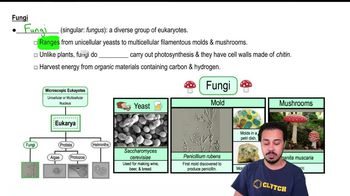
Fungi

Budding Reproduction in Microbes

Budding is an asexual reproduction method where a new organism grows from a parent cell. This process is common in certain fungi like yeasts, which reproduce by forming a bud that eventually detaches to become an independent cell.
Video consigliato:
07:45
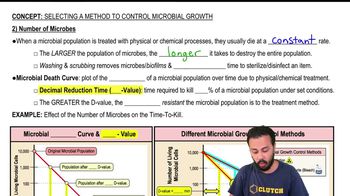
Number of Microbes

Louis Pasteur's Contributions to Microbiology

Louis Pasteur demonstrated the role of microbes in fermentation and spoilage, clarifying the function of yeast in processes like brewing and baking. His work established the connection between microbes and biochemical transformations, laying foundations for microbiology.
Video consigliato:
07:27
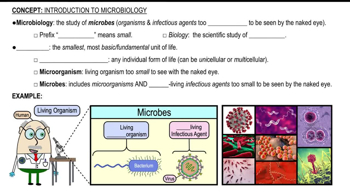
Introduction to Microbiology