Ch. 28 - Applied and Industrial Microbiology
Tortora - Microbiology: An Introduction 14th Edition
Tortora14th EditionMicrobiology: An IntroductionISBN: 9780138200398Non è quello che usi tu?Cambia libro di testo
Capitolo 24, Problema 6

The term 12D treatment refers to
a. Heat treatment sufficient to kill 12 bacteria.
b. The use of 12 different treatments to preserve food.
c. A 1012 reduction in C. botulinum endospores.
d. Any process that destroys thermophilic bacteria.

Guida verificata passo dopo passo
1
Understand that the term '12D treatment' is related to food microbiology and sterilization processes, specifically targeting Clostridium botulinum endospores, which are highly resistant and dangerous in food safety.
Recall that 'D-value' in microbiology refers to the time required at a certain temperature to reduce the microbial population by 90%, or one log cycle (i.e., a 10-fold reduction).
Recognize that a '12D treatment' means applying a process that achieves a 12 log reduction in the number of C. botulinum endospores, which corresponds to reducing the population by a factor of 10^{12}.
Evaluate the options given: (a) refers to killing 12 bacteria, which is not the correct scale; (b) mentions 12 different treatments, which is unrelated; (c) correctly describes a 10^{12} reduction in C. botulinum endospores; (d) refers to thermophilic bacteria, which is not specific to the 12D concept.
Conclude that the correct understanding of '12D treatment' is a sterilization process that achieves a 10^{12} reduction in C. botulinum endospores, ensuring food safety by effectively eliminating this pathogen.

Risposta video verificata per un problema simile:

Questa soluzione video è stata consigliata dai nostri tutor come utile per risolvere questo problema.
Durata del video:
1m

Concetti chiave

Ecco i concetti essenziali che devi comprendere per rispondere correttamente alla domanda.

Decimal Reduction Time (D-value)

The D-value is the time required at a certain temperature to kill 90% (one log reduction) of a specific microorganism. It is a standard measure used in food microbiology to assess the effectiveness of heat treatments in reducing microbial populations.
Video consigliato:
05:48
Calculating Generation Times

12D Treatment in Food Safety

A 12D treatment refers to a heat process that achieves a 12-log (10¹²) reduction in Clostridium botulinum spores, ensuring food safety by effectively eliminating this highly heat-resistant pathogen in canned foods.
Video consigliato:
03:15
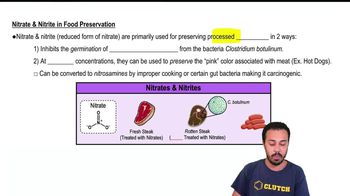
Nitrate & Nitrite in Food Preservation

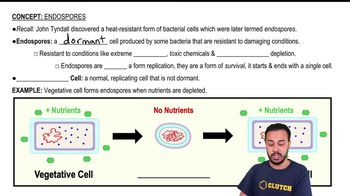
Clostridium botulinum Endospores

C. botulinum produces heat-resistant endospores that can survive inadequate processing and cause botulism. Understanding their resistance is crucial for designing thermal treatments that ensure food safety.
Video consigliato:
05:35
Endospores