
Ch. 3 - Observing Microorganisms Through a Microscope
Tortora - Microbiology: An Introduction 14th Edition
Tortora14th EditionMicrobiology: An IntroductionISBN: 9780138200398Non è quello che usi tu?Cambia libro di testo
Capitolo 3, Problema 3

Carbolfuchsin can be used as a simple stain and a negative stain. As a simple stain, the pH is:
a. 2
b. Higher than the negative stain
c. Lower than the negative stain
d. The same as the negative stain

Guida verificata passo dopo passo
1
Understand the role of carbolfuchsin in staining: it can be used both as a simple stain and as a negative stain, but the pH conditions differ depending on the staining method.
Recall that a simple stain typically uses a basic dye, which means the pH is usually higher (alkaline) to allow the dye to bind to negatively charged cell components.
Recognize that a negative stain uses an acidic dye, which means the pH is lower (acidic) so that the background is stained and the cells remain unstained.
Compare the pH of carbolfuchsin when used as a simple stain (basic pH) versus when used as a negative stain (acidic pH).
Conclude that the pH of carbolfuchsin as a simple stain is higher than the pH when it is used as a negative stain.

Risposta video verificata per un problema simile:

Questa soluzione video è stata consigliata dai nostri tutor come utile per risolvere questo problema.
Durata del video:
2m

Concetti chiave

Ecco i concetti essenziali che devi comprendere per rispondere correttamente alla domanda.

Carbolfuchsin as a Stain

Carbolfuchsin is a basic dye commonly used in microbiology for staining bacterial cells. It binds to negatively charged components like nucleic acids and cell walls, making cells visible under a microscope. Its staining properties depend on the pH of the solution, which affects its charge and interaction with cells.
Video consigliato:
02:10
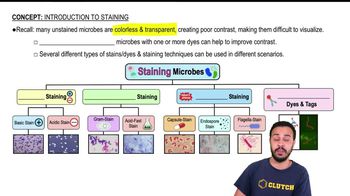
Introduction to Staining

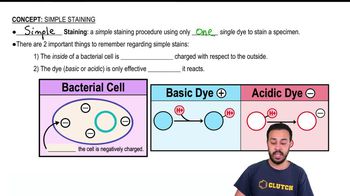
Simple Stain vs. Negative Stain

A simple stain colors the cells directly, usually with a basic dye, highlighting cell morphology. In contrast, a negative stain colors the background, leaving cells unstained and visible as clear shapes. The pH of the stain influences whether the dye acts as a basic or acidic stain, affecting which part is stained.
Video consigliato:
03:23
Simple Staining

Effect of pH on Dye Charge and Staining

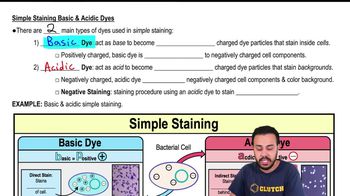
The pH of a staining solution determines the ionization state of the dye molecules. At low pH, dyes like carbolfuchsin carry a positive charge, acting as basic stains that bind to negatively charged cell components. At higher pH, the dye may lose its positive charge, altering its staining behavior, such as in negative staining.
Video consigliato:
05:30
Simple Staining Basic & Acidic Dyes
Pratica correlata
Domanda del libro di testo

Assume you stain Bacillus by applying malachite green with heat and then counterstain with safranin. Through the microscope, the green structures are

a. Cell walls

b. Capsules

c. Endospores

d. Flagella

e. Impossible to identify

1899
views
Domanda del libro di testo

Three-dimensional images of live cells can be produced with:

a. Darkfield microscopy

b. Fluorescence microscopy

c. Transmission electron microscopy

d. Confocal microscopy

e. Phase-contrast microscopy

1659
views
Domanda del libro di testo

The maximum magnification of a compound microscope is (a) ________; that of an electron microscope, (b) ________. The maximum resolution of a compound microscope is (c) ________; that of an electron microscope, (d) ________. One advantage of a scanning electron microscope over a transmission electron microscope is (e) ________.

1905
views
Domanda del libro di testo

Looking at the cell of a photosynthetic microorganism, you observe the chloroplasts are green in brightfield microscopy and red in fluorescence microscopy. You conclude:

a. Chlorophyll is fluorescent

b. The magnification has distorted the image

c. You’re not looking at the same structure in both microscopes

d. The stain masked the green color

e. None of the above

1179
views
Domanda del libro di testo

Calculate the total magnification of the nucleus of a cell being observed through a compound light microscope with a 10x ocular lens and an oil immersion lens.

1828
views
Domanda del libro di testo

Which type of microscope would be best to use to observe each of the following?

a. A stained bacterial smear

b. Unstained bacterial cells: the cells are small, and no detail is needed

c. Unstained live tissue when it is desirable to see some intracellular detail

d. A sample that emits light when illuminated with ultraviolet light

e. Intracellular detail of a cell that is 1μm long

f. Unstained live cells in which intracellular structures are shown in color

1799
views