 Indietro
Microeconomics: Supply, Demand, and Market Equilibrium Practice Guidance
Guida di studio - Note intelligenti
 Appunti personalizzati basati sui tuoi materiali, ampliati con definizioni chiave, esempi e contesto.
Q1. The relative price of a good is all of the following except:
Background
Topic: Relative Price and Opportunity Cost
This question tests your understanding of the concept of relative price, how it differs from money price, and its role as an opportunity cost in microeconomics.
Key Terms:
Relative Price: The price of one good in terms of another good (a ratio).
Money Price: The price of a good in currency terms.
Opportunity Cost: The value of the next best alternative forgone.
Step-by-Step Guidance
Review the definitions of relative price and money price. Consider how relative price is calculated as a ratio.
Think about which options describe relative price and which do not.
Identify the option that does NOT fit the definition of relative price.
Try solving on your own before revealing the answer!
Final Answer: A) the same as the money price of a good.
The relative price is not the same as the money price; it is a ratio of prices and reflects opportunity cost.
Q2. How many sides does a market have?
Background
Topic: Market Structure
This question tests your understanding of the basic structure of a market in microeconomics, specifically the roles of buyers and sellers.
Key Terms:
Market: Any arrangement that allows buyers and sellers to exchange goods and services.
Buyers and Sellers: The two main participants in a market.
Step-by-Step Guidance
Recall the definition of a market and who participates in it.
Consider whether a market always involves both buyers and sellers, or if there are other possible 'sides.'
Eliminate options that do not fit the standard economic definition of a market.
Try solving on your own before revealing the answer!
Final Answer: C) two sides - buyers and sellers
Markets consist of buyers and sellers interacting to exchange goods and services.
Q3. Which market is an example of a market for factors of production?
Background
Topic: Factors of Production
This question tests your ability to distinguish between markets for final goods and markets for factors of production (inputs used to produce goods and services).
Key Terms:
Factors of Production: Inputs such as labor, capital, land, and entrepreneurship used to produce goods and services.
Product Market vs. Factor Market: Product markets are for final goods; factor markets are for resources/inputs.
Step-by-Step Guidance
Identify which options are markets for final goods and which are for inputs (factors of production).
Recall that labor, capital, and land are examples of factors of production.
Choose the market that deals with a factor of production, not a final good.
Try solving on your own before revealing the answer!
Final Answer: A) labour market
The labor market is where the factor of production 'labor' is bought and sold.
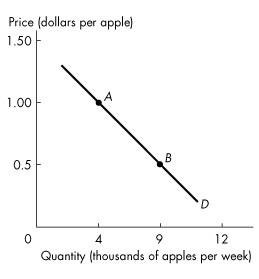
Q4. Point A in Figure 3.2.1 indicates that:
Background
Topic: Demand Curve Interpretation
This question asks you to interpret a point on a demand curve, specifically what the price and quantity at point A represent.
Key Terms and Concepts:
Demand Curve: Shows the relationship between the price of a good and the quantity demanded.
Willingness to Pay: The maximum price consumers are willing to pay for a given quantity.
Step-by-Step Guidance
Locate point A on the demand curve and note its price and quantity coordinates.
Recall what a point on the demand curve means: at that price, consumers plan to buy that quantity.
Consider whether the price at point A is the maximum consumers are willing to pay for the 4,000th apple, or if it means something else.
Eliminate options that do not match the meaning of a point on the demand curve.
Try solving on your own before revealing the answer!
Final Answer: C) $1 is the least that consumers are willing to pay for the 4,000th apple.
Point A shows the price consumers are just willing to pay for the 4,000th apple, which is $1.
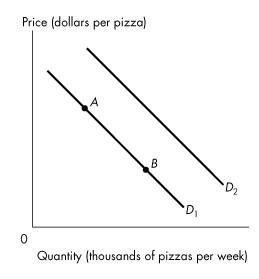
Q5. Refer to Figure 3.2.2. Which one of the following represents a decrease in quantity demanded?
Background
Topic: Movements Along vs. Shifts of the Demand Curve
This question tests your understanding of the difference between a movement along the demand curve (change in quantity demanded) and a shift of the demand curve (change in demand).
Key Terms:
Quantity Demanded: The amount of a good consumers are willing to buy at a specific price, represented by a movement along the demand curve.
Change in Demand: A shift of the entire demand curve due to factors other than the good's own price.
Step-by-Step Guidance
Identify which options describe a movement along the same demand curve and which describe a shift to a new curve.
Recall that a decrease in quantity demanded is shown by a movement up the demand curve (to the left), not a shift.
Eliminate options that involve shifting the curve rather than moving along it.
Try solving on your own before revealing the answer!
Final Answer: A) a movement from B to A
A movement from B to A is a movement up along the demand curve, representing a decrease in quantity demanded due to a higher price.
