 Indietro
Production Possibilities Frontier and the Economic Problem
Guida di studio - Note intelligenti
 Appunti personalizzati basati sui tuoi materiali, ampliati con definizioni chiave, esempi e contesto.
The Economic Problem
Production Possibilities and Opportunity Cost
The Production Possibilities Frontier (PPF) is a fundamental concept in microeconomics that illustrates the maximum combinations of two goods or services that can be produced with available resources and technology. The PPF demonstrates the trade-offs and opportunity costs that arise due to scarcity.
Scarcity: Resources are limited, so producing more of one good requires sacrificing some of another.
Opportunity Cost: The value of the next best alternative forgone when making a choice. On the PPF, it is measured by the amount of one good that must be given up to produce more of the other good.
Attainable Points: Points on or inside the PPF are attainable; points outside are unattainable with current resources.
Efficient Production: All points on the PPF represent efficient production, while points inside the PPF are inefficient.
Example: If Brazil increases food production from 2 to 3 tonnes per day, the opportunity cost is the decrease in ethanol production (e.g., 14 barrels per day). As food production increases further, the opportunity cost (in ethanol) also increases, illustrating the law of increasing opportunity cost.
Shapes of the PPF
Linear PPF: Indicates constant opportunity cost between two goods.
Bowed-Outward (Concave) PPF: Indicates increasing opportunity cost as more of one good is produced.
Example: If the opportunity cost of producing food is always the same, the PPF is linear. If the opportunity cost rises as more food is produced, the PPF is bowed outward.
Marginal Cost and Marginal Benefit
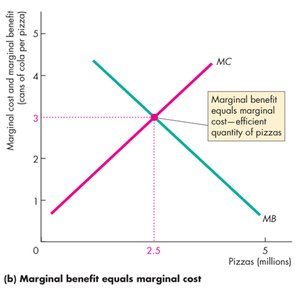
The marginal cost (MC) of a good is the opportunity cost of producing one more unit of that good. The marginal benefit (MB) is the additional benefit received from consuming one more unit of a good. Generally, as more of a good is produced, its marginal cost increases, while its marginal benefit decreases.
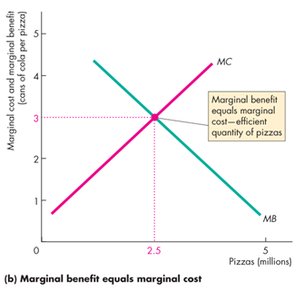
Allocative Efficiency: Achieved when marginal benefit equals marginal cost (MB = MC). This is the point on the PPF where resources are used most efficiently from society's perspective.
Using Resources Efficiently
Production Efficiency vs. Allocative Efficiency
Production Efficiency: Achieved when the economy operates on the PPF, using all resources efficiently.
Allocative Efficiency: Achieved at the point on the PPF where MB = MC, indicating the most preferred combination of goods and services for society.
Economic Growth
Shifting the PPF
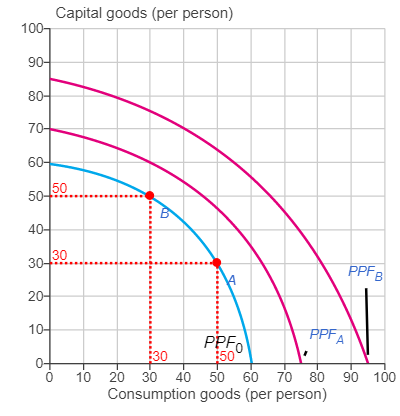
Economic growth occurs when an economy's capacity to produce goods and services increases, shifting the PPF outward. This can result from technological advancements, capital accumulation, or improvements in resource quality.
Technological Change: Improves production efficiency, allowing more output from the same inputs.
Capital Accumulation: Increases the stock of capital goods, enabling higher future production.
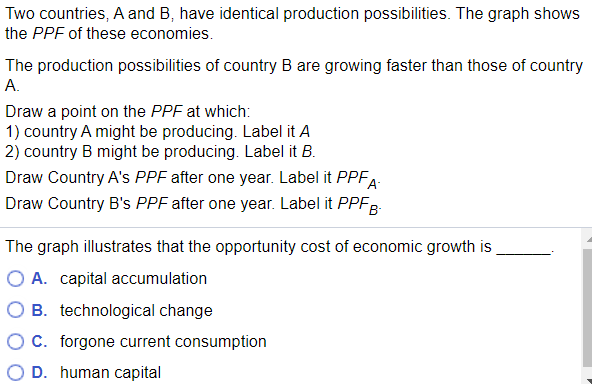
Opportunity Cost of Growth: Investing in capital goods or technology often requires sacrificing current consumption (forgone current consumption).
Practice Application
Consider two countries, A and B, with identical initial PPFs. If country B's PPF grows faster, it may be due to greater capital accumulation or technological progress. The opportunity cost of this growth is typically forgone current consumption, as resources are diverted from producing consumer goods to producing capital goods.
Summary Table: Key Concepts of the PPF
Concept | Definition | Example |
|---|---|---|
Scarcity | Limited resources for unlimited wants | Choosing between producing food or ethanol |
Opportunity Cost | Value of the next best alternative forgone | Giving up ethanol to produce more food |
Production Efficiency | Producing on the PPF | All resources fully utilized |
Allocative Efficiency | MB = MC | Optimal mix of goods for society |
Economic Growth | Outward shift of the PPF | More capital goods produced today, higher future output |
Key Equations
Marginal Cost (MC):
Allocative Efficiency Condition:
