Indietro
The Ten Principles of Economics: Foundations of Microeconomics
Guida di studio - Note intelligenti
 Appunti personalizzati basati sui tuoi materiali, ampliati con definizioni chiave, esempi e contesto.
Principles of Microeconomics
Introduction: Ten Principles of Economics
Economics studies how society manages its scarce resources. The Ten Principles of Economics provide a foundational framework for understanding individual and societal decision-making, market interactions, and the functioning of the entire economy.
Scarcity and Economic Decision-Making
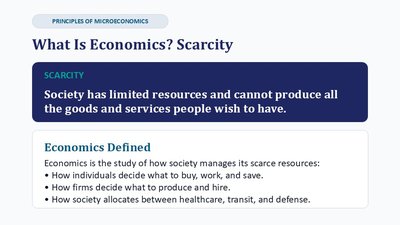
What Is Economics? Scarcity
Scarcity means that society has limited resources and cannot produce all the goods and services people wish to have. Economics is the study of how society manages these scarce resources, including:
How individuals decide what to buy, work, and save.
How firms decide what to produce and hire.
How society allocates resources among competing uses (e.g., healthcare, transit, defense).
The Ten Principles Roadmap
Overview of the Ten Principles
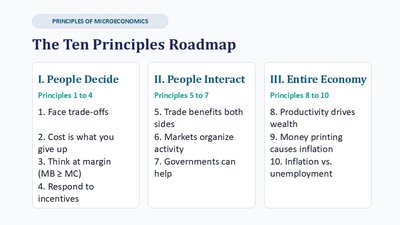
The Ten Principles are grouped into three categories:
I. People Decide (Principles 1–4): Trade-offs, opportunity cost, marginal thinking, and incentives.
II. People Interact (Principles 5–7): Trade, market organization, and government roles.
III. Entire Economy (Principles 8–10): Productivity, inflation, and the short-run trade-off between inflation and unemployment.
I. People Decide
Principle 1: People Face Trade-offs
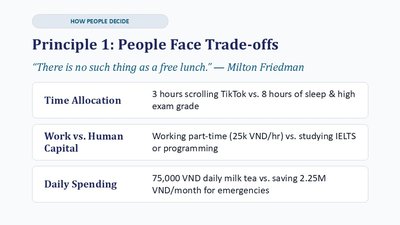
Every choice involves trade-offs because resources are limited. Choosing one option means giving up another. Examples include:
Time Allocation: Choosing between leisure and study time.
Work vs. Human Capital: Working part-time versus investing in education.
Daily Spending: Spending on non-essentials versus saving for emergencies.
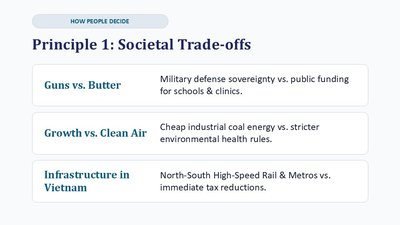
Societal Trade-offs
Guns vs. Butter: Military spending versus public services.
Growth vs. Clean Air: Economic growth versus environmental protection.
Infrastructure vs. Tax Cuts: Investing in infrastructure versus reducing taxes.
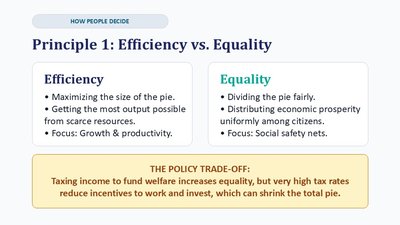
Efficiency vs. Equality
Efficiency: Maximizing output from scarce resources (focus: growth, productivity).
Equality: Distributing economic prosperity fairly (focus: social safety nets).
Policy Trade-off: Taxing income to fund welfare increases equality but may reduce incentives to work and invest, potentially shrinking the economic pie.
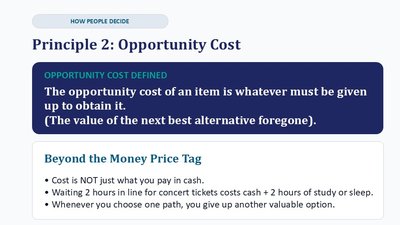
Principle 2: Opportunity Cost
Opportunity cost is the value of the next best alternative foregone when making a decision. It is not just the monetary cost, but includes all resources sacrificed.
Waiting in line for tickets costs both money and time.
Choosing one path means giving up another valuable option.
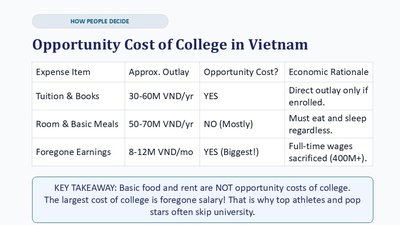
Opportunity Cost of College in Vietnam
Expense Item | Approx. Outlay | Opportunity Cost? | Economic Rationale |
|---|---|---|---|
Tuition & Books | 30–60M VND/yr | YES | Direct outlay only if enrolled |
Room & Basic Meals | 50–70M VND/yr | NO (Mostly) | Must eat and sleep regardless |
Foregone Earnings | 8–12M VND/mo | YES (Biggest!) | Full-time wages sacrificed |
Key takeaway: The largest cost of college is foregone salary, not basic food or rent.
Principle 3: Thinking at the Margin
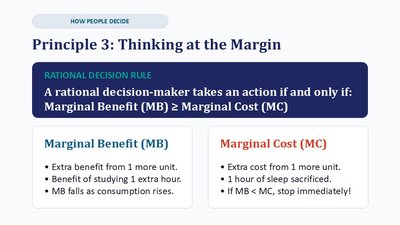
Rational decision-makers compare the marginal benefit (MB) and marginal cost (MC) of an action. The rational decision rule is:
Marginal Benefit (MB): Extra benefit from one more unit (e.g., one more hour of study).
Marginal Cost (MC): Extra cost from one more unit (e.g., one hour less sleep).
Marginal Thinking in Real Life
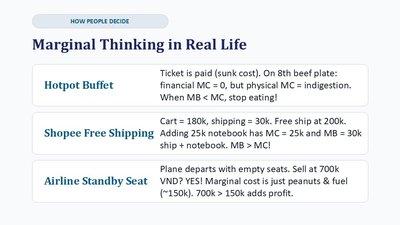
Hotpot Buffet: Stop eating when the marginal benefit of more food is less than the marginal cost (e.g., discomfort).
Shopee Free Shipping: Add items to reach free shipping if MB > MC.
Airline Standby Seat: Selling empty seats at a price above marginal cost adds profit.
Principle 4: People Respond to Incentives
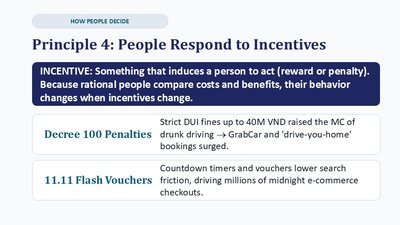
Incentives are rewards or penalties that motivate behavior. Rational people change their actions when costs or benefits change.
Decree 100 Penalties: Higher fines for drunk driving increase the marginal cost, reducing offenses.
11.11 Flash Vouchers: Discounts and timers encourage more purchases.
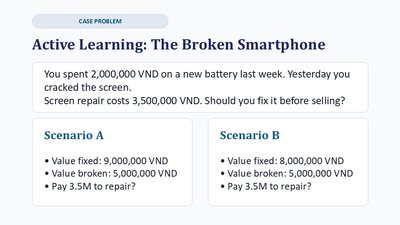
Case Problem: The Broken Smartphone
Should you repair a cracked screen before selling your phone? Consider only future costs and benefits, not past (sunk) costs.
Scenario A: Repair if MB > MC.
Scenario B: Do not repair if MB < MC.
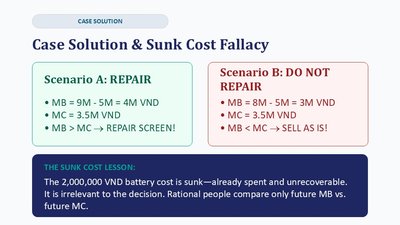
Sunk Cost Lesson: Ignore costs that are already spent and unrecoverable. Only future marginal benefits and costs matter for rational decisions.
II. People Interact
Principle 5: Trade Benefits Both Sides
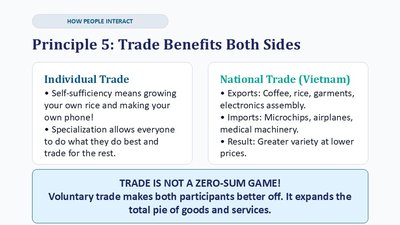
Trade allows individuals and nations to specialize in what they do best and to enjoy a greater variety of goods and services at lower cost. Voluntary trade is mutually beneficial and expands the total economic pie.
Individual Trade: Specialization and exchange increase efficiency.
National Trade: Exports and imports allow access to a wider range of goods and services.
Principle 6: Market Organization
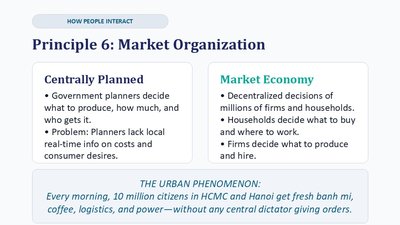
Markets organize economic activity through the decentralized decisions of many firms and households. There are two main systems:
Centrally Planned: Government planners decide what and how much to produce.
Market Economy: Decisions are made by millions of firms and households, guided by prices.
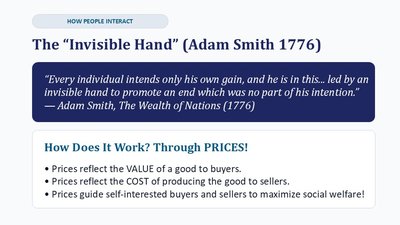
The "Invisible Hand" (Adam Smith, 1776)
Prices guide self-interested buyers and sellers to maximize social welfare. Prices reflect both the value to buyers and the cost to sellers.
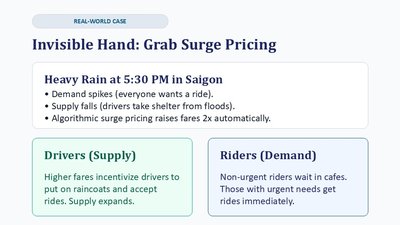
Real-World Case: Grab Surge Pricing
Algorithmic surge pricing during heavy rain increases fares, incentivizing more drivers to supply rides and allocating rides to those who value them most.
Drivers (Supply): Higher fares increase willingness to drive.
Riders (Demand): Urgent riders pay more; non-urgent riders wait.
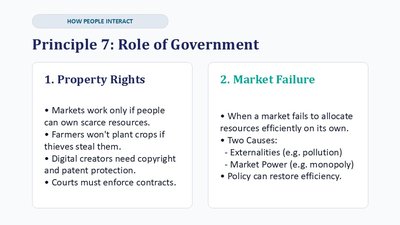
Principle 7: Role of Government
Governments can sometimes improve market outcomes by enforcing property rights and correcting market failures.
Property Rights: Markets require secure ownership and contract enforcement.
Market Failure: Occurs when markets fail to allocate resources efficiently, due to externalities or market power.
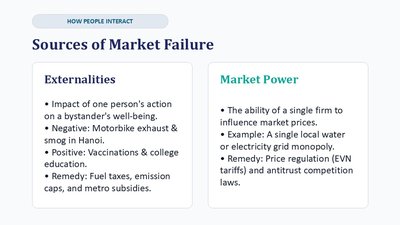
Sources of Market Failure
Externalities: Impact of one person's actions on others (e.g., pollution, vaccinations).
Market Power: Ability of a single firm to influence prices (e.g., monopoly).
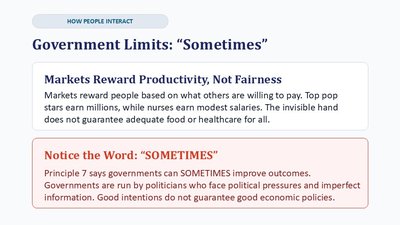
Limits of Government Intervention
Markets reward productivity, not fairness. Government intervention can sometimes improve outcomes, but is limited by imperfect information and political pressures.
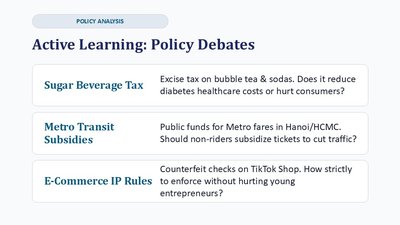
Policy Debates
Sugar Beverage Tax: Does it reduce healthcare costs or harm consumers?
Metro Transit Subsidies: Should non-riders subsidize public transit?
E-Commerce IP Rules: How to enforce intellectual property without stifling entrepreneurship?
III. The Entire Economy
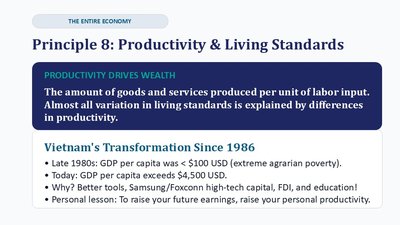
Principle 8: Productivity & Living Standards
Productivity—the amount of goods and services produced per unit of labor input—determines living standards. Differences in productivity explain most variations in income across countries and over time.
Vietnam's transformation since 1986: Higher productivity led to rapid GDP growth and improved living standards.
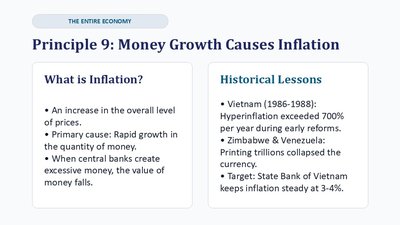
Principle 9: Money Growth Causes Inflation
Inflation is an increase in the overall price level. The primary cause is rapid growth in the quantity of money. When central banks create excessive money, the value of money falls.
Historical examples: Vietnam (1986–1988), Zimbabwe, Venezuela.
Central banks aim to keep inflation steady (e.g., 3–4%).
Principle 10: The Short-Run Trade-off between Inflation and Unemployment
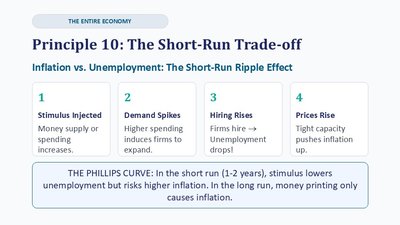
In the short run, increasing the money supply or government spending can lower unemployment but may cause higher inflation. This relationship is illustrated by the Phillips Curve.
Stimulus injected (money supply or spending increases)
Demand spikes (induces firms to expand)
Hiring rises (unemployment drops)
Prices rise (tight capacity pushes inflation up)
Phillips Curve: In the short run (1–2 years), stimulus lowers unemployment but risks higher inflation. In the long run, only inflation rises.
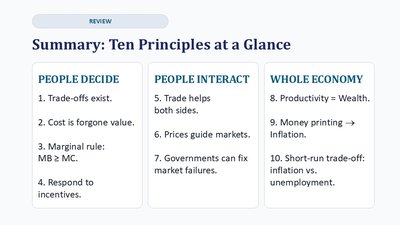
Summary: Ten Principles at a Glance
People Decide | People Interact | Whole Economy |
|---|---|---|
1. Trade-offs exist. 2. Cost is forgone value. 3. Marginal rule: MB ≥ MC. 4. Respond to incentives. | 5. Trade helps both sides. 6. Prices guide markets. 7. Governments can fix market failures. | 8. Productivity = Wealth. 9. Money printing → Inflation. 10. Short-run trade-off: inflation vs. unemployment. |