Skip to main content
Nutrition
Il mio corso
Impara
Preparazione agli esami
AI Tutor
Guide di studio
Flashcard
Prova l'app
Il mio corso
Impara
Preparazione agli esami
AI Tutor
Guide di studio
Flashcard
Prova l'app
Indietro
Major Mineral: Sodium and Potassium quiz
Puoi toccare per girare la carta.
What is the chemical abbreviation for sodium and where does it come from?
Puoi toccare per girare la carta.
👆
What is the chemical abbreviation for sodium and where does it come from?
The chemical abbreviation for sodium is Na, which comes from the Latin word for sodium.
Avanzamenti del tracciato
I pulsanti di controllo sono stati cambiati in modalità "navigazione".
1/15
Flashcard correlate
Pratica correlata
Video consigliati
Major Mineral: Sodium and Potassium definitions
Major Mineral: Sodium and Potassium
15 Termini
Major Mineral: Sodium and Potassium exam
Major Mineral: Sodium and Potassium
29 Termini
Major Mineral: Sodium and Potassium quiz #1
Major Mineral: Sodium and Potassium
10 Termini
Major Mineral: Sodium and Potassium
8. Water and Minerals
10 Problemi
Argomento
Hypertension and Minerals
8. Water and Minerals
10 Problemi
Argomento
8. Water and Minerals
10 Argomenti
15 Problemi
Capitolo
02:02
Major Mineral: Sodium and Potassium Example 2
166
views
1
rank
05:34
Sodium (Na)
247
views
2
rank
04:24
Potassium (K)
198
views
Termini in questo insieme (15)
Nascondere definizioni
What is the chemical abbreviation for sodium and where does it come from?
The chemical abbreviation for sodium is Na, which comes from the Latin word for sodium.
Where is sodium primarily found in the body?
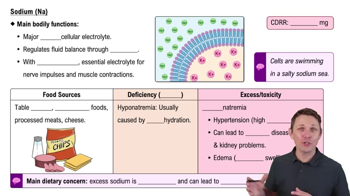
Sodium is the major extracellular electrolyte, found mainly in the fluid outside cells.
What is the main function of sodium in fluid balance?
Sodium regulates fluid balance through osmosis by controlling where electrolytes are, which in turn controls water movement.
What is the recommended maximum daily intake of sodium to reduce chronic disease risk?
The chronic disease risk reduction value for sodium is 2,300 milligrams per day.
Name two common food sources of sodium.
Table salt and processed foods are common sources of sodium.
What is the term for sodium deficiency and what usually causes it?
Sodium deficiency is called hyponatremia, and it is usually caused by overhydration rather than low sodium intake.
What health problems can result from excess sodium intake?
Excess sodium can lead to hypernatremia, which may cause hypertension, heart disease, stroke, kidney problems, and edema.
What is the main dietary concern regarding sodium for most people?
Most people consume too much sodium, increasing their risk of hypertension.
What is the chemical abbreviation for potassium and its origin?
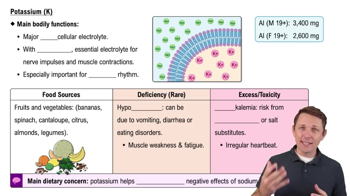
Potassium is abbreviated as K, which comes from the Latin word for potassium.
Where is potassium primarily found in the body?
Potassium is the major intracellular electrolyte, found mainly inside cells.
What are the adequate intake values for potassium for adult men and women?
The adequate intake for potassium is 3,400 mg for men and 2,600 mg for women.
List two food sources high in potassium.
Fruits and vegetables, such as bananas and spinach, are high in potassium.
What is the term for potassium deficiency and what are its symptoms?
Potassium deficiency is called hypokalemia, and it can cause muscle weakness and fatigue.
What can cause potassium toxicity and what is a possible effect?
Potassium toxicity, or hyperkalemia, is usually caused by supplements or salt substitutes and can result in an irregular heartbeat.
How does potassium help counteract the effects of sodium?
Potassium helps counteract the negative effects of sodium, particularly by lowering the risk of hypertension.
 IndietroIndietro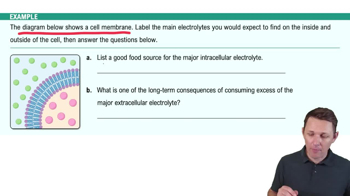
 02:02
02:02