Skip to main content
Nutrition
Il mio corso
Impara
Preparazione agli esami
AI Tutor
Guide di studio
Flashcard
Prova l'app
Il mio corso
Impara
Preparazione agli esami
AI Tutor
Guide di studio
Flashcard
Prova l'app
Indietro
Nutrition During Adolescence (Ages 12-19) definitions
Puoi toccare per girare la carta.
Adolescence
Puoi toccare per girare la carta.
👆
Adolescence
Life stage from ages 12 to 19 marked by puberty, rapid growth, and increased nutritional requirements.
Avanzamenti del tracciato
I pulsanti di controllo sono stati cambiati in modalità "navigazione".
1/15
Flashcard correlate
Pratica correlata
Video consigliati
Nutrition During Adolescence (Ages 12-19) quiz
Nutrition During Adolescence (Ages 12-19)
15 Termini
Nutrition During Adolescence (Ages 12-19)
15. Nutrition: Toddlers to Late Adulthood
10 Problemi
Argomento
Nutrition For Older Adults (Ages 50+)
15. Nutrition: Toddlers to Late Adulthood
10 Problemi
Argomento
15. Nutrition: Toddlers to Late Adulthood
4 Argomenti
15 Problemi
Capitolo
VideoThumbView.guidedCourse
02:09
Nutrition During Adolescence (Ages 12-19)
176
views
Termini in questo insieme (15)
Nascondere definizioni
Adolescence
Life stage from ages 12 to 19 marked by puberty, rapid growth, and increased nutritional requirements.
Puberty
Developmental phase triggering hormonal changes, growth spurts, and higher energy and nutrient needs.
Growth Spurts
Periods of accelerated physical development requiring increased calories and nutrients.
Calorie Needs
Daily energy requirements ranging from 1800 to 3200 kilocalories, varying by sex and activity.
Fat Intake
Recommended to provide 25-35% of daily calories, supporting growth and development in this age group.
Protein Requirement
Amount set at about 0.8 grams per kilogram of body weight, aligning with adult recommendations.
Carbohydrate Intake
Stable daily requirement, serving as a primary energy source during rapid growth.
Calcium
Essential mineral for bone growth, with increased importance due to rapid skeletal development.
Vitamin D
Nutrient crucial for calcium absorption and bone health during periods of rapid growth.
Iron
Micronutrient with higher needs in menstruating girls to compensate for blood loss.
Fluid Intake
Recommended daily consumption of 2.3 to 3.3 liters to support metabolic and growth processes.
Eating Disorders
Increased risk during this stage, potentially impacting nutrient intake and overall health.
Obesity
Prevalence rises in this age group, often linked to poor dietary choices and lifestyle factors.
Peer Influence
Social factor affecting food choices, often leading to less healthy eating patterns.
Nutrient Absorption
Process that can be impaired by substances like alcohol, leading to deficiencies.
 IndietroIndietro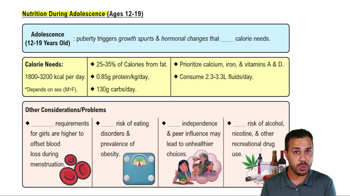
 02:09
02:09