 Indietro
BIO115 D03 Introduction to Nutrition – Course Syllabus and Structure
Guida di studio - Note intelligenti
 Appunti personalizzati basati sui tuoi materiali, ampliati con definizioni chiave, esempi e contesto.
Course Overview
Introduction to Nutrition
This course provides a comprehensive introduction to the science of nutrition, focusing on the application of nutrition principles in food planning, selection, and preparation to meet physical, social, and economic needs. Students will explore current issues such as vegetarianism, health foods, fad diets, weight control, food additives, nutrition labeling, food budgeting, and safe food handling. The course emphasizes critical evaluation of nutrition information and the development of a personal nutrition philosophy for lifelong health.
Course Objectives and Learning Outcomes
What You Will Learn
Understand nutrition as a basic science essential to life processes.
Distinguish between nutritional myths and scientific facts.
Analyze the credibility of nutrition and health information sources.
Describe the physical building materials of the body and their functions.
Explain the interrelationships among body organs and systems for overall health.
Discuss key nutrients, including their functions, food sources, and deficiency symptoms.
Recognize the importance of good nutrition for body functioning and metabolism.
Design a personalized healthy meal plan.
Develop a personal nutrition philosophy related to health and safety.
Engage with current nutrition research and critically evaluate published findings.
Course Structure and Topics
Weekly Topics and Textbook Chapters
Week 1-2: Introduction/What is Nutrition? (Chapter 1)
Week 3: Tools for Healthy Eating (Chapter 2)
Week 4: The Basics of Digestion (Chapter 3)
Week 5-6: Carbohydrates: Sugar, Starches, and Fiber (Chapter 4)
Week 6-7: Fats, Oils, and Other Lipids (Chapter 5)
Week 7-8: Proteins and Amino Acids (Chapter 6)
Week 9: Vitamins (Chapter 7)
Week 10: Minerals and Water (Chapter 8)
Week 11: Weight Management and Energy Balance (Chapter 10)
Week 12: Nutrition and Fitness (Chapter 11)
Week 13: Alcohol (Chapter 9)
Week 14: Food Safety & Regulation: Consumerism, GMOs (Chapter 12, section 5)
Week 15: Course Summary and Final Exam
Additional info: The course schedule aligns with standard college-level nutrition curriculum, covering all major macronutrients, micronutrients, energy balance, and public health topics.
Assignments and Grading
Assessment Components
Lecture Exams (3): 45% (15% each)
Final Exam: 15%
Online Quizzes: 10% (lowest grade dropped)
Discussion Board Homework: 10% (two lowest grades dropped)
Mastering Homework: 10% (two lowest grades dropped)
Project 1 – Dietary Analysis: 5%
Project 2 – Cost of Healthy Foods: 5%
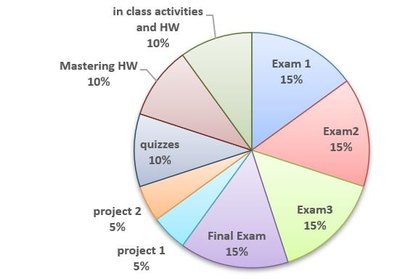
This pie chart visually represents the percentage of the total grade assigned to each assessment component.
Grading Scale
Letter Grade | Course Average (%) |
|---|---|
A | 93-100 |
A- | 90-92 |
B+ | 87-89 |
B | 83-86 |
B- | 80-82 |
C+ | 77-79 |
C | 73-76 |
C- | 70-72 |
D+ | 67-69 |
D | 63-66 |
D- | 60-62 |
F | <60 |
Course Policies and Expectations
Academic Honesty
Cheating, plagiarism, unauthorized collaboration, and use of AI for assignments are strictly prohibited.
Violations result in failure for the assignment or course and may lead to disciplinary action.
Attendance and Participation
Active engagement is required; attendance is tracked by assignment completion.
Students are responsible for withdrawing from the course if they stop participating.
Assignment Deadlines
All assignments are due by 5:00pm on the specified date.
Late submissions are generally not accepted, except for exams under compelling circumstances.
Technical Requirements
Textbook: Nutrition and You, 6th edition by Joan Salge Blake (with Pearson Mastering Nutrition and My Diet Analysis).
Reliable computer with webcam and internet access; LockDown Browser required for exams.
Weekly Study Recommendations
Suggested Weekly Timeline
Monday: Review weekly assignments and begin reading the chapter.
Tuesday: Continue reading and start Mastering assignment.
Wednesday: Work on Mastering and discussion assignments; begin quiz review.
Thursday: Submit Mastering and discussion assignments; continue quiz study.
Friday: Take quiz; begin exam review.
Saturday-Sunday: Study for and complete exams as scheduled.
Additional info: Students should expect to spend at least 5-6 hours per week on coursework, including reading, assignments, and assessments.
Support and Resources
Student Support Services
Technical support for Blackboard and Mastering Nutrition.
Academic accommodations through the Office of Disability Services.
Access to tutoring, academic planning, career services, and other student resources.
