Indietro
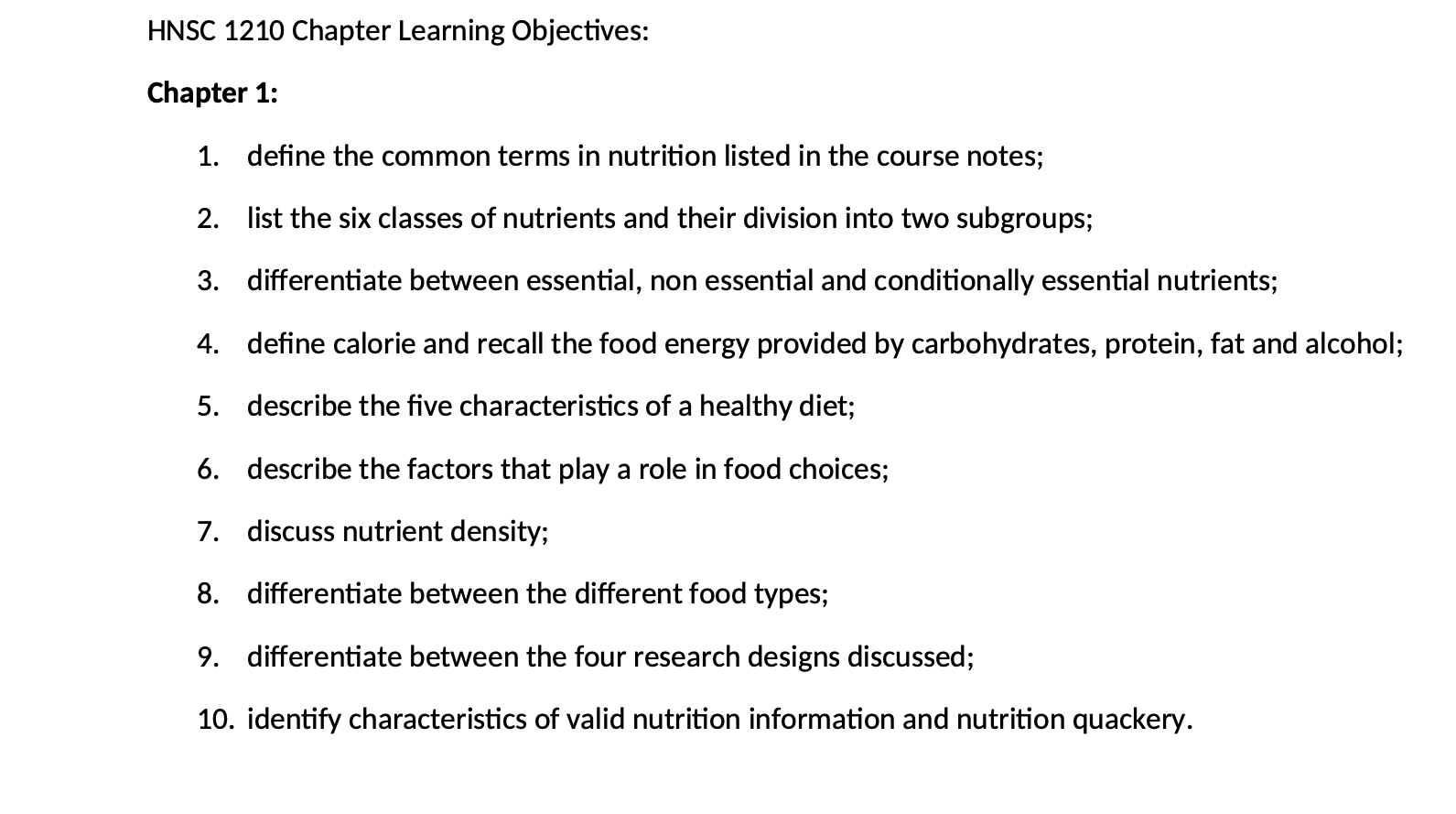
Chapter 1: Foundations of Nutrition – Key Concepts and Study Guide
Guida di studio - Note intelligenti
 Appunti personalizzati basati sui tuoi materiali, ampliati con definizioni chiave, esempi e contesto.
Science of Nutrition
Common Terms in Nutrition
Understanding nutrition requires familiarity with key terminology used throughout the field. These terms provide the foundation for discussing nutrients, dietary patterns, and health outcomes.
Nutrient: A substance in food that is used by the body for growth, maintenance, and repair.
Diet: The foods and beverages a person consumes regularly.
Malnutrition: Imbalance in nutrient intake, including both undernutrition and overnutrition.
Deficiency: Inadequate intake of a nutrient leading to health problems.
RDA (Recommended Dietary Allowance): The average daily dietary intake level sufficient to meet the nutrient requirements of nearly all healthy individuals.
Six Classes of Nutrients and Their Subgroups
Nutrients are classified into six main groups, which are further divided based on their chemical nature and function in the body.
Macronutrients: Needed in large amounts. Includes carbohydrates, proteins, and fats.
Micronutrients: Needed in smaller amounts. Includes vitamins and minerals.
Water: Essential for life, involved in many bodily functions.
Class | Subgroup |
|---|---|
Carbohydrates | Simple & Complex |
Proteins | Complete & Incomplete |
Fats (Lipids) | Saturated & Unsaturated |
Vitamins | Fat-soluble & Water-soluble |
Minerals | Major & Trace |
Water | --- |
Essential, Non-Essential, and Conditionally Essential Nutrients
Nutrients are categorized based on whether the body can synthesize them or must obtain them from the diet.
Essential Nutrients: Cannot be synthesized by the body; must be obtained from food (e.g., essential amino acids, essential fatty acids).
Non-Essential Nutrients: Can be synthesized by the body (e.g., some amino acids).
Conditionally Essential Nutrients: Normally non-essential, but may become essential under certain conditions (e.g., illness, stress).
Calorie and Food Energy
A calorie is a unit of energy. In nutrition, it refers to the energy provided by food and beverages.
Definition: One calorie is the amount of energy needed to raise the temperature of 1 gram of water by 1°C.
Food Energy Values:
Carbohydrates: 4 kcal/g
Proteins: 4 kcal/g
Fats: 9 kcal/g
Alcohol: 7 kcal/g
Formula:
Tools for Healthful Eating
Characteristics of a Healthy Diet
A healthy diet is defined by several key characteristics that promote optimal health and prevent disease.
Adequacy: Provides sufficient nutrients and energy.
Balance: Includes appropriate proportions of different food groups.
Calorie Control: Maintains energy balance to support healthy weight.
Moderation: Limits excess intake of unhealthy components.
Variety: Incorporates diverse foods to ensure a broad range of nutrients.
Factors Influencing Food Choices
Food choices are influenced by a variety of factors, both internal and external.
Personal Preference: Taste, texture, and aroma.
Cultural Influences: Traditions and social norms.
Economic Factors: Cost and accessibility.
Psychological Factors: Stress, mood, and emotional eating.
Health Concerns: Allergies, medical conditions, and dietary restrictions.
Nutrient Density
Nutrient density refers to the amount of nutrients a food provides relative to its energy content.
High Nutrient Density: Foods rich in vitamins, minerals, and other beneficial substances with relatively few calories (e.g., fruits, vegetables).
Low Nutrient Density: Foods high in calories but low in nutrients (e.g., sugary drinks, processed snacks).
Food Types
Foods are categorized based on their nutrient composition and role in the diet.
Whole Foods: Minimally processed, retain most of their natural nutrients (e.g., whole grains, fresh fruits).
Processed Foods: Modified from their original form, often with added ingredients (e.g., canned vegetables, bread).
Fortified Foods: Have added nutrients not originally present (e.g., fortified cereals).
Functional Foods: Provide health benefits beyond basic nutrition (e.g., probiotics, omega-3 enriched eggs).
Science of Nutrition
Research Designs in Nutrition
Nutrition science relies on various research designs to investigate dietary effects and health outcomes.
Case Study: In-depth analysis of a single individual or group.
Epidemiological Study: Observes patterns, causes, and effects in populations.
Intervention Study: Tests the effects of a specific dietary change or treatment.
Laboratory Study: Conducted in controlled environments to explore mechanisms.
Valid Nutrition Information and Nutrition Quackery
It is important to distinguish between credible nutrition information and quackery.
Characteristics of Valid Information:
Based on scientific evidence
Peer-reviewed sources
Transparent methodology
Qualified experts
Nutrition Quackery:
Unsubstantiated claims
Promises of quick fixes
Use of testimonials instead of scientific data
Promotion of products for profit
Example: A website claiming a supplement cures all diseases without scientific backing is an example of nutrition quackery.