 Indietro
Digestive System and Macronutrient Digestion: Carbohydrates, Proteins, and Lipids
Guida di studio - Note intelligenti
 Appunti personalizzati basati sui tuoi materiali, ampliati con definizioni chiave, esempi e contesto.
Digestive System Overview
Anatomy and Function
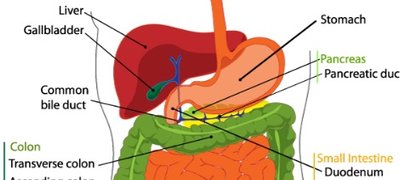
The digestive system is a complex network of organs responsible for breaking down food, absorbing nutrients, and eliminating waste. It includes the mouth, pharynx, esophagus, stomach, small intestine, large intestine, liver, gallbladder, and pancreas. Each organ plays a specific role in the digestion and absorption of macronutrients.
Mouth: Initiates mechanical and chemical digestion.
Stomach: Secretes acid and enzymes for protein digestion.
Small Intestine: Primary site for nutrient absorption.
Large Intestine: Absorbs water and forms feces.
Liver: Produces bile for fat emulsification.
Gallbladder: Stores and releases bile.
Pancreas: Secretes digestive enzymes and bicarbonate.
Carbohydrate Digestion
Stages of Carbohydrate Digestion
Carbohydrate digestion begins in the mouth and continues through the stomach, small intestine, and large intestine. The process differs for starch and fiber.
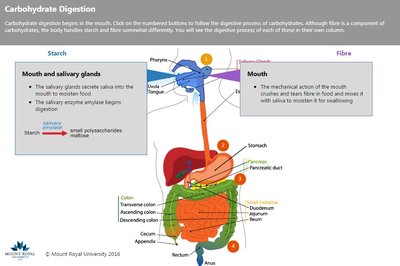
Mouth and Salivary Glands:
Salivary glands secrete salivary amylase to break down starch into small polysaccharides.
Mechanical action mixes food with saliva for swallowing.
Stomach:
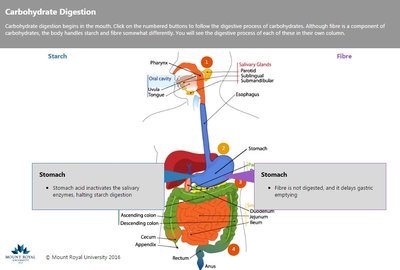
Stomach acid inactivates salivary amylase, halting starch digestion.
Fiber is not digested and delays gastric emptying.
Small Intestine & Pancreas:
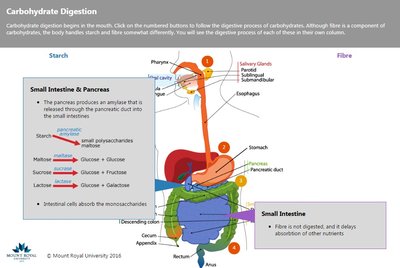
Pancreas secretes pancreatic amylase to break down starch into maltose, sucrose, and lactose.
Enzymes on the intestinal wall further digest disaccharides into monosaccharides (glucose, fructose, galactose).
Monosaccharides are absorbed into the bloodstream.
Fiber is not digested and delays absorption of other nutrients.
Large Intestine:
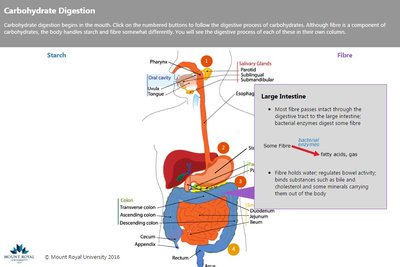
Most fiber passes through undigested; some is fermented by bacteria, producing short-chain fatty acids, gas, and other byproducts.
Soluble fiber helps regulate bowel activity and cholesterol.
Summary Table: Carbohydrate Digestion
Stage | Enzyme/Process | Product |
|---|---|---|
Mouth | Salivary amylase | Small polysaccharides |
Stomach | Acid inactivation | Starch digestion stops |
Small Intestine | Pancreatic amylase, disaccharidases | Monosaccharides |
Large Intestine | Bacterial fermentation | Short-chain fatty acids, gas |
Protein Digestion
Stages of Protein Digestion
Protein digestion involves mechanical and chemical processes, starting in the mouth and continuing in the stomach and small intestine.
Mouth:
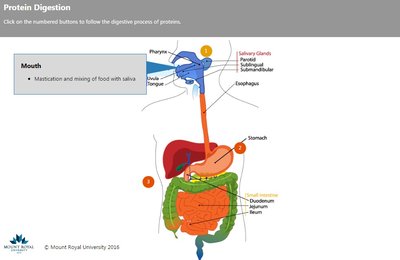
Mastication and mixing of food with saliva; no enzymatic protein digestion occurs here.
Stomach:
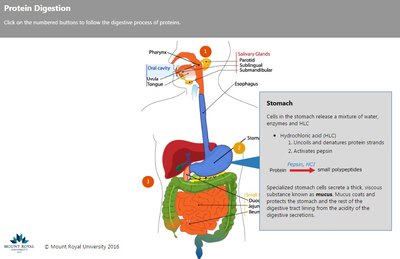
Cells release hydrochloric acid (HCl) and pepsin.
HCl denatures proteins and activates pepsin.
Pepsin breaks proteins into small polypeptides.
Small Intestine:
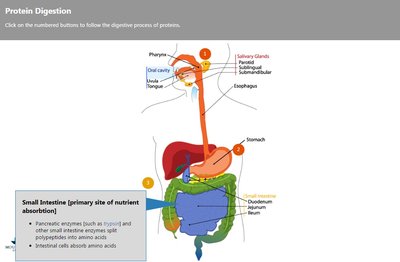
Pancreatic enzymes (such as trypsin) and intestinal enzymes break polypeptides into amino acids.
Intestinal cells absorb amino acids into the bloodstream.
Summary Table: Protein Digestion
Stage | Enzyme/Process | Product |
|---|---|---|
Mouth | Mastication | No protein digestion |
Stomach | HCl, pepsin | Small polypeptides |
Small Intestine | Trypsin, other proteases | Amino acids |
Lipid Digestion
Stages of Lipid Digestion
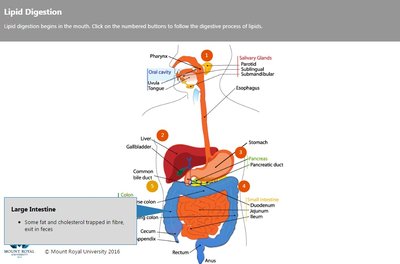
Lipid digestion is a multi-step process involving emulsification and enzymatic breakdown, beginning in the mouth and continuing through the small intestine and large intestine.
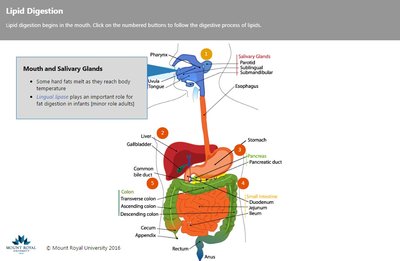
Mouth and Salivary Glands:
Some fats melt at body temperature.
Lingual lipase plays a minor role, especially in infants.
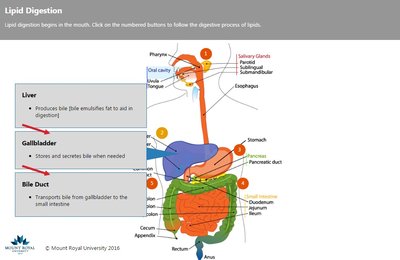
Liver, Gallbladder, and Bile Duct:
Liver produces bile, which emulsifies fats.
Gallbladder stores and releases bile as needed.
Bile duct transports bile to the small intestine.
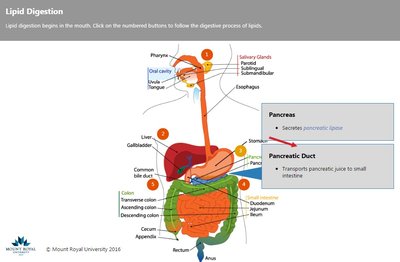
Pancreas and Pancreatic Duct:
Pancreas secretes pancreatic lipase.
Pancreatic duct transports pancreatic juice to the small intestine.
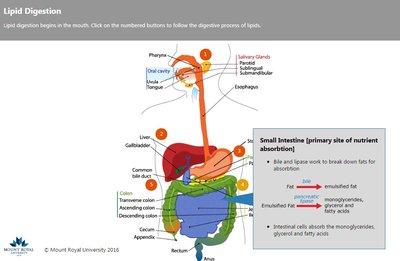
Small Intestine:
Bile and lipase break down fats into emulsified fat, monoglycerides, glycerol, and fatty acids.
Intestinal cells absorb these products.
Large Intestine:
Some fat and cholesterol are trapped in fiber and exit in feces.
Summary Table: Lipid Digestion
Stage | Enzyme/Process | Product |
|---|---|---|
Mouth | Lingual lipase | Minor fat digestion |
Liver/Gallbladder | Bile | Emulsified fat |
Pancreas | Pancreatic lipase | Monoglycerides, fatty acids |
Small Intestine | Bile, lipase | Absorbed lipids |
Large Intestine | None | Fat excreted in feces |
Key Terms and Concepts
Enzyme: A protein that catalyzes chemical reactions in the body.
Emulsification: The process of breaking fat into smaller droplets, increasing surface area for enzyme action.
Absorption: The uptake of nutrients from the digestive tract into the bloodstream.
Monosaccharide: The simplest form of carbohydrate (e.g., glucose).
Amino acid: The building block of proteins.
Fatty acid: The building block of lipids.
Equations and Formulas
General Digestion Equation
Digestion of macronutrients can be summarized as:
Carbohydrate Digestion Example
Protein Digestion Example
Lipid Digestion Example
Additional info:
These notes expand upon the provided diagrams and brief points, offering academic context and definitions to ensure completeness and clarity for Nutrition students.
