 Indietro
Tools for Healthful Eating: Understanding Diet Quality, Food Choices, and Food Labels
Guida di studio - Note intelligenti
 Appunti personalizzati basati sui tuoi materiali, ampliati con definizioni chiave, esempi e contesto.
Tools for Healthful Eating
Characteristics of a Healthful Diet
A healthful diet is essential for maintaining optimal health and preventing chronic diseases. It is defined by five key characteristics: adequacy, moderation, nutrient density, balance, and variety.
Adequate: Provides enough energy, nutrients, and fiber to support health. Adequacy varies by individual and nutrient.
Moderate: Includes appropriate amounts of foods to maintain a healthy weight and nutrient intake, avoiding excesses.
Nutrient-Dense: Consists of foods and beverages that supply the highest level of nutrients for the lowest number of calories. Examples include fruits, vegetables, lean proteins, low-fat dairy, and whole grains.
Balanced: Contains combinations of foods that provide proper proportions of nutrients from all food groups.
Varied: Involves eating many different foods from all food groups regularly to meet nutrient needs.
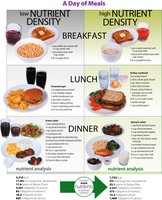
Additional info: Nutrient density is calculated as the ratio of nutrient content to energy content in a food. Foods with high nutrient density provide more vitamins and minerals per calorie.
Influences on Food Choices
Food choices are shaped by both biological and psychological factors. Understanding these influences can help individuals make more healthful decisions.
Hunger: A basic biological urge to eat, regulated by physiological signals.
Appetite: A psychological desire to eat, influenced by sensory data (taste, smell, appearance), sociocultural cues (traditions, social settings), emotions, and learned behaviors.
Conditioned Taste Aversion: Avoidance of a food due to a negative experience, such as illness.
Learning: Food preferences are largely learned from family, community, and cultural practices.
Understanding Food Labels
Required Components of Food Labels
Food labels provide essential information to help consumers make informed choices. The FDA requires five main components on packaged food labels:
Statement of Identity: The name of the product.
Net Contents: The quantity of food in the package.
Ingredient List: Ingredients listed in descending order by weight.
Name and Address: The manufacturer, packer, or distributor's information.
Nutrition Facts Panel: Standardized nutrition information per serving.
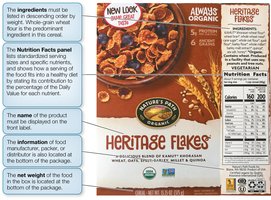
The Nutrition Facts Panel
The Nutrition Facts Panel provides detailed nutrition information, including calories, macronutrients, and specific vitamins and minerals. Label regulations began in 1973 and have evolved to improve consumer understanding.
Serving Size: Standardized to allow comparison among similar foods.
Calories: Total energy per serving.
Daily Values (%DV): Reference values to help consumers understand the nutrient content in the context of a total daily diet.
Added Sugars: Amount of sugars added during processing.
Vitamins and Minerals: Four nutrients are required: Vitamin D, Calcium, Iron, and Potassium.
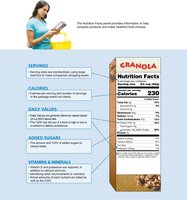
Additional info: The %DV helps consumers determine if a serving of food is high or low in a nutrient (5% or less is low, 20% or more is high).
Types of Claims on Food Labels
The FDA regulates claims on food labels to ensure accuracy and protect consumers.
Nutrient Claims: Describe the level of a nutrient in a food (e.g., "low fat," "high fiber"). Must meet FDA definitions.
Health Claims: Describe a relationship between a food or nutrient and a disease or health-related condition. Must be supported by scientific evidence and approved by the FDA.
Structure-Function Claims: Describe the effect of a nutrient or ingredient on the structure or function of the body (e.g., "builds strong bones"). These do not require FDA approval and may not be scientifically validated.
Functional foods, also called nutraceuticals, are foods with biologically active ingredients that may provide health benefits. Examples include whole foods (nuts, oats, blueberries), fortified foods (nutrients added), and enriched foods (nutrients replaced after processing).
Other Food Label Terms
Organic: At least a specified percentage of ingredients are organically produced by weight.
Natural: Not regulated; generally means nothing artificial or synthetic is included.
Kosher: Meets requirements of Jewish dietary law.
Dietary Guidelines for Americans (2025–2030)
Purpose and Principles
The Dietary Guidelines for Americans are developed by the U.S. Department of Health and Human Services and the U.S. Department of Agriculture. They are revised every five years to promote health and reduce the risk of chronic diseases.
Encourage healthy eating patterns across the lifespan.
Focus on variety, nutrient density, and amount.
Limit calories from added sugars and saturated fats, and reduce sodium intake.
Support healthy eating patterns for all.
Additional info: The MyPlate guidelines are now integrated into the Dietary Guidelines for Americans.
Special Topics in Food Choices
Empty Calories
Empty calories are calories from solid fats and/or added sugars that provide little or no nutrients. Foods high in empty calories have low nutrient density and should be limited in a healthful diet.
Estimating Serving Sizes
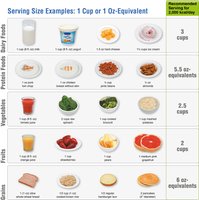
Understanding serving sizes helps with portion control and dietary planning. Visual cues, such as using your hand, can help estimate common serving sizes.
Eating Out and Healthful Choices
Restaurant meals often contain high amounts of fat and large portion sizes, which can exceed daily recommended intakes. Making healthful choices when eating out involves selecting nutrient-dense options, controlling portion sizes, and being mindful of added fats and sugars.
Key Terms and Definitions
Appetite: Psychological desire to eat.
Conditioned Taste Aversion: Avoidance of a food after a negative experience.
Dietary Guidelines for Americans: Federal recommendations for healthy eating patterns.
Empty Calories: Calories from solid fats and added sugars with little nutritional value.
Enriched Foods: Foods with nutrients replaced after processing.
Fortified Foods: Foods with added nutrients not originally present.
Functional Foods: Foods with health-promoting or disease-preventing properties.
Healthful Diet: Diet that is adequate, moderate, nutrient-dense, balanced, and varied.
Mouthfeel: The physical sensations in the mouth produced by a particular food.
Nutrient Density: Ratio of nutrient content to energy content in a food.
Nutrition Facts Panel: Standardized label with nutrition information.
Olfaction: Sense of smell.
Ounce-Equivalent (oz-equivalent): Standardized amount of food from each group.
Processed Foods: Foods altered from their natural state.
Staple Foods: Foods eaten routinely and in such quantities that they constitute a dominant portion of a diet.
Ultra-Processed Foods: Foods that have undergone significant processing and contain ingredients not commonly used in home cooking.
USDA Food Patterns: Guidelines for recommended food group intakes.
Whole Foods: Foods that are not processed and are free from artificial substances.
