Skip to main content
Organic Chemistry
Il mio corso
Impara
Preparazione agli esami
AI Tutor
Guide di studio
Soluzioni per libri di testo
Flashcard
Esplora
Prova l'app
Il mio corso
Impara
Preparazione agli esami
AI Tutor
Guide di studio
Soluzioni per libri di testo
Flashcard
Esplora
Prova l'app
Indietro
Base Pairing definitions
Puoi toccare per girare la carta.
Hydrogen Bonding
Puoi toccare per girare la carta.
👆
Hydrogen Bonding
Intermolecular force responsible for holding complementary bases together, providing overall structural stability to DNA and RNA.
Avanzamenti del tracciato
I pulsanti di controllo sono stati cambiati in modalità "navigazione".
1/13
Flashcard correlate
Pratica correlata
Video consigliati
Base Pairing quiz #1
Base Pairing
40 Termini
Base Pairing quiz #2
Base Pairing
5 Termini
Base Pairing
34. Nucleic Acids
5 Problemi
Argomento
DNA Double Helix
34. Nucleic Acids
5 Problemi
Argomento
34. Nucleic Acids - Part 1 of 2
4 Argomenti
12 Problemi
Capitolo
34. Nucleic Acids - Part 2 of 2
3 Argomenti
9 Problemi
Capitolo
VideoThumbView.guidedCourse
2:56
Base Pairing Concept 1
648
views
VideoThumbView.guidedCourse
2:01
Base Pairing Concept 2
609
views
VideoThumbView.guidedCourse
1:46
Base Pairing Example 2
625
views
Termini in questo insieme (13)
Nascondere definizioni
Hydrogen Bonding
Intermolecular force responsible for holding complementary bases together, providing overall structural stability to DNA and RNA.
Complementary Base Pairing
Specific matching of nitrogenous bases, ensuring accurate pairing and stability in nucleic acid structures.
Adenine
Nitrogenous base that forms two hydrogen bonds with thymine in DNA or uracil in RNA, crucial for genetic coding.
Thymine
Nitrogenous base in DNA that pairs exclusively with adenine through two hydrogen bonds, absent in RNA.
Uracil
Nitrogenous base found in RNA, replacing thymine and pairing with adenine via two hydrogen bonds.
Cytosine
Nitrogenous base that forms three hydrogen bonds with guanine, contributing to increased DNA stability.
Guanine
Nitrogenous base that pairs with cytosine through three hydrogen bonds, enhancing the strength of DNA regions.
Nitrogenous Base
Molecule forming the rungs of DNA and RNA, participating in specific hydrogen bonding for genetic information storage.
Structural Integrity
Overall stability and robustness of DNA or RNA, maintained by numerous hydrogen bonds between paired bases.
Chargaff's Rule
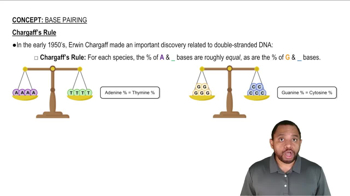
Principle stating that in DNA, the amounts of adenine and thymine are equal, as are cytosine and guanine.
Double-Stranded DNA
Molecular structure where two nucleotide chains are held together by complementary base pairing and hydrogen bonds.
Base Pair
Two nitrogenous bases from opposite strands of DNA or RNA connected by hydrogen bonds, forming the genetic code.
Stabilizing Effect
Collective contribution of multiple hydrogen bonds that strengthens the DNA or RNA molecule.
 IndietroIndietro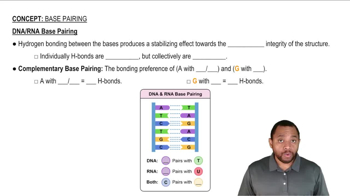
 2:56
2:56