Skip to main content
Organic Chemistry
Il mio corso
Impara
Preparazione agli esami
AI Tutor
Guide di studio
Soluzioni per libri di testo
Flashcard
Esplora
Prova l'app
Il mio corso
Impara
Preparazione agli esami
AI Tutor
Guide di studio
Soluzioni per libri di testo
Flashcard
Esplora
Prova l'app
Indietro
Base Pairing quiz #2
Puoi toccare per girare la carta.
What type of bonds hold the base pairs together?
Puoi toccare per girare la carta.
👆
What type of bonds hold the base pairs together?
Hydrogen bonds hold the base pairs together.
Avanzamenti del tracciato
I pulsanti di controllo sono stati cambiati in modalità "navigazione".
1/5
Flashcard correlate
Pratica correlata
Video consigliati
Base Pairing quiz #1
Base Pairing
40 Termini
Base Pairing definitions
Base Pairing
13 Termini
Base Pairing
34. Nucleic Acids
5 Problemi
Argomento
DNA Double Helix
34. Nucleic Acids
5 Problemi
Argomento
34. Nucleic Acids - Part 1 of 2
4 Argomenti
12 Problemi
Capitolo
34. Nucleic Acids - Part 2 of 2
3 Argomenti
9 Problemi
Capitolo
VideoThumbView.guidedCourse
2:56
Base Pairing Concept 1
647
views
VideoThumbView.guidedCourse
2:01
Base Pairing Concept 2
609
views
VideoThumbView.guidedCourse
1:46
Base Pairing Example 2
624
views
Termini in questo insieme (5)
Nascondere definizioni
What type of bonds hold the base pairs together?
Hydrogen bonds hold the base pairs together.
How many hydrogen bonds connect each base pair?
Adenine and thymine form two hydrogen bonds; cytosine and guanine form three hydrogen bonds.
Which base in an anticodon will pair with the base adenine in a codon?
Uracil (U) in the anticodon will pair with adenine (A) in the codon.
What nucleotide pairs with T? With C?
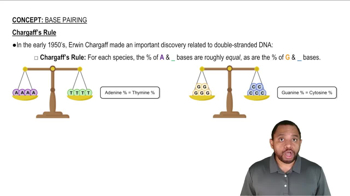
Adenine (A) pairs with thymine (T), and guanine (G) pairs with cytosine (C).
What are complementary base pairs? Give an example.
Complementary base pairs are specific pairs of nitrogenous bases that bond together, such as adenine with thymine and cytosine with guanine.
 IndietroIndietro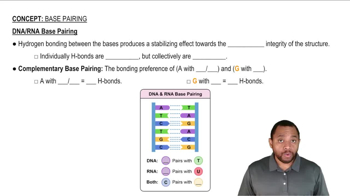
 2:56
2:56