Skip to main content
Organic Chemistry
Il mio corso
Impara
Preparazione agli esami
AI Tutor
Guide di studio
Soluzioni per libri di testo
Flashcard
Esplora
Prova l'app
Il mio corso
Impara
Preparazione agli esami
AI Tutor
Guide di studio
Soluzioni per libri di testo
Flashcard
Esplora
Prova l'app
Indietro
Curtius Rearrangement definitions
Puoi toccare per girare la carta.
Curtius Rearrangement
Puoi toccare per girare la carta.
👆
Curtius Rearrangement
A synthetic pathway converting acyl azide to primary amine, involving isocyanate and loss of a carbon atom.
Avanzamenti del tracciato
I pulsanti di controllo sono stati cambiati in modalità "navigazione".
1/15
Flashcard correlate
Pratica correlata
Video consigliati
Curtius Rearrangement quiz
Curtius Rearrangement
15 Termini
Curtius Rearrangement
26. Amines
5 Problemi
Argomento
Hofmann Rearrangement
26. Amines
5 Problemi
Argomento
23. Amines - Part 1 of 3
4 Argomenti
11 Problemi
Capitolo
Nicole
23. Amines - Part 2 of 3
5 Argomenti
13 Problemi
Capitolo
Nicole
26. Amines - Part 3 of 3
1 Argomento
3 Problemi
Capitolo
04:46
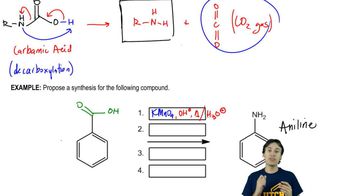
Propose a Synthesis
1001
views
4
rank
3
comments
10:14
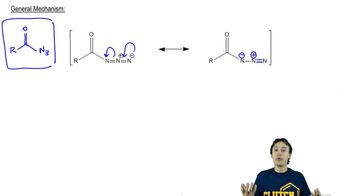
General Mechanism
1158
views
7
rank
2
comments
Termini in questo insieme (15)
Nascondere definizioni
Curtius Rearrangement
A synthetic pathway converting acyl azide to primary amine, involving isocyanate and loss of a carbon atom.
Acyl Azide
A functional group with a carbonyl, R group, and azide, serving as the starting material for the rearrangement.
Isocyanate
A reactive intermediate with a carbonyl and nitrogen, formed after rearrangement and attacked by water.
Nitrene
A highly reactive intermediate with six valence electrons, formed during decomposition of acyl azide.
Primary Amine
The target product containing an R group and two hydrogens on nitrogen, formed after decarboxylation.
Decarboxylation
A process where a carboxyl group is removed as CO2, occurring after water attacks isocyanate.
Resonance Structure
Alternative electron arrangements in acyl azide, influencing its reactivity under heat.
N2 Gas
A highly stable diatomic molecule released during decomposition, making the reaction thermodynamically favorable.
CO2 Gas
A greenhouse gas liberated during decarboxylation, marking the loss of a carbon atom.
Carbamic Acid
An unstable intermediate formed after water addition to isocyanate, which spontaneously decarboxylates.
Functional Group
A specific group of atoms within molecules, such as acyl azide, that determines chemical reactivity.
Rearrangement
A process where atoms within a molecule shift positions, crucial for transforming acyl azide to isocyanate.
Synthetic Application
The practical use of a reaction, such as forming primary amines while removing a carbon atom.
Nucleophilic Attack
A step where water targets the electrophilic carbon in isocyanate, initiating decarboxylation.
Electrophilic Aromatic Substitution
A reaction type referenced for comparison, not directly involved but related to aniline synthesis.
 IndietroIndietro
 04:46
04:46