Skip to main content
Organic Chemistry
Il mio corso
Impara
Preparazione agli esami
AI Tutor
Guide di studio
Soluzioni per libri di testo
Flashcard
Esplora
Prova l'app
Il mio corso
Impara
Preparazione agli esami
AI Tutor
Guide di studio
Soluzioni per libri di testo
Flashcard
Esplora
Prova l'app
Indietro
Curtius Rearrangement quiz
Puoi toccare per girare la carta.
What is the Curtius rearrangement also known as?
Puoi toccare per girare la carta.
👆
What is the Curtius rearrangement also known as?
It is also known as the reduction of acyl azide.
Avanzamenti del tracciato
I pulsanti di controllo sono stati cambiati in modalità "navigazione".
1/15
Flashcard correlate
Pratica correlata
Video consigliati
Curtius Rearrangement definitions
Curtius Rearrangement
15 Termini
Curtius Rearrangement
26. Amines
5 Problemi
Argomento
Hofmann Rearrangement
26. Amines
5 Problemi
Argomento
23. Amines - Part 1 of 3
4 Argomenti
11 Problemi
Capitolo
Nicole
23. Amines - Part 2 of 3
5 Argomenti
13 Problemi
Capitolo
Nicole
26. Amines - Part 3 of 3
1 Argomento
3 Problemi
Capitolo
04:46
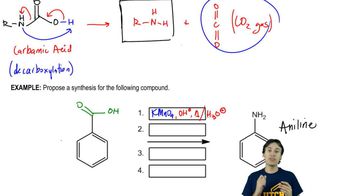
Propose a Synthesis
1001
views
4
rank
3
comments
10:14
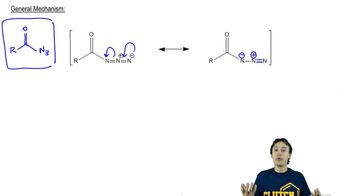
General Mechanism
1158
views
7
rank
2
comments
Termini in questo insieme (15)
Nascondere definizioni
What is the Curtius rearrangement also known as?
It is also known as the reduction of acyl azide.
What are the two reagents required for the Curtius rearrangement?
The reaction requires only heat and water.
What is the starting material for the Curtius rearrangement?
The starting material is an acyl azide.
What is the main organic product of the Curtius rearrangement?
The main product is a primary amine.
What key intermediate is formed during the Curtius rearrangement after heating?
An isocyanate intermediate is formed after heating.
What highly reactive intermediate is generated during the mechanism?
A nitrene intermediate is generated, which is highly reactive due to an incomplete octet.
What gases are released during the Curtius rearrangement?
CO2 and N2 gases are released.
What is the role of water in the Curtius rearrangement?
Water attacks the isocyanate carbon, leading to decarboxylation and formation of the primary amine.
What is the resonance structure of the azide group important for in this reaction?
It helps explain the stability of N2 gas and why the reaction proceeds under heat.
What is the significance of the nitrene intermediate in the Curtius rearrangement?
The nitrene is highly reactive and rearranges to form the isocyanate.
What is the structure called that forms after water attacks the isocyanate?
It forms carbamic acid, which is unstable and decarboxylates.
Why is N2 gas considered highly stable in this reaction?
N2 gas is highly stable because it makes up 78% of the atmosphere and is unreactive.
What happens to the carbonyl group during the Curtius rearrangement?
The carbonyl group is lost as CO2 gas during decarboxylation.
Why might a chemist use the Curtius rearrangement in synthesis?
It is used to synthesize a primary amine while losing a carbon atom from the starting material.
What is the final step in the Curtius rearrangement mechanism?
The final step is decarboxylation of carbamic acid to yield a primary amine and CO2 gas.
 IndietroIndietro
 04:46
04:46