Skip to main content
Organic Chemistry
Il mio corso
Impara
Preparazione agli esami
AI Tutor
Guide di studio
Soluzioni per libri di testo
Flashcard
Esplora
Prova l'app
Il mio corso
Impara
Preparazione agli esami
AI Tutor
Guide di studio
Soluzioni per libri di testo
Flashcard
Esplora
Prova l'app
Indietro
POCl3 Dehydration definitions
Puoi toccare per girare la carta.
Phosphoryl Chloride
Puoi toccare per girare la carta.
👆
Phosphoryl Chloride
A highly electrophilic reagent with strong partial positive phosphorus, used to activate alcohols for elimination.
Avanzamenti del tracciato
I pulsanti di controllo sono stati cambiati in modalità "navigazione".
1/15
Flashcard correlate
Pratica correlata
Video consigliati
POCl3 Dehydration quiz
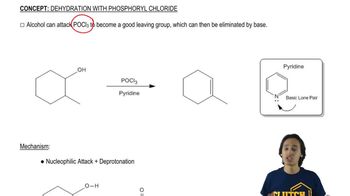
Dehydration with Phosphoryl Chloride
15 Termini
POCl3 Dehydration
9. Alkenes and Alkynes
1 problema
Argomento
Ernest
Alkynide Synthesis
9. Alkenes and Alkynes
7 Problemi
Argomento
Johnny
9. Alkenes and Alkynes - Part 1 of 2
5 Argomenti
11 Problemi
Capitolo
Ernest
9. Alkenes and Alkynes - Part 2 of 2
5 Argomenti
11 Problemi
Capitolo
Johnny
04:52
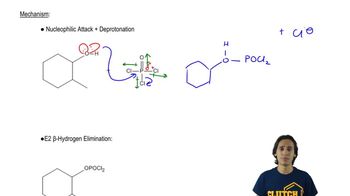
Mechanism of Dehydration with POCl3
2915
views
14
rank
6
comments
01:23
General Reaction of Dehydration with POCl3
2396
views
9
rank
Termini in questo insieme (15)
Nascondere definizioni
Phosphoryl Chloride
A highly electrophilic reagent with strong partial positive phosphorus, used to activate alcohols for elimination.
Pyridine
A nitrogen-containing aromatic base that facilitates deprotonation and promotes elimination without acid.
Dehydration
A process that removes water from alcohols, converting them into alkenes via elimination.
Zaitsev Product
The most substituted alkene formed preferentially during elimination, following regioselectivity rules.
Leaving Group
An atom or group that departs with an electron pair, enabling the formation of a double bond in elimination.
E2 Elimination
A concerted mechanism where a base removes a proton as a leaving group exits, forming a double bond.
Nucleophilic Attack
An electron-rich species donates a pair to an electron-deficient center, initiating a reaction.
Electrophile
A species with a partial positive charge that attracts nucleophiles, such as phosphorus in POCl3.
Beta Carbon
A carbon atom adjacent to the one bearing the leaving group, from which a proton is abstracted in elimination.
Regioselectivity
A preference for forming one constitutional isomer over another, as seen in Zaitsev’s rule.
Acid Sensitivity
A property of molecules that decompose or react undesirably in acidic conditions, necessitating alternative reagents.
Double Bond
A pair of shared electron pairs between two atoms, characteristic of alkenes formed in dehydration.
Conjugate Base
A species formed after an acid donates a proton, such as chloride after leaving in the reaction.
Formal Charge
A calculated charge on an atom in a molecule, indicating electron distribution after bonding changes.
Substitution
The degree to which carbons attached to a double bond are replaced by other carbon groups, influencing product stability.
 IndietroIndietro

 04:52
04:52