Skip to main content
Organic Chemistry
Il mio corso
Impara
Preparazione agli esami
AI Tutor
Guide di studio
Soluzioni per libri di testo
Flashcard
Esplora
Prova l'app
Il mio corso
Impara
Preparazione agli esami
AI Tutor
Guide di studio
Soluzioni per libri di testo
Flashcard
Esplora
Prova l'app
Indietro
POCl3 Dehydration quiz
Puoi toccare per girare la carta.
What is the main advantage of using POCl3 and pyridine for alcohol dehydration instead of acid?
Puoi toccare per girare la carta.
👆
What is the main advantage of using POCl3 and pyridine for alcohol dehydration instead of acid?
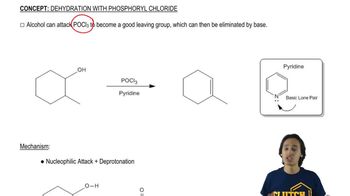
POCl3 and pyridine allow dehydration without acid, which is useful for acid-sensitive molecules that might decompose in acidic conditions.
Avanzamenti del tracciato
I pulsanti di controllo sono stati cambiati in modalità "navigazione".
1/15
Flashcard correlate
Pratica correlata
Video consigliati
POCl3 Dehydration definitions
Dehydration with Phosphoryl Chloride
15 Termini
POCl3 Dehydration
9. Alkenes and Alkynes
1 problema
Argomento
Ernest
Alkynide Synthesis
9. Alkenes and Alkynes
7 Problemi
Argomento
Johnny
9. Alkenes and Alkynes - Part 1 of 2
5 Argomenti
11 Problemi
Capitolo
Ernest
9. Alkenes and Alkynes - Part 2 of 2
5 Argomenti
11 Problemi
Capitolo
Johnny
04:52
Mechanism of Dehydration with POCl3
2911
views
14
rank
6
comments
01:23
General Reaction of Dehydration with POCl3
2395
views
9
rank
Termini in questo insieme (15)
Nascondere definizioni
What is the main advantage of using POCl3 and pyridine for alcohol dehydration instead of acid?
POCl3 and pyridine allow dehydration without acid, which is useful for acid-sensitive molecules that might decompose in acidic conditions.
What type of reaction does POCl3 and pyridine perform on alcohols?
They perform an elimination reaction, converting alcohols into alkenes.
Which alkene product is favored in POCl3/pyridine dehydration reactions?
The Zaitsev product, which is the most substituted alkene, is favored.
What role does pyridine play in the POCl3 dehydration mechanism?
Pyridine acts as a base, facilitating deprotonation and the E2 elimination step.
Why is the oxygen in alcohol considered nucleophilic in this reaction?
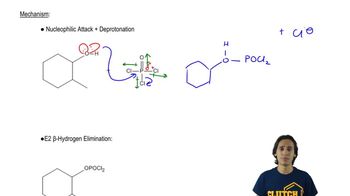
Because it has two lone pairs that can attack the electrophilic phosphorus in POCl3.
What makes the phosphorus atom in POCl3 highly electrophilic?
The three chlorine atoms pull electron density away, giving phosphorus a strong partial positive charge.
What happens to one of the chlorine atoms in POCl3 during the reaction?
It leaves as a chloride ion, making room for the alcohol to attach to the phosphorus.
How does the leaving group ability of the alcohol change after reaction with POCl3?
The alcohol's oxygen becomes part of a much better leaving group (OPOCl2), facilitating elimination.
What is the first step in the POCl3 dehydration mechanism?
The alcohol's oxygen attacks the electrophilic phosphorus atom in POCl3.
How many equivalents of pyridine are used in the full dehydration mechanism?
Two equivalents: one for deprotonation after the alcohol attacks POCl3, and one for the E2 elimination.
What type of elimination mechanism occurs in the final step of POCl3 dehydration?
An E2 β-elimination occurs, forming the double bond.
How does the reaction ensure formation of the Zaitsev product?
The base (pyridine) abstracts a proton from the β-carbon that leads to the most substituted (Zaitsev) alkene.
What is the structure of pyridine?
Pyridine is a benzene ring with one nitrogen atom replacing a CH group.
Why are Cl atoms in POCl3 considered good leaving groups?
Chloride ions are stable as conjugate bases, making them excellent leaving groups.
What is the main organic product of the POCl3/pyridine dehydration of an alcohol?
The main product is an alkene, specifically the most substituted one according to Zaitsev's rule.
 IndietroIndietro

 04:52
04:52