Skip to main content
Organic Chemistry
Il mio corso
Impara
Preparazione agli esami
AI Tutor
Guide di studio
Soluzioni per libri di testo
Flashcard
Esplora
Prova l'app
Il mio corso
Impara
Preparazione agli esami
AI Tutor
Guide di studio
Soluzioni per libri di testo
Flashcard
Esplora
Prova l'app
Indietro
Substitution Comparison definitions
Puoi toccare per girare la carta.
SN1 Mechanism
Puoi toccare per girare la carta.
👆
SN1 Mechanism
A pathway where a carbocation intermediate forms before nucleophilic attack, favored by weak nucleophiles and stable tertiary alkyl halides.
Avanzamenti del tracciato
I pulsanti di controllo sono stati cambiati in modalità "navigazione".
1/14
Flashcard correlate
Pratica correlata
Video consigliati
Substitution Comparison quiz
Substitution Comparison
15 Termini
Substitution Comparison
7. Substitution Reactions
7 Problemi
Argomento
Ernest
SN1 Reaction
7. Substitution Reactions
7 Problemi
Argomento
Ernest
7. Substitution Reactions
5 Argomenti
15 Problemi
Capitolo
Johnny
03:32
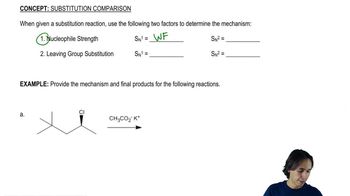
How do we predict if the mechanism is SN1 or SN2?
5068
views
43
rank
5
comments
Termini in questo insieme (14)
Nascondere definizioni
SN1 Mechanism
A pathway where a carbocation intermediate forms before nucleophilic attack, favored by weak nucleophiles and stable tertiary alkyl halides.
SN2 Mechanism
A concerted substitution process involving a backside attack by a strong nucleophile, best with methyl or primary alkyl halides.
Nucleophile Strength
A measure of how readily a species donates electrons to form a new bond, influencing which substitution mechanism occurs.
Leaving Group
An atom or group that departs with a pair of electrons during substitution, affecting reaction rate and pathway.
Backside Attack
A direct approach of a nucleophile opposite the leaving group, essential for the SN2 mechanism.
Carbocation
A positively charged carbon intermediate, whose stability determines the feasibility of the SN1 pathway.
Tertiary Alkyl Halide
A carbon bonded to three other carbons and a halogen, highly stable for carbocation formation in SN1 reactions.
Primary Alkyl Halide
A carbon bonded to one other carbon and a halogen, favoring SN2 reactions due to minimal steric hindrance.
Secondary Alkyl Halide
A carbon bonded to two other carbons and a halogen, showing intermediate reactivity in both SN1 and SN2 mechanisms.
Methyl Group
A single carbon attached to three hydrogens, offering the least steric hindrance and best suited for SN2 reactions.
Steric Hindrance
The crowding around a reactive center that impedes nucleophilic attack, especially relevant in SN2 reactions.
Degree of Substitution
The classification of a carbon based on the number of attached alkyl groups, influencing substitution mechanism preference.
Reaction Mechanism
A stepwise description of how reactants convert to products, crucial for predicting substitution outcomes.
Product Prediction
The process of determining the final compounds formed based on the chosen substitution pathway and reactants.
 IndietroIndietro

 03:32
03:32