Skip to main content
Organic Chemistry
Il mio corso
Impara
Preparazione agli esami
AI Tutor
Guide di studio
Soluzioni per libri di testo
Flashcard
Esplora
Prova l'app
Il mio corso
Impara
Preparazione agli esami
AI Tutor
Guide di studio
Soluzioni per libri di testo
Flashcard
Esplora
Prova l'app
Indietro
Substitution Comparison quiz
Puoi toccare per girare la carta.
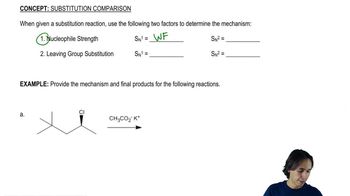
What are the two main variables to consider when choosing between SN1 and SN2 mechanisms?
Puoi toccare per girare la carta.
👆
What are the two main variables to consider when choosing between SN1 and SN2 mechanisms?
The two main variables are nucleophile strength and leaving group substitution (degree of alkyl halide).
Avanzamenti del tracciato
I pulsanti di controllo sono stati cambiati in modalità "navigazione".
1/15
Flashcard correlate
Pratica correlata
Video consigliati
Substitution Comparison definitions
Substitution Comparison
14 Termini
Substitution Comparison
7. Substitution Reactions
7 Problemi
Argomento
Ernest
SN1 Reaction
7. Substitution Reactions
7 Problemi
Argomento
Ernest
7. Substitution Reactions
5 Argomenti
15 Problemi
Capitolo
Johnny
03:32
How do we predict if the mechanism is SN1 or SN2?
5070
views
43
rank
5
comments
Termini in questo insieme (15)
Nascondere definizioni
What are the two main variables to consider when choosing between SN1 and SN2 mechanisms?
The two main variables are nucleophile strength and leaving group substitution (degree of alkyl halide).
What type of nucleophile is favored in an SN1 reaction?
A weak nucleophile is favored in SN1 reactions because it waits for the carbocation to form.
Why are weak nucleophiles favored in SN1 reactions?
Weak nucleophiles are favored because they do not initiate the reaction but wait for the carbocation intermediate to form.
What type of nucleophile is favored in an SN2 reaction?
A strong nucleophile is favored in SN2 reactions because it performs a backside attack.
Why are strong nucleophiles favored in SN2 reactions?
Strong nucleophiles are needed for SN2 because they directly attack the substrate in a single step.
Which degree of alkyl halide is most stable for SN1 reactions?
Tertiary alkyl halides are the most stable for SN1 reactions due to their ability to form stable carbocations.
What is the order of alkyl halide stability for SN1 reactions?
The order is tertiary > secondary > primary, with tertiary being the most stable.
Which degree of alkyl halide is most favored for SN2 reactions?
Methyl and primary alkyl halides are most favored for SN2 reactions.
Why are tertiary alkyl halides not favored in SN2 reactions?
Tertiary alkyl halides are not favored because steric hindrance prevents effective backside attack.
Why do primary and methyl alkyl halides not undergo SN1 reactions?
They do not form stable carbocations, making SN1 reactions unfavorable for them.
What is the trend for leaving group substitution in SN2 reactions?
The trend is methyl > primary > secondary > tertiary, with methyl being the most favored.
What is the main reason tertiary alkyl halides are poor substrates for SN2?
They have a 'bad backside' due to steric hindrance, making backside attack difficult.
What is the main reason primary and methyl alkyl halides are poor substrates for SN1?
They are 'bad carbocations' because they cannot stabilize the positive charge well.
What should you do when given a substitution reaction to solve?
Determine the mechanism (SN1 or SN2) using nucleophile strength and alkyl halide degree, then draw the product.
How does the complexity of choosing between SN1 and SN2 change when elimination reactions are introduced?
It becomes more complicated, but for now, only nucleophile strength and leaving group substitution are considered.
 IndietroIndietro

 03:32
03:32