 Indietro
Acids and Bases in Organic Chemistry: Concepts, Mechanisms, and Applications
Guida di studio - Note intelligenti
 Appunti personalizzati basati sui tuoi materiali, ampliati con definizioni chiave, esempi e contesto.
Acids and Bases
Arrhenius and Brønsted-Lowry Definitions
Acids and bases are fundamental concepts in organic chemistry, with several definitions used to describe their behavior in aqueous and non-aqueous environments.
Arrhenius Acid: A substance that ionizes in water to produce H+ ions.
Arrhenius Base: A substance that ionizes in water to produce OH- ions.
Brønsted-Lowry Acid: A proton (H+) donor.
Brønsted-Lowry Base: A proton (H+) acceptor.
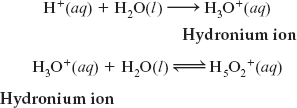
H+ and H3O+ are used synonymously in aqueous solution, as the proton associates with water to form the hydronium ion.
Conjugate Acid-Base Pairs
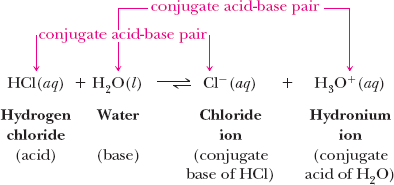
When an acid donates a proton, it forms its conjugate base; when a base accepts a proton, it forms its conjugate acid. Acid-base reactions always involve two conjugate acid-base pairs.
Conjugate acid-base pairs differ by one proton.
Example: HCl (acid) + H2O (base) ↔ Cl- (conjugate base) + H3O+ (conjugate acid).
Curved Arrow Notation and Electron Flow
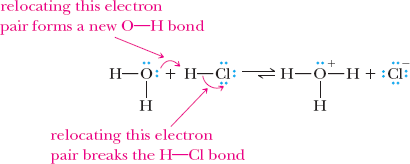
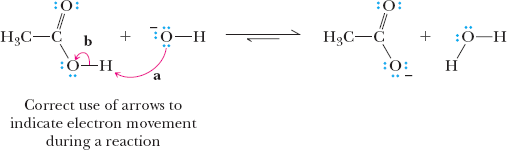
Curved arrows are used to show the movement of electron pairs during acid-base reactions. The tail of the arrow starts at the electron source (lone pair or bond), and the head points to where the electrons are moving.
Correct use of arrows is essential for depicting mechanisms.
Example: Proton transfer from HCl to water, showing electron flow.
Mechanistic Representation of Proton Transfer
Mechanisms illustrate the stepwise movement of electrons in acid-base reactions. Proper arrow placement is crucial for clarity.
Arrows indicate which bonds are being formed and broken.
Electron-rich sites (nucleophiles) attack electron-poor sites (electrophiles).
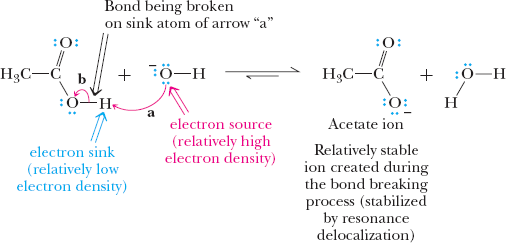
Examples of Acid-Base Reactions and Conjugate Pairs
Identifying acids, bases, and their conjugates is a key skill. Lewis structures and electron flow should be shown for clarity.
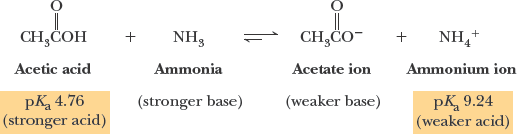
Example: CH3COOH (acid) + NH3 (base) ↔ CH3COO- (conjugate base) + NH4+ (conjugate acid).
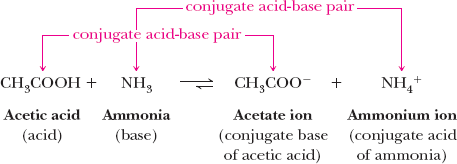
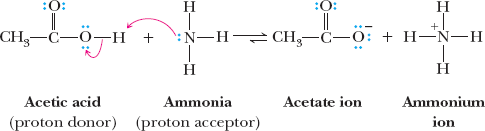
Resonance and Delocalization in Acid-Base Chemistry
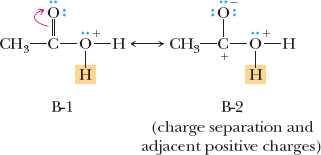
Resonance Structures and Protonation Sites
Organic molecules with multiple proton acceptor sites require resonance analysis to determine the most favorable site for protonation. The site with greater charge delocalization is generally preferred.
Resonance structures distribute charge, stabilizing the conjugate base or acid.
Protonation typically occurs at the atom where the resulting positive charge is most stabilized by resonance.
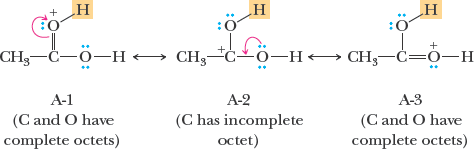
π Electrons as Brønsted-Lowry Bases
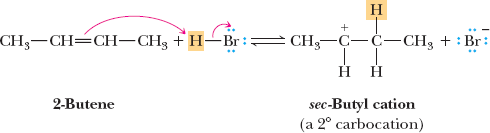
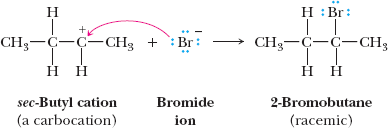
π electrons in double and triple bonds can act as bases, accepting protons from strong acids to form carbocations. The stability of the resulting carbocation influences the reaction pathway.
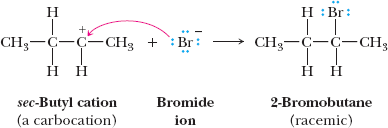
Example: 2-butene reacts with HBr to form a secondary (sec-butyl) carbocation.
Acid Strength, pKa, and Equilibrium
Acid Dissociation Constants and pKa
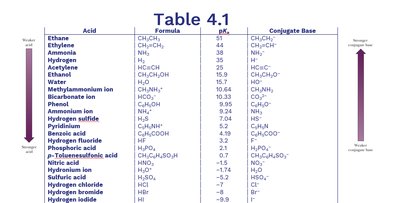
The strength of an acid is quantified by its acid dissociation constant (Ka) and its logarithmic counterpart, pKa. Lower pKa values indicate stronger acids.
Each unit change in pKa represents a tenfold change in acid strength.
Predicting Acid-Base Equilibria
In acid-base reactions, equilibrium favors the formation of the weaker acid and weaker base. The position of equilibrium can be predicted using pKa values.
Equilibrium constant:
Thermodynamics and Mechanisms of Acid-Base Reactions
Reaction Coordinate Diagrams and Gibbs Free Energy
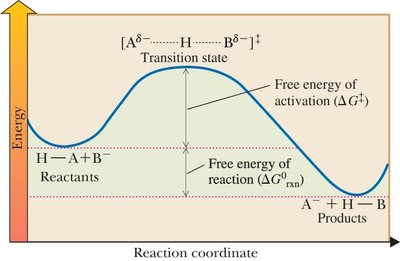
Thermodynamics describes the energy changes during a reaction. The reaction coordinate diagram shows the energy profile, including the transition state and the free energy of activation (ΔG‡).
Standard Gibbs free energy change:
R = 8.31 J/(mol·K)
At equilibrium, the system favors the lowest energy (most stable) products.
Factors Affecting Acidity and Basicity
Electronegativity and Periodic Trends
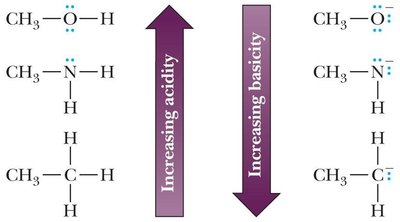
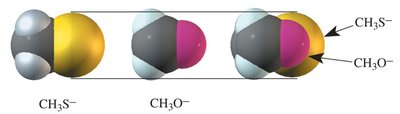
The stability of the conjugate base (and thus the acidity of the acid) is influenced by the electronegativity and size of the atom bearing the negative charge.
Greater electronegativity stabilizes negative charge.
Larger atoms (down a group) better delocalize negative charge, increasing acidity.
Delocalization and Resonance Stabilization
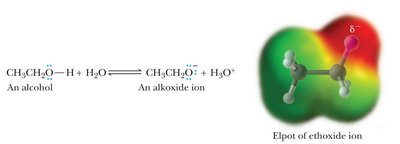
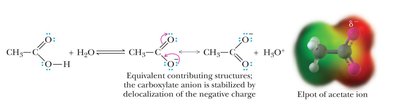
Delocalization of negative charge through resonance increases the stability of the conjugate base, making the parent acid stronger.
Carboxylic acids (pKa ≈ 4-5) are much more acidic than alcohols (pKa ≈ 15-18) due to resonance stabilization of the carboxylate anion.
Inductive Effects
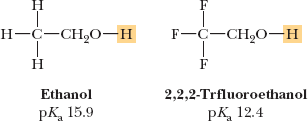
Electronegative atoms near the acidic proton withdraw electron density, stabilizing the conjugate base and increasing acidity. The effect diminishes with distance from the acidic site.
Example: 2,2,2-Trifluoroethanol is more acidic than ethanol due to the electron-withdrawing effect of fluorine atoms.
Hybridization and s Character
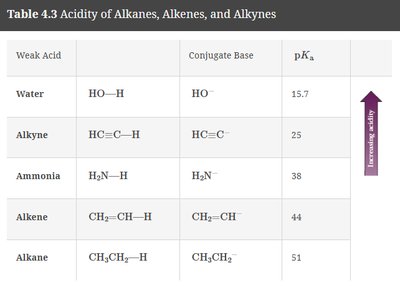
The more s character in the orbital holding the negative charge, the closer the electrons are to the nucleus, increasing acidity. Thus, sp-hybridized carbons (alkynes) are more acidic than sp2 (alkenes) or sp3 (alkanes).
Weak Acid | Conjugate Base | pKa |
|---|---|---|
Water | HO- | 15.7 |
Alkyne | HC≡C- | 25 |
Ammonia | H2N- | 38 |
Alkene | CH2=CH- | 44 |
Alkane | CH3CH2- | 51 |
Lewis Acids and Bases
Lewis Acid-Base Theory
The Lewis definition broadens the concept of acids and bases. A Lewis acid accepts an electron pair, while a Lewis base donates an electron pair. All Brønsted-Lowry acids and bases are also Lewis acids and bases, but not vice versa.
Lewis acids can be electron-deficient species (e.g., BF3).
Lewis bases are electron-rich species (nucleophiles).
Electrophiles are electron-poor species that seek electrons.
Examples of Lewis Acid-Base Reactions
Lewis acid-base reactions are depicted with curved arrows showing electron pair donation from the base to the acid.
Example: BF3 + NH3 → adduct formation via electron pair donation from NH3 to BF3.
Additional info: This guide covers the core concepts of acids and bases in organic chemistry, including mechanistic details, resonance, inductive effects, and the relationship between structure and acidity/basicity. It is suitable for exam preparation and foundational understanding in college-level organic chemistry.
