 Indietro
Acids and Bases in Organic Chemistry: Mechanisms, Structure, and Biological Context
Guida di studio - Note intelligenti
 Appunti personalizzati basati sui tuoi materiali, ampliati con definizioni chiave, esempi e contesto.
Chapter 3: Acids and Bases
3.1 Introduction to Brønsted-Lowry Acids and Bases
Acids and bases are fundamental to organic chemistry, influencing reactivity, mechanisms, and molecular structure. The Brønsted-Lowry definition classifies acids as proton donors and bases as proton acceptors. In any acid-base reaction, the direction of proton transfer determines which species acts as the acid or base.
Brønsted acid: A substance that donates a proton (H+).
Brønsted base: A substance that accepts a proton.
Conjugate acid-base pair: Two species that differ by a single proton.
Conjugate acid: The species formed when a base gains a proton.
Conjugate base: The species formed when an acid loses a proton.
Example: In the reaction of ammonia with water, NH3 acts as a base (accepts H+), and H2O acts as an acid (donates H+).
3.2 Curved Arrow Notation and Mechanisms
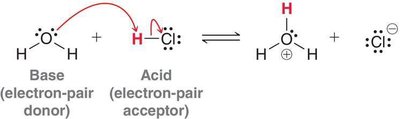
Curved arrow notation is used to depict the movement of electron pairs during chemical reactions, especially in acid-base mechanisms. The tail of the arrow starts at the electron source (lone pair or bond), and the head points to where the electrons are moving.
Mechanism: Shows the stepwise movement of electrons in bond formation and breaking.
In proton transfer, the base uses its lone pair to form a bond with a proton, while the bond between the proton and the acid breaks, transferring electrons to the acid.

Learning Goal: Apply curved arrow notation to acid-base reaction mechanisms.
3.3 Acidity: pKa and Acid Strength
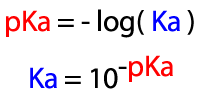
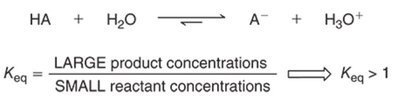
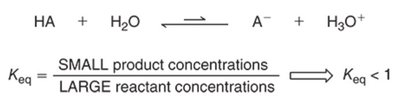
The strength of an acid is quantified by its acid dissociation constant (Ka) and its logarithmic counterpart, pKa. The lower the pKa, the stronger the acid. The equilibrium constant (Keq) for acid dissociation indicates whether products or reactants are favored.
Ka > 1: Product-favored (strong acid).
Ka < 1: Reactant-favored (weak acid).
pKa:
Ka:
Example: HCl (pKa = -7) is a much stronger acid than acetic acid (pKa = 5).
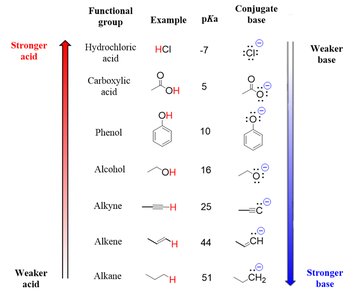
3.4 Factors Affecting Acidity and Base Stability (ARIO/CARIO)
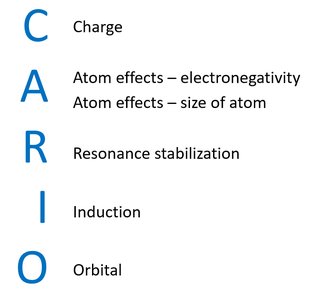
The stability of conjugate bases (and thus acid strength) is determined by several structural factors, summarized by the acronym CARIO:
Charge: Negative charge is less stable than neutral; more stable conjugate base means stronger acid.
Atom: Electronegativity (across a period) and size (down a group) affect stability.
Resonance: Delocalization of charge stabilizes the conjugate base.
Induction: Electron-withdrawing groups stabilize negative charge by induction.
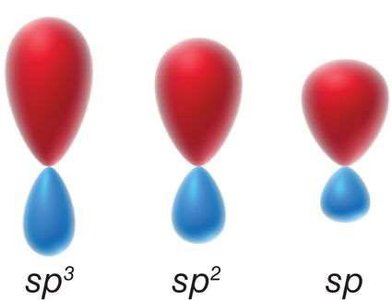
Orbital: Greater s-character (sp > sp2 > sp3) stabilizes lone pairs.
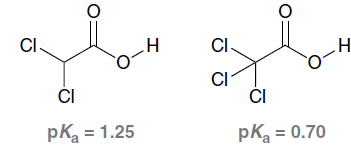
Inductive Effects
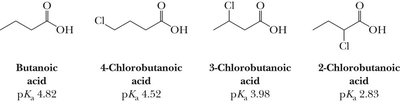
Inductive effects are additive and decrease with distance from the charged center. Electron-withdrawing groups (like Cl) stabilize the conjugate base, lowering the pKa and increasing acidity.
Orbital Hybridization
Orbitals with more s-character hold electrons closer to the nucleus, stabilizing negative charge. Thus, acidity increases in the order: alkane < alkene < alkyne.
Weak Acid | Conjugate Base | pKa | s-character |
|---|---|---|---|
HC≡CH | HC≡C− | 25 | sp (50%) |
CH2=CH2 | CH2=CH− | 44 | sp2 (33%) |
CH3CH2H | CH3CH2− | 51 | sp3 (25%) |
3.5 Acidity: Stability of Cations
For cationic acids, stability is often determined by the ability to delocalize or stabilize the positive charge. Resonance, inductive effects, and atom identity are key factors.
3.6 Position of Equilibrium and Choice of Reagents
The position of equilibrium in acid-base reactions is determined by the relative strengths of acids and bases. The equilibrium favors the formation of the weaker acid and base (more stable species). The equilibrium constant (Keq) can be estimated using pKa values:
If the acid on the left is stronger (lower pKa), equilibrium favors products (Keq > 1).
If the acid on the right is stronger, equilibrium favors reactants (Keq < 1).
3.7 Leveling Effect
The leveling effect states that the strongest acid or base that can exist in a given solvent is the conjugate acid or base of the solvent itself. For example, in water, any base stronger than hydroxide (OH−) will simply deprotonate water to form OH−.
3.8 Solvating Effects
Solvation stabilizes ions in solution. The ability of a solvent to stabilize the conjugate base affects the observed acidity (pKa) of a compound. More effective solvation leads to greater acid strength.
3.9 Counterions
In acid-base reactions involving ionic compounds, counterions (spectator ions) are present to balance charge but do not participate in the reaction mechanism. They are often omitted from mechanistic drawings for clarity.
3.10 Lewis Acids and Bases
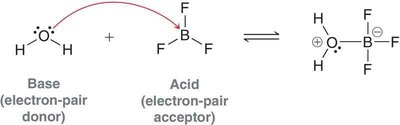
Lewis acids and bases are defined by their ability to accept or donate electron pairs, respectively. This definition expands the concept of acids and bases beyond proton transfer.
Lewis acid: Electron pair acceptor (often an electrophile).
Lewis base: Electron pair donor (often a nucleophile).
3.11 Acids and Bases in Living Systems
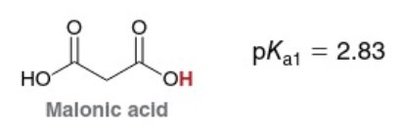
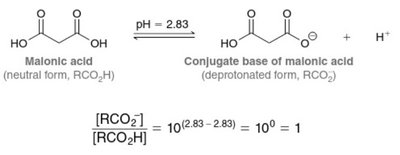
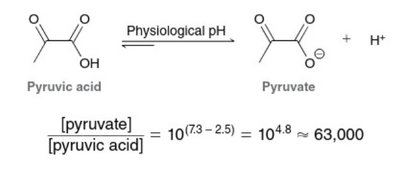
Biological systems maintain a tightly regulated pH, affecting the protonation state of functional groups. The Henderson-Hasselbalch equation relates pH, pKa, and the ratio of conjugate base to acid:
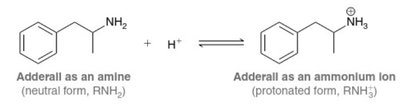
At physiological pH (7.3):
Carboxylic acids are primarily in their conjugate base form (deprotonated).
Amines are primarily in their conjugate acid form (protonated).
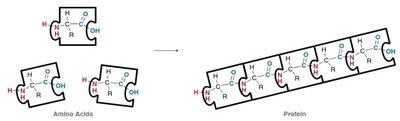
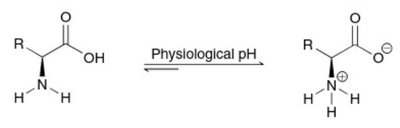
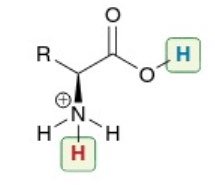
Example: At physiological pH, amino acids exist as zwitterions, with the carboxyl group deprotonated and the amino group protonated.
Additional info: The principles of acid-base chemistry are essential for understanding organic reactivity, biological function, and the design of synthetic pathways. Mastery of pKa values, ARIO/CARIO factors, and mechanistic reasoning is foundational for success in organic chemistry.
