 Indietro
Arrow Pushing and Reaction Mechanisms in Organic Chemistry
Guida di studio - Note intelligenti
 Appunti personalizzati basati sui tuoi materiali, ampliati con definizioni chiave, esempi e contesto.
Arrow Pushing and Reaction Mechanisms
Introduction to Arrow Pushing
Arrow pushing is a fundamental tool in organic chemistry for depicting the movement of electrons during chemical reactions. It allows chemists to visualize and rationalize the stepwise transformation of reactants into products by showing how bonds are broken and formed.
Understanding Reaction Mechanisms
Energy Profiles and Reaction Coordinates
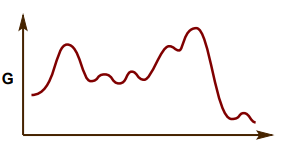
Reaction mechanisms are best understood by considering the energy changes that occur as reactants are converted to products. The reaction coordinate diagram illustrates the energy profile of a reaction, showing the relative energies of intermediates and transition states along the reaction pathway.
Transition States: Peaks in the diagram represent high-energy transition states.
Intermediates: Valleys between peaks correspond to reaction intermediates.
Factors Influencing Organic Reactions
Non-Bonding and Covalent Interactions
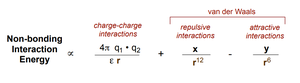
Organic reactions are influenced by several types of interactions, including non-bonding (non-covalent) and covalent interactions. Non-bonding interactions can be described by equations that account for charge-charge, repulsive, and attractive (van der Waals) forces.
Coulombic Interactions: Attraction between opposite charges and repulsion between like charges.
Steric Effects: Repulsion due to the spatial arrangement of atoms.
Orbital Interactions: Stabilization or destabilization due to overlap of molecular orbitals.
The Salem-Klopman Equation
The Salem-Klopman equation provides a more comprehensive description of interaction energy in organic reactions, incorporating electron densities, charges, and molecular orbital interactions.
First Term: Electron density and resonance/overlap integrals.
Second Term: Charge interactions and distance dependence.
Third Term: Molecular orbital coefficients and energy differences.

Principles of Arrow Pushing
Depicting Electron Flow
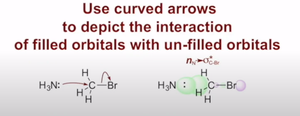
Curved arrows are used to depict the movement of electron pairs from filled orbitals (lone pairs or bonds) to unfilled orbitals (atoms or bonds). This is essential for illustrating the third term in the Salem-Klopman equation, which involves molecular orbital interactions.
Filled Orbitals: Lone pairs, π bonds, and σ bonds.
Unfilled Orbitals: Empty p orbitals, π* and σ* orbitals.
Rules for Drawing Curved Arrows
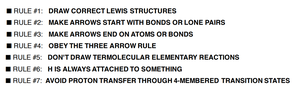
To ensure clarity and accuracy, several rules must be followed when drawing curved arrows in reaction mechanisms:
Rule #1: Draw correct Lewis structures, showing all atoms, charges, and lone pairs.
Rule #2: Arrows must start from bonds or lone pairs, not from charges or atoms.
Rule #3: Arrows must end on atoms or bonds, not in empty space.
Rule #4: Do not use more than three arrows in a single step (the three-arrow rule).
Rule #5: Avoid termolecular elementary reactions; break them into bimolecular steps.
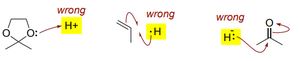
Rule #6: Hydrogen is always attached to something; do not depict free H+, H-, or H• in solution.
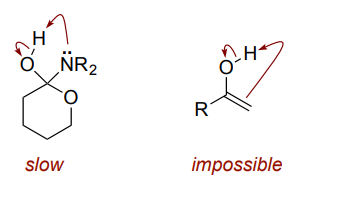
Rule #7: Avoid proton transfer through four-membered transition states; use acid/base catalysis instead.
Correct Use of Curved Arrows
Proper arrow placement is crucial for accurately depicting mechanisms. Arrows should originate from electron-rich sources (lone pairs or bonds) and terminate at electron-deficient sites (atoms or bonds).
Correct: Arrow starts from a bond or lone pair.
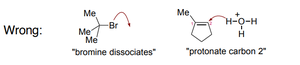
Incorrect: Arrow starts from a charge or atom.

Examples of Arrow Pushing
Below are examples illustrating correct and incorrect arrow pushing in organic mechanisms:
Example 1: Hydroxide attacking a carbonyl carbon via lone pair electrons.
Example 2: Bromine leaving as a result of electron flow from the C-Br bond, not from the atom itself.
Three-Arrow Rule and Resonance Structures
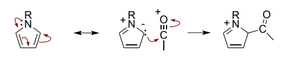
When more than three electron movements are required, break the mechanism into multiple steps or use resonance structures to simplify the depiction.
Resonance Structures: Used to distribute electron movement over several steps, maintaining clarity.
Termolecular Reactions
Termolecular reactions (involving three molecules colliding simultaneously) are extremely rare and should not be depicted as a single step. Instead, break them into sequential bimolecular steps.

Depicting Hydrogen in Mechanisms
Hydrogen atoms are always attached to another atom in solution. Avoid depicting free protons (H+), hydrides (H-), or hydrogen atoms (H•) as independent species in solution-phase mechanisms.
Symbolic Acids and Bases
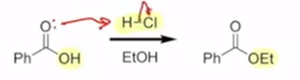
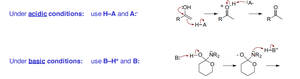
When the identity of the acid or base is ambiguous, use symbolic representations (HA for acid, A- for conjugate base) to generalize the mechanism. This is especially useful in complex equilibria or catalytic cycles.
Proton Transfer and Transition States
Proton transfers involving four-membered ring transition states are typically slow or impossible. Instead, use acid or base catalysis to facilitate proton transfer via more favorable transition states.
Mechanistic Steps Under Acidic and Basic Conditions
When writing mechanisms, first determine whether the conditions are acidic or basic. Use symbolic acids (H–A) and bases (B:) accordingly, and do not mix representations within a single mechanism.
Summary Table: Rules for Drawing Curved Arrows
Rule | Description |
|---|---|
1 | Draw correct Lewis structures |
2 | Make arrows start with bonds or lone pairs |
3 | Make arrows end on atoms or bonds |
4 | Obey the three-arrow rule |
5 | Don't draw termolecular elementary reactions |
6 | H is always attached to something |
7 | Avoid proton transfer through 4-membered transition states |
Conclusion
Mastering arrow pushing and understanding the principles behind reaction mechanisms are essential skills in organic chemistry. By following the established rules and considering the underlying physical organic principles, students can accurately depict and rationalize a wide variety of organic transformations.
