 Indietro
Chapter 1: Electronic Structure and Bonding in Organic Molecules
Guida di studio - Note intelligenti
 Appunti personalizzati basati sui tuoi materiali, ampliati con definizioni chiave, esempi e contesto.
Introduction to Electronic Structure and Bonding
Nature of the Atom
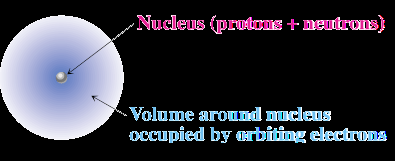
Atoms are the fundamental units of matter, consisting of a dense, positively charged nucleus (containing protons and neutrons) surrounded by a cloud of negatively charged electrons. The nucleus is extremely small compared to the overall size of the atom, with electrons occupying most of the atomic volume.
Atomic Number (Z): Number of protons in the nucleus; defines the element.
Mass Number (A): Total number of protons and neutrons.
Isotopes: Atoms of the same element with different numbers of neutrons.
Atomic Mass: Weighted average mass of an element's isotopes (in amu).
Atomic Orbitals and Quantum Numbers
Electrons occupy atomic orbitals, which are regions of space with a high probability of finding an electron. Each electron in an atom is described by four quantum numbers:
Principal quantum number (n): Indicates energy level and size (n = 1, 2, 3, ...).
Angular momentum quantum number (\ell): Indicates shape (\ell = 0 for s, 1 for p, 2 for d, ...).
Magnetic quantum number (m_\ell): Orientation of orbital (-\ell to +\ell).
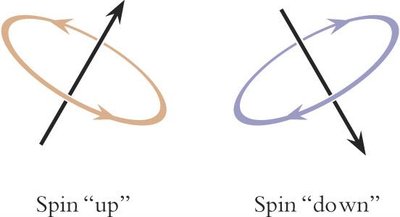
Spin quantum number (m_s): Electron spin (+1/2 or -1/2).
Shapes of Atomic Orbitals
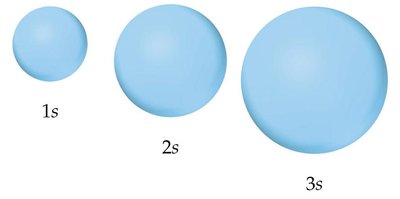
s Orbitals: Spherical; number of nodes = n - 1.
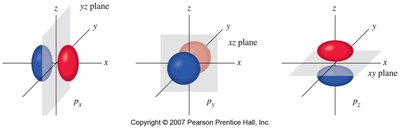
p Orbitals: Dumbbell-shaped; oriented along x, y, z axes; have a node at the nucleus.
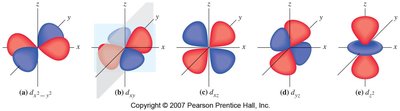
d Orbitals: More complex shapes; five orientations per energy level.
Electron Configuration and the Periodic Table
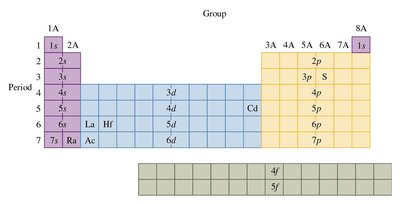
Electrons fill orbitals in order of increasing energy, following the Aufbau principle, Pauli exclusion principle, and Hund's rule. The periodic table reflects this order and helps predict electron configurations.
Aufbau Principle: Fill lowest energy orbitals first.
Pauli Exclusion Principle: No two electrons in an atom can have the same set of four quantum numbers.
Hund's Rule: Electrons occupy degenerate orbitals singly before pairing.
Bonding in Molecules
Ionic and Covalent Bonds
Bonds form because atoms achieve greater stability (lower energy) together than apart. There are two main types of bonds:
Ionic Bonds: Formed by transfer of electrons from a metal to a nonmetal, resulting in cations and anions held by electrostatic attraction.
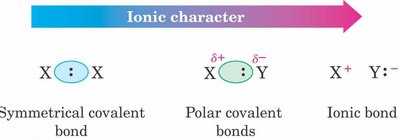
Covalent Bonds: Formed by sharing electrons between nonmetals. Can be nonpolar (equal sharing) or polar (unequal sharing).
Electronegativity and Bond Polarity
Electronegativity (EN) is the ability of an atom to attract electrons in a bond. The difference in EN between atoms determines bond polarity:
Nonpolar Covalent: ΔEN ≈ 0
Polar Covalent: 0 < ΔEN < 2
Ionic: ΔEN ≥ 2
Polar bonds have a dipole moment (μ), a measure of charge separation:
where Q is the charge and r is the distance between charges.
Lewis Structures and the Octet Rule
Drawing Lewis Structures
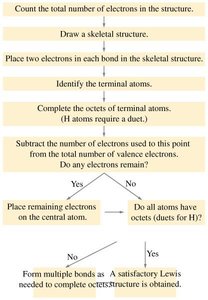
Lewis structures represent the arrangement of valence electrons in molecules. Key rules:
Sum valence electrons from all atoms (add for anions, subtract for cations).
Arrange atoms (least EN central, H always terminal).
Connect atoms with single bonds, complete octets (or duets for H).
Use multiple bonds if necessary to satisfy octet rule.
Formal Charge
Formal charge helps determine the most stable Lewis structure:
Octet Rule and Exceptions
Octet Rule: Atoms (especially C, N, O, F) tend to form bonds until they are surrounded by 8 electrons.
Exceptions: Hydrogen (2 electrons), Boron (often 6 electrons), expanded octets (P, S, etc. can have more than 8 electrons).
Valence Bond Theory and Hybridization
Valence Bond Theory
Covalent bonds form by the overlap of atomic orbitals. Sigma (σ) bonds result from end-to-end overlap, while pi (π) bonds result from side-to-side overlap of p orbitals.
Hybridization
Hybrid orbitals are formed by mixing atomic orbitals to explain molecular geometry:
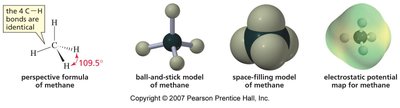
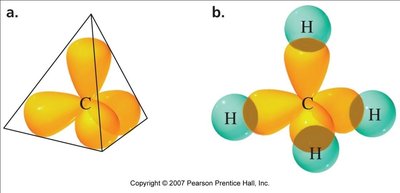
sp3 Hybridization: Four equivalent orbitals, tetrahedral geometry, bond angle ≈ 109.5° (e.g., methane, CH4).
sp2 Hybridization: Three equivalent orbitals, trigonal planar geometry, bond angle ≈ 120° (e.g., ethene, C2H4).
sp Hybridization: Two equivalent orbitals, linear geometry, bond angle ≈ 180° (e.g., acetylene, C2H2).
Resonance and Delocalized Electrons
Resonance Structures
Some molecules cannot be adequately represented by a single Lewis structure. Resonance structures are multiple valid Lewis structures that differ only in the arrangement of electrons (not atom positions). The actual molecule is a resonance hybrid, with properties intermediate between the contributors.
Resonance increases stability (resonance energy).
Only π electrons and lone pairs adjacent to π systems participate in resonance.
All resonance contributors must have the same net charge and valid Lewis structures.
Localized vs. Delocalized Electrons
Localized electrons: Confined to a single atom or bond.
Delocalized electrons: Spread over several atoms, as in resonance structures.
Summary Table: Key Bonding Concepts
Bond Type | Electron Sharing | Example | Bond Strength |
|---|---|---|---|
Ionic | Transfer | NaCl | Strong (lattice) |
Covalent (σ) | Equal/Unequal | H2, HCl | Strong |
Covalent (π) | Side-to-side | C2H4 | Weaker than σ |
Key Concepts
Atomic structure and quantum numbers determine chemical behavior.
Electron configuration and periodic trends predict bonding patterns.
Lewis structures, formal charge, and resonance are essential for understanding molecular structure and reactivity.
Hybridization explains molecular geometry and bond angles.
Resonance and delocalization contribute to molecular stability.
