 Indietro
Families of Carbon Compounds, Functional Groups, and Resonance in Organic Chemistry
Guida di studio - Note intelligenti
 Appunti personalizzati basati sui tuoi materiali, ampliati con definizioni chiave, esempi e contesto.
Families of Carbon Compounds
Hydrocarbons
Hydrocarbons are organic compounds composed exclusively of carbon and hydrogen atoms. They are classified based on the types of bonds between carbon atoms.
Alkanes: Saturated hydrocarbons with only single bonds between carbon atoms. General formula: .
Alkenes: Contain at least one carbon–carbon double bond. General formula: .
Alkynes: Contain at least one carbon–carbon triple bond. General formula: .
Aromatic Compounds: Contain a special type of ring, most commonly a benzene ring, with delocalized π-electrons.
Sources and Properties of Alkanes
Primary sources: natural gas and petroleum.
Lower alkanes (methane to butane) are gases at room temperature; higher alkanes are liquids or solids.
Methane is the main component of natural gas.
Industrial Importance of Alkenes and Alkynes
Ethene (ethylene): Used to synthesize ethanol, ethylene oxide, ethanal, and polyethylene.
Propene (propylene): Used to produce acetone, cumene, and polypropylene.
Ethyne (acetylene): Simplest alkyne, used in welding and as a chemical building block.
Aromatic Compounds and Benzene
Benzene is a planar, cyclic molecule with all C–C bond lengths equal (1.39 Å), intermediate between single and double bonds due to resonance stabilization.
All carbons in benzene are sp2 hybridized, and the six π-electrons are delocalized above and below the ring.
Bonding and Electronegativity
Polar Covalent Bonds
Bonds can be classified based on electron sharing:
Non-polar covalent: Equal sharing of electrons (e.g., C–C in ethane).
Polar covalent: Unequal sharing due to differences in electronegativity (EN).
Ionic: Complete transfer of electrons (e.g., LiF).
Electronegativity
Electronegativity is the intrinsic ability of an atom to attract shared electrons in a covalent bond. Fluorine is the most electronegative element (EN = 4.0), while cesium is the least (EN = 0.7).
Electronegativity increases across a period and decreases down a group.
Common EN values: H (2.1), C (2.5), N (3.0), O (3.5), F (4.0).
Functional Groups
Functional groups are specific groups of atoms within molecules that are responsible for the characteristic chemical reactions of those molecules.
Alkyl Halides (Haloalkanes): R–X (X = F, Cl, Br, I)
Alcohols: R–OH
Ethers: R–O–R'
Amines: R–NH2
Aldehydes and Ketones: Contain the carbonyl group (C=O)
Carboxylic Acids, Esters, Amides: Contain carboxyl, ester, or amide groups
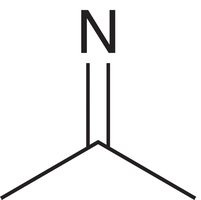
Nitriles: R–C≡N
Representing Molecules
Types of Structural Representations
Molecules can be represented in several ways, each providing different levels of detail:
Lewis structures
Partially condensed structures
Condensed structures
Molecular formulas

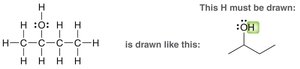
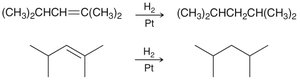
Bond-line Structures
Bond-line (skeletal) structures are the most common way to represent organic molecules, especially large ones. Carbon atoms are implied at the ends and bends of lines, and hydrogen atoms attached to carbon are usually omitted for clarity.
Each vertex or endpoint represents a carbon atom.
Lines represent bonds; zigzag pattern reflects actual bond angles.
Heteroatoms (non-carbon, non-hydrogen) and their attached hydrogens are explicitly shown.
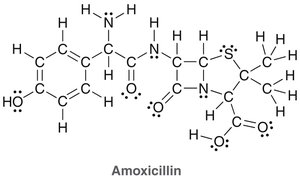
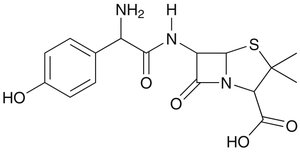

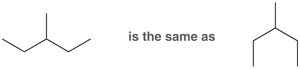
Practice with Bond-line Structures
It is important to be able to convert between Lewis, condensed, and bond-line structures, and to recognize equivalent representations.

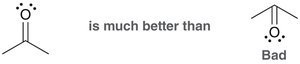
Bond-line Structures with Formal Charges and Lone Pairs
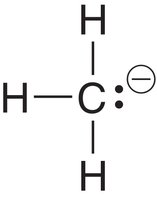
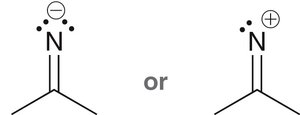
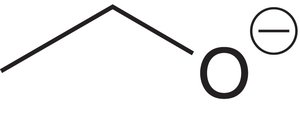
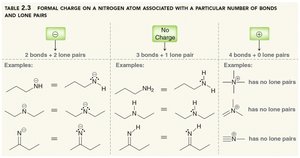
Formal charges must be shown on bond-line structures when present. Lone pairs are often omitted unless necessary for clarity or to determine formal charge.


Three-Dimensional Structures
3D Bond-line Structures
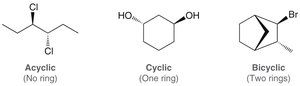
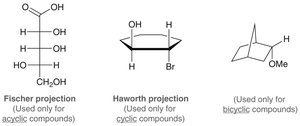
Dashed and solid wedges are used to indicate bonds going into or out of the plane of the paper, respectively. This is essential for representing stereochemistry and chirality.
Resonance and Electron Delocalization
Resonance Structures
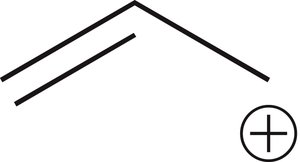
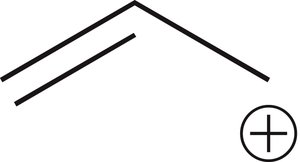
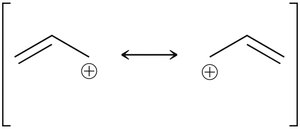
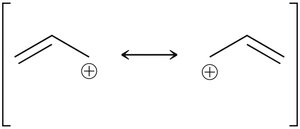
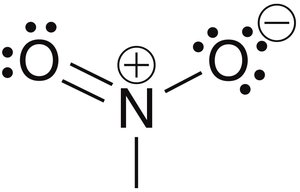
Resonance occurs when more than one valid Lewis structure can be drawn for a molecule, differing only in the placement of electrons. The true structure is a resonance hybrid, which is more stable than any individual contributor.
Stability from Resonance
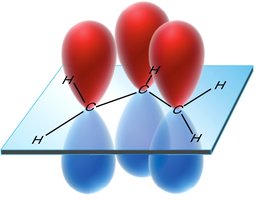
Delocalization of electrons increases molecular stability by spreading out charge and minimizing electron repulsion.
Resonance hybrids are always more stable than any individual resonance contributor.
Curved Arrows in Resonance
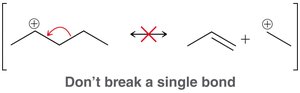
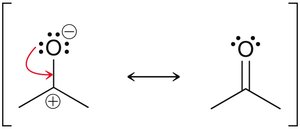
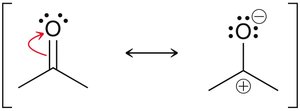
Curved arrows are used to show the movement of electron pairs in resonance structures. The arrow starts at the electron source (lone pair or bond) and points to where the electrons move.
Never break a single bond in resonance (only move π or lone pair electrons).
Never exceed an octet for second-row elements (B, C, N, O, F).
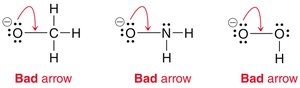
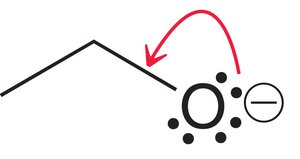
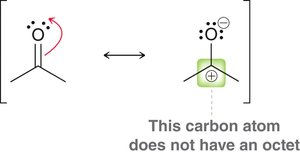
Formal Charge in Resonance
Formal charges must be shown on resonance contributors. Curved arrows help track the movement of charge within the molecule.
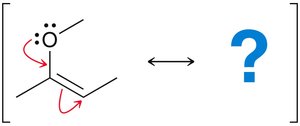
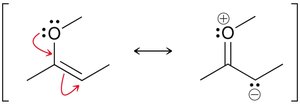
Patterns in Resonance
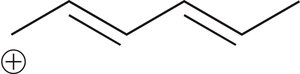
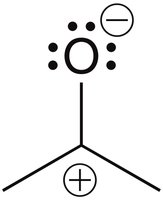
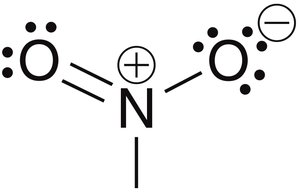
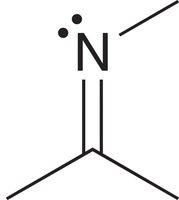
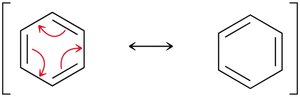
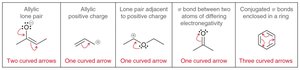
There are five main bonding patterns where resonance occurs:
Allylic lone pairs
Allylic positive charge
Lone pair adjacent to a positive charge
π bond between atoms of different electronegativity
Conjugated π bonds in a ring
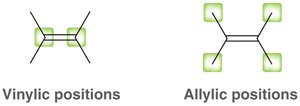
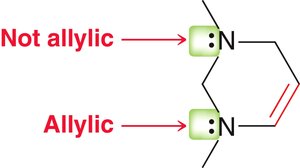


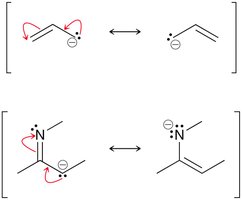

Stability of Resonance Contributors
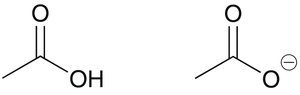
Not all resonance contributors contribute equally to the resonance hybrid. The most stable contributors are those with:
Complete octets on all atoms
Minimal formal charges
Negative charges on more electronegative atoms, positive charges on less electronegative atoms
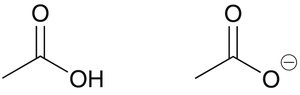
Delocalized vs. Localized Electrons
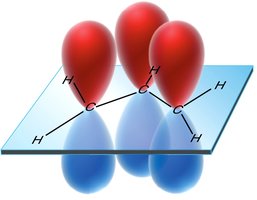
Electrons are localized if they are not involved in resonance, and delocalized if they are. Delocalization increases stability. For electrons to be delocalized, they must be in unhybridized p orbitals that can overlap with neighboring p orbitals, and the atom must be sp or sp2 hybridized.
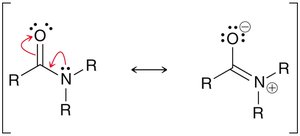
Hybridization and Delocalization
Atoms may adopt sp2 hybridization to allow for delocalization, even if sp3 would otherwise be more stable. For example, the nitrogen in an amide is sp2 hybridized to allow its lone pair to participate in resonance with the adjacent carbonyl group.
Additional info: sp2 hybridization leads to a trigonal planar geometry, while sp3 is tetrahedral. Delocalization can override the preference for sp3 hybridization due to the extra stability gained.
