 Indietro
Families of Carbon Compounds, Intermolecular Forces, and Infrared (IR) Spectroscopy
Guida di studio - Note intelligenti
 Appunti personalizzati basati sui tuoi materiali, ampliati con definizioni chiave, esempi e contesto.
Families of Carbon Compounds
Hydrocarbons
Hydrocarbons are organic compounds composed exclusively of carbon and hydrogen atoms. They are classified based on the types of bonds between carbon atoms:
Alkanes: Contain only single bonds between carbon atoms (C–C). General formula: .
Alkenes: Contain at least one carbon–carbon double bond (C=C). General formula: .
Alkynes: Contain at least one carbon–carbon triple bond (C≡C). General formula: .
Aromatic Compounds: Contain a special type of ring structure, most commonly the benzene ring, with delocalized π-electrons.
Example: Methane (alkane), ethene (alkene), ethyne (alkyne), benzene (aromatic).
Functional Groups
Functional groups are specific groups of atoms within molecules that are responsible for the characteristic chemical reactions of those molecules. They define the class and reactivity of organic compounds.
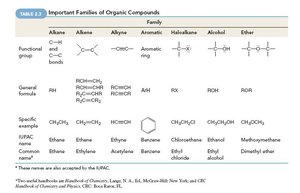
Alkyl Halides (Haloalkanes): R–X (X = F, Cl, Br, I)
Alcohols: R–OH
Ethers: R–O–R'
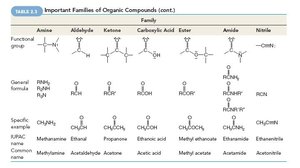
Amines: R–NH2, R2NH, R3N
Aldehydes: R–CHO
Ketones: R2C=O
Carboxylic Acids: R–COOH
Esters: R–COOR'
Amides: R–CONH2
Nitriles: R–C≡N
These groups can be designated by the symbol R, representing an alkyl group.
Bond Polarity and Molecular Properties
Electronegativity and Bond Polarity
Electronegativity (EN) is the intrinsic ability of an atom to attract shared electrons in a covalent bond. The difference in EN between two atoms determines bond polarity:
Nonpolar Covalent Bond: Electrons are shared equally (e.g., C–C in ethane).
Polar Covalent Bond: Electrons are shared unequally, resulting in partial charges (δ+ and δ–).
Ionic Bond: Electrons are transferred, not shared (e.g., LiF).
Electronegativity increases across a period and decreases down a group in the periodic table. Fluorine is the most electronegative element (EN = 4.0).
Dipole Moments
A dipole moment is a measure of the separation of positive and negative charges in a molecule. It is calculated as:
where is the distance between charges and is the magnitude of the charge. Dipole moments are measured in debyes (D).
Molecules with polar bonds may be nonpolar overall if their geometry causes dipoles to cancel (e.g., BF3, CCl4).
Cis-trans isomerism affects dipole moments (e.g., cis-1,2-dichloroethene is polar, trans is nonpolar).
Intermolecular Forces and Physical Properties
Ionic and Covalent Bonds
Ionic compounds are held together by strong electrostatic (ion–ion) forces, resulting in high melting and boiling points. Covalent compounds have shared electron pairs and generally lower melting/boiling points.
Types of Intermolecular Forces (van der Waals Forces)
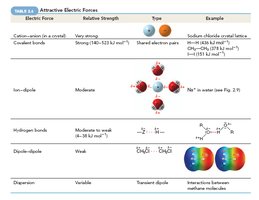
Ion–Dipole: Moderate strength; interaction between an ion and a polar molecule.
Hydrogen Bonds: Moderate to weak; special dipole-dipole interaction involving H bonded to O, N, or F.
Dipole–Dipole: Weak; attraction between polar molecules.
Dispersion (London) Forces: Variable; present in all molecules, especially significant in nonpolar molecules due to temporary dipoles.
Factors Affecting Dispersion Forces
Polarizability: Larger atoms with loosely held electrons are more polarizable, leading to stronger dispersion forces.
Surface Area: Molecules with larger surface areas have stronger dispersion forces (e.g., pentane vs. neopentane).
Boiling Points and Solubility
Boiling Point: The temperature at which vapor pressure equals atmospheric pressure; depends on intermolecular forces.
Solubility: "Like dissolves like"—polar compounds dissolve in polar solvents, nonpolar in nonpolar solvents.
Hydrophilic: Water-compatible groups (e.g., –OH).
Hydrophobic: Water-incompatible groups (e.g., long hydrocarbon chains).
Organic compounds are considered water-soluble if at least 3 g dissolve in 100 mL of water. Solubility decreases with increasing hydrocarbon chain length.
Infrared (IR) Spectroscopy
Principles of IR Spectroscopy
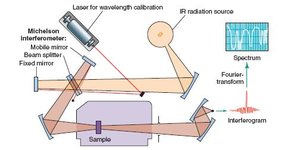
IR spectroscopy is a technique used to identify functional groups in organic molecules by measuring the absorption of IR radiation, which causes molecular vibrations. The position of an absorption band is specified in wavenumbers (cm–1).
The energy of absorption is related to frequency () and wavelength ():
where is Planck's constant.
Molecular Vibrations
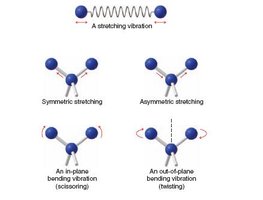
Molecules absorb IR radiation by undergoing vibrational transitions, including stretching and bending modes:
Stretching: Symmetric and asymmetric stretching of bonds.
Bending: In-plane (scissoring) and out-of-plane (twisting) bending vibrations.
Characteristic IR Absorptions
Different functional groups absorb IR radiation at characteristic wavenumbers:
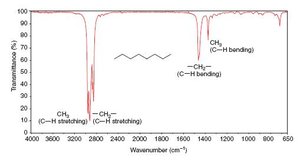
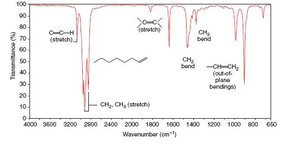
Alkanes: C–H stretching (2850–2960 cm–1), C–H bending (1350–1470 cm–1).
Alkenes: =C–H stretching (3020–3100 cm–1), C=C stretching (1620–1680 cm–1).
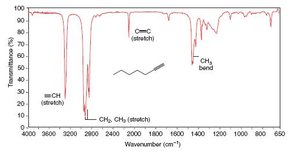
Alkynes: ≡C–H stretching (3300 cm–1), C≡C stretching (2100–2260 cm–1).
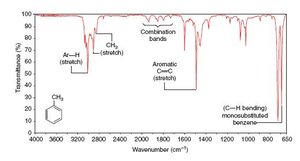
Aromatic: C–H stretching (3030 cm–1), C=C stretching (1450–1600 cm–1).
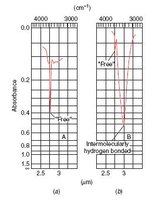
Alcohols/Phenols: O–H stretching (3200–3550 cm–1, broad).
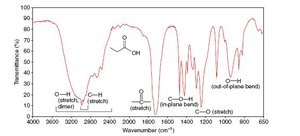
Carboxylic Acids: O–H stretching (2500–3300 cm–1, very broad), C=O stretching (1700–1725 cm–1).
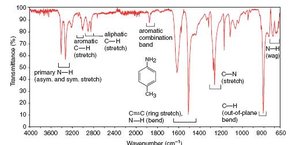
Amines: N–H stretching (3300–3500 cm–1), primary amines show two peaks, secondary one peak, tertiary none.
Interpreting IR Spectra
IR spectra display transmittance (%) versus wavenumber (cm–1). Key absorptions are used to identify functional groups present in a molecule.
Octane: Shows C–H stretching and bending typical of alkanes.
Toluene: Shows aromatic C–H and C=C stretches.
1-Heptyne: Shows ≡C–H and C≡C stretches.
1-Octene: Shows =C–H and C=C stretches.
Alcohols/Phenols: Broad O–H stretch.
Carboxylic Acids: Very broad O–H and strong C=O stretches.
Amines: N–H stretches, with number of peaks indicating primary or secondary amine.
Summary Table: Important Families of Organic Compounds
The following tables summarize the main families of organic compounds, their functional groups, general formulas, and examples:
Summary Table: Attractive Electric Forces
This table summarizes the types, relative strengths, and examples of attractive electric forces relevant to organic molecules:
