 Indietro
Nucleophilic Substitution and Elimination Reactions: Mechanisms, Factors, and Applications
Guida di studio - Note intelligenti
 Appunti personalizzati basati sui tuoi materiali, ampliati con definizioni chiave, esempi e contesto.
Nucleophilic Substitution Reactions
Overview of SN1 and SN2 Mechanisms
Nucleophilic substitution reactions are fundamental in organic chemistry, involving the replacement of a leaving group by a nucleophile. Two primary mechanisms are observed: SN1 (unimolecular) and SN2 (bimolecular).
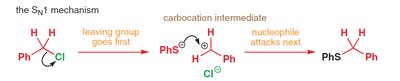
SN1 Mechanism: Occurs in two steps: first, the leaving group departs, forming a carbocation intermediate; second, the nucleophile attacks the carbocation. The rate depends only on the concentration of the substrate.
SN2 Mechanism: Occurs in a single step where the nucleophile attacks as the leaving group departs. The rate depends on both the substrate and nucleophile concentrations.
Stereochemistry: SN1 produces racemic mixtures due to planar carbocation intermediates, while SN2 results in inversion of configuration at the reaction center.

Kinetic Evidence for SN1 and SN2
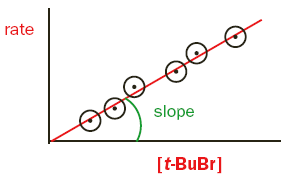
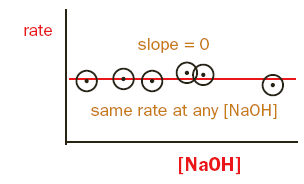
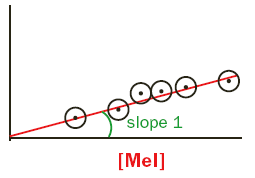
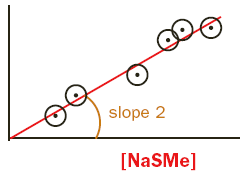
The kinetic profiles of SN1 and SN2 reactions can be distinguished by varying reactant concentrations.
SN1: Rate is independent of nucleophile concentration, but directly proportional to substrate concentration.
SN2: Rate is proportional to both substrate and nucleophile concentrations.
Energy Profile and Transition States
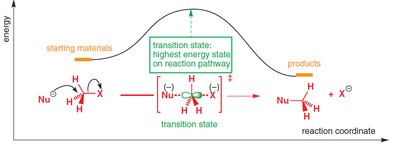
The energy profile of nucleophilic substitution reactions illustrates the transition state and activation energy.
SN1: Two transition states, with the first (formation of carbocation) being rate-limiting.
SN2: Single transition state, simultaneous bond formation and breaking.

Factors Affecting Reactivity and Mechanism Choice
Structure of the Substrate (Carbon Skeleton)
The structure of the substrate is crucial in determining whether SN1 or SN2 occurs.
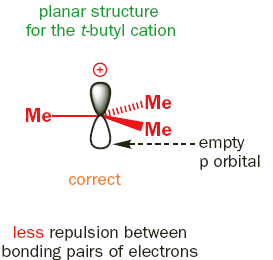
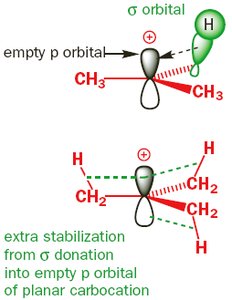
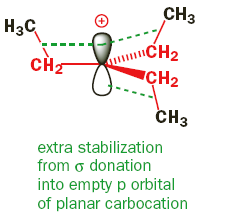
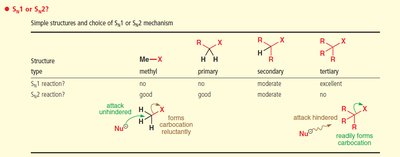
SN1: Favored by substrates that form stable carbocations (tertiary, allylic, benzylic).
SN2: Favored by substrates with minimal steric hindrance (methyl, primary).


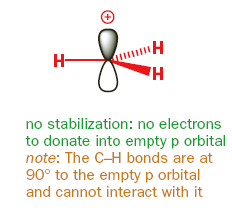
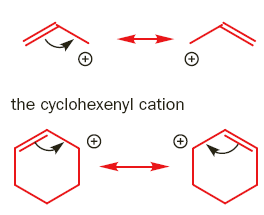
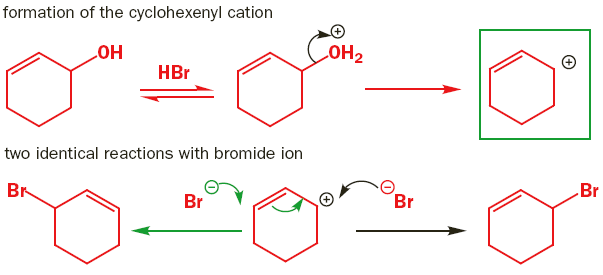
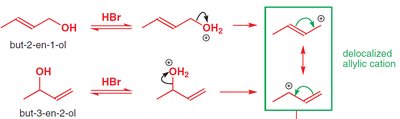
Allylic and Benzylic Carbocations
Allylic and benzylic carbocations are stabilized by resonance, making SN1 more favorable.
Heteroatom Stabilization
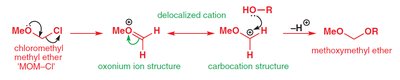
Carbocations adjacent to heteroatoms (e.g., oxygen) are stabilized by resonance, facilitating SN1.

Steric Factors
Steric hindrance affects the accessibility of the electrophilic carbon.
SN2: Sensitive to steric bulk; bulky substrates or nucleophiles slow the reaction.
SN1: Less affected by steric hindrance due to carbocation intermediate.


Nucleophilicity
Nucleophilicity is the reactivity of a nucleophile toward an electrophile. It is influenced by charge, electronegativity, steric bulk, and solvent.
Charge: Anions are stronger nucleophiles than neutral molecules.
Electronegativity: Lower electronegativity increases nucleophilicity.
Steric Bulk: Bulky nucleophiles are less reactive.


Nucleophile X- | pKa of HX | Relative rate |
|---|---|---|
HO- | 15.7 | 1.2 × 10⁴ |
PhO- | 10.0 | 2.0 × 10³ |
AcO- | 4.8 | 9 × 10² |
H2O | -1.7 | 1.0 |
ClO4- | -10 | 0 |
Leaving Groups and Their Manipulation
Leaving Group Ability
Good leaving groups stabilize the negative charge after departure.
Conjugate bases of strong acids are typically good leaving groups.
Alcohols are poor leaving groups but can be converted to better leaving groups by protonation or derivatization.
Leaving Group Manipulation: Tosylates and Mesylates
Alcohols can be converted to tosylates, mesylates, or triflates, which are excellent leaving groups.
Compound | Structure | Nomenclature |
|---|---|---|
Toluenesulfonic acid | TsOH | "tosic acid" |
Toluenesulfonyl chloride | TsCl | "tosyl chloride" |
Tosylate | ROTs | "tosylate" |
Methanesulfonic acid | MsOH | "mesyl acid" |
Methanesulfonyl chloride | MsCl | "mesyl chloride" |
Mesylate | ROMs | "mesylate" |
Trifluoromethanesulfonic acid | TfOH | "triflic acid" |
Trifluoromethanesulfonyl chloride | TfCl | "triflic chloride" |
Triflate | ROTf | "triflate" |
Solvent Effects
Solvent Choice and Mechanism
SN1: Favored by polar, protic solvents (e.g., water, alcohols) which stabilize carbocation intermediates.
SN2: Favored by polar, aprotic solvents (e.g., DMSO, DMF) which do not solvate anions strongly, increasing nucleophilicity.
Stereochemical Implications
SN1 vs SN2 Stereochemistry
SN1: Racemization due to planar carbocation intermediate.
SN2: Inversion of configuration due to backside attack.
Elimination Reactions
E2 and E1 Mechanisms
Elimination reactions compete with substitution, especially with strong bases.
E2: Bimolecular, single-step mechanism; rate depends on both substrate and base. Requires anti-periplanar geometry.
E1: Unimolecular, two-step mechanism; rate depends only on substrate. Forms carbocation intermediate.
Regioselectivity and Zaitsev's Rule
The most substituted alkene is usually the major product (Zaitsev's rule).
Bulky bases or leaving groups can favor the less substituted (Hoffman) product.
Stereoselectivity
E alkenes are generally favored over Z alkenes due to lower steric strain in the transition state.
Summary Table: SN1 vs SN2 vs E1 vs E2
Mechanism | Substrate | Nucleophile/Base | Solvent | Leaving Group | Stereochemistry |
|---|---|---|---|---|---|
SN1 | Tertiary, allylic, benzylic | Weak, neutral | Polar protic | Good | Racemization |
SN2 | Methyl, primary | Strong, anionic | Polar aprotic | Good | Inversion |
E1 | Tertiary | Weak base | Polar protic | Good | Mix of E/Z |
E2 | Primary, secondary, tertiary | Strong base | Polar aprotic | Good | E favored |
Additional info:
These notes cover core topics from Organic Chemistry chapters: Substitution Reactions, Elimination Reactions, Stereochemistry, Solvent Effects, and Nucleophilicity.
Images included are directly relevant to the mechanisms, energy profiles, and tables discussed.
