 Indietro
Organic Chemistry Exam 1 Review – Step-by-Step Guidance
Guida di studio - Note intelligenti
 Appunti personalizzati basati sui tuoi materiali, ampliati con definizioni chiave, esempi e contesto.
Q1. Which of the following species possesses a formal charge?
Background
Topic: Formal Charge Calculation
This question tests your ability to determine whether a molecule or ion has a formal charge based on its Lewis structure and electron distribution.
Key Terms and Formulas
Formal charge: The charge assigned to an atom in a molecule, calculated by comparing the number of valence electrons in the free atom to those assigned in the molecule.
Formula:
Step-by-Step Guidance
Draw the Lewis structures for each species: CCl4, SiCl4, AlCl4, PCl3.
Count the valence electrons for the central atom in each molecule.
Assign electrons to the central atom: count nonbonding electrons and bonding electrons.
Use the formal charge formula to calculate the formal charge for the central atom in each species.
Compare the results to determine which species has a nonzero formal charge.
Try solving on your own before revealing the answer!
Final Answer: AlCl4-
AlCl4 has a formal charge because aluminum typically forms three bonds, but in AlCl4- it forms four, resulting in a negative formal charge on the aluminum atom.
Q2. Which of the following compounds is a carboxylic acid?
Background
Topic: Functional Groups – Carboxylic Acids
This question tests your ability to identify the carboxylic acid functional group in organic molecules.
Key Terms and Formulas
Carboxylic acid: Contains the functional group (carboxyl group).
General formula:
Step-by-Step Guidance
Examine each compound for the presence of the group.
Compare the structures: CH3CH2CH2COOH, CH3CH2OCH3, CH3CH2CH2OH, CH3CH2NH2.
Identify which compound contains the carboxyl group.
Try solving on your own before revealing the answer!
Final Answer: CH3CH2CH2COOH
This compound contains the carboxylic acid functional group (), making it a carboxylic acid.
Q3. Which of the following is a tertiary alcohol?
Background
Topic: Alcohol Classification
This question tests your ability to distinguish between primary, secondary, and tertiary alcohols based on their structure.
Key Terms and Formulas
Tertiary alcohol: An alcohol in which the carbon bearing the group is attached to three other carbons.
General formula:
Step-by-Step Guidance
Draw the structure for each compound.
Identify the carbon attached to the group in each compound.
Determine how many other carbons are attached to that carbon.
Find the compound where the bearing carbon is attached to three other carbons.
Try solving on your own before revealing the answer!
Final Answer: (CH3)3COH
This is a tertiary alcohol because the central carbon is attached to three methyl groups and the group.
Q4. Which of the following molecules has a molecular dipole moment?
Background
Topic: Molecular Polarity and Dipole Moments
This question tests your understanding of molecular geometry and polarity, which determines whether a molecule has a dipole moment.
Key Terms and Formulas
Dipole moment: A measure of the separation of positive and negative charges in a molecule.
Polarity: Depends on both the difference in electronegativity and the molecular geometry.
Step-by-Step Guidance
Draw the Lewis structures for CO2, BF3, NH3, and CH4.
Determine the molecular geometry for each molecule.
Assess whether the geometry allows for a net dipole moment (i.e., if the dipoles cancel or not).
Identify which molecule has a net dipole moment based on its shape and bond polarities.
Try solving on your own before revealing the answer!
Final Answer: NH3
Ammonia (NH3) has a trigonal pyramidal shape, resulting in a net dipole moment due to the lone pair on nitrogen.
Q5. Rank the following in order of decreasing importance as a contributing resonance structure to the molecular structure of acetone, CH3COCH3 (more important > less important)
Background
Topic: Resonance Structures
This question tests your ability to evaluate resonance structures based on stability and contribution to the overall hybrid.
Key Terms and Formulas
Resonance structure: Alternative Lewis structures for a molecule that differ only in the placement of electrons.
Stability factors: Full octets, minimal formal charges, and charge separation.
Step-by-Step Guidance
Draw all possible resonance structures for acetone.
Evaluate each structure for octet completion and formal charges.
Rank the structures based on stability (octet, charge separation, formal charge).
Order the resonance structures from most to least important based on these criteria.
Try solving on your own before revealing the answer!
Final Answer: 1 > 2 > 3
The resonance structure with full octets and minimal formal charges is most important, followed by those with less stability.
Q6. Which of the following is the strongest acid?
Background
Topic: Acid Strength
This question tests your understanding of factors affecting acid strength, such as electronegativity, bond strength, and resonance.
Key Terms and Formulas
Acid strength: Measured by the tendency to donate a proton ( value).
Factors: Electronegativity, size, resonance stabilization, and bond polarity.
Step-by-Step Guidance
Compare the atoms attached to the hydrogen in each compound: N, P, O, S.
Consider electronegativity and atomic size trends in the periodic table.
Evaluate which compound is most likely to lose a proton based on these factors.
Rank the compounds in order of acid strength.
Try solving on your own before revealing the answer!
Final Answer: CH3SH
Thiols (CH3SH) are stronger acids than alcohols and amines due to the larger size and lower bond strength of S-H compared to O-H and N-H.
Q7. Which sets of curved arrows accounts for the protonation of propene with HI?
Background
Topic: Reaction Mechanisms – Protonation
This question tests your ability to interpret curved arrow notation in organic reaction mechanisms, specifically the protonation of an alkene by a strong acid.
Key Terms and Formulas
Curved arrow: Shows movement of electron pairs during a reaction.
Protonation: Addition of a proton (H+) to a molecule.
Electrophile: HI (hydrogen iodide) acts as a proton donor.
Step-by-Step Guidance
Examine each mechanism (see image below) for the correct movement of electrons from the alkene to the hydrogen atom of HI.
Identify which curved arrow shows the alkene acting as a nucleophile, attacking the proton (H) of HI.
Check that the second arrow shows the breaking of the H-I bond, resulting in the formation of I-.
Compare all four options to see which matches the expected mechanism for protonation of propene.
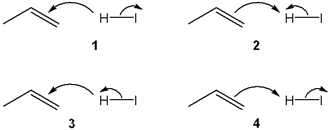
Try solving on your own before revealing the answer!
Final Answer: 1
Option 1 shows the correct electron flow: the alkene donates electrons to the proton, and the H-I bond breaks to give I-.
Q8. Which species is the conjugate acid in the following acid-base reaction?
Background
Topic: Acid-Base Reactions
This question tests your ability to identify conjugate acids and bases in a reaction.
Key Terms and Formulas
Conjugate acid: The species formed when a base gains a proton.
Conjugate base: The species formed when an acid loses a proton.
Step-by-Step Guidance
Identify the acid and base in the reaction.
Determine which species gains a proton during the reaction.
Label the conjugate acid and conjugate base accordingly.
Try solving on your own before revealing the answer!
Final Answer: 2
Species 2 is the conjugate acid because it is formed by the addition of a proton to the base.
Q9. Which of the following is a Lewis acid but not a Brønsted-Lowry acid?
Background
Topic: Acid Definitions
This question tests your understanding of the difference between Lewis acids and Brønsted-Lowry acids.
Key Terms and Formulas
Lewis acid: Electron pair acceptor.
Brønsted-Lowry acid: Proton donor.
Step-by-Step Guidance
Identify which compounds can accept an electron pair but do not donate protons.
Compare the options: CH3COOH, BCl3, H2O, CH3OH.
Determine which compound fits the Lewis acid definition but not the Brønsted-Lowry definition.
Try solving on your own before revealing the answer!
Final Answer: BCl3
Boron trichloride (BCl3) is a Lewis acid because it can accept an electron pair, but it does not donate protons.
Q10. Which of the following is a definition of the rate-determining step of a reaction mechanism?
Background
Topic: Reaction Mechanisms – Rate-Determining Step
This question tests your understanding of the concept of the rate-determining step in multi-step reaction mechanisms.
Key Terms and Formulas
Rate-determining step: The slowest step in a reaction mechanism, which controls the overall rate.
Energy barrier: The step with the highest activation energy.
Step-by-Step Guidance
Review the definitions of each step in a reaction mechanism.
Identify which step is associated with the highest energy barrier.
Determine which option best describes the rate-determining step.
Try solving on your own before revealing the answer!
Final Answer: The step that crosses the highest energy barrier
The rate-determining step is the slowest step, corresponding to the highest activation energy in the mechanism.
