 Indietro
Organic Chemistry Exam 1 Review – Step-by-Step Guidance
Guida di studio - Note intelligenti
 Appunti personalizzati basati sui tuoi materiali, ampliati con definizioni chiave, esempi e contesto.
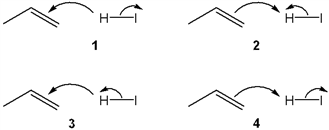
Q7. Which sets of curved arrows accounts for the protonation of propene with HI?
Background
Topic: Reaction Mechanisms – Curved Arrow Notation
This question tests your understanding of how to use curved arrows to represent the movement of electrons during the protonation of an alkene (propene) with hydroiodic acid (HI). This is a fundamental concept in organic chemistry mechanisms, especially in electrophilic addition reactions.
Key Terms and Concepts:
Curved Arrow Notation: Shows the movement of electron pairs during chemical reactions.
Protonation: The addition of a proton (H+) to a molecule.
Electrophile: An electron-poor species that accepts electrons (here, H+ from HI).
Nucleophile: An electron-rich species that donates electrons (here, the alkene in propene).
HI (Hydroiodic Acid): A strong acid that can donate a proton to the alkene.
Step-by-Step Guidance
Recall that in the protonation of an alkene with HI, the alkene acts as a nucleophile and attacks the proton (H+) from HI, while the I- acts as a leaving group.
Examine each curved arrow set in the provided images. The correct mechanism should show the pi electrons of the double bond attacking the hydrogen atom of HI, and simultaneously, the H–I bond breaking to give I-.
Look for the image where the curved arrow starts from the double bond (alkene) and points to the hydrogen atom of HI, and another arrow starts from the H–I bond and points to the iodine atom.
Compare all four options and identify which one matches the correct electron flow for this electrophilic addition step.
Try solving on your own before revealing the answer!
Final Answer: Option 1
In option 1, the curved arrow correctly shows the pi electrons from the double bond attacking the hydrogen of HI, while the H–I bond breaks and the electrons move to iodine, forming I-. This is the correct representation of the protonation step in the electrophilic addition of HI to propene.
