 Indietro
Organic Chemistry Study Notes: Introduction, Molecular Representations, and Alkanes
Guida di studio - Note intelligenti
 Appunti personalizzati basati sui tuoi materiali, ampliati con definizioni chiave, esempi e contesto.
Chapter 3.5: The Mole and Mole Conversions
Definition of a Mole
The mole is a fundamental unit in chemistry used to count large numbers of particles, such as atoms or molecules. It is analogous to other counting units like a dozen or a gross, but much larger.
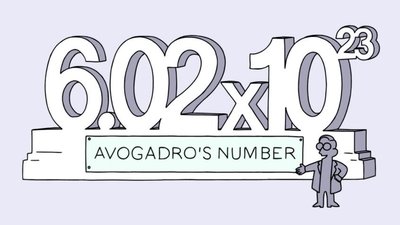
Mole (mol): Contains entities (Avogadro's number).
Avogadro's Number: , the number of atoms, molecules, or particles in one mole.
Examples: 1 mol of marbles = marbles; 1 mol of sand grains = $6.02 \times 10^{23}$ sand grains.
Mole Conversions: Atoms to Moles and Vice Versa
Converting between moles and atoms is essential for quantifying substances in chemistry. The conversion factor is based on Avogadro's number.
Conversion Factor:
Example Calculation:
Number of copper atoms in 2.45 mol:
Number of moles in silver atoms:
Molecular Weight and Mole Calculations
The molecular weight (MW) of a compound is the mass of one mole of that compound, expressed in grams per mole.
Glucose (C6H12O6):
Molecular weight:
Moles in 100 g of glucose:
Chapter 4: Introduction to Organic Compounds
Overview of Chapter 4
This chapter introduces the basic concepts of organic chemistry, including the structure of organic compounds, alkanes, functional groups, nomenclature, and isomerism.
4.1 – Structures of Organic Compounds
4.2 – Alkanes
4.3 – Functional Groups
4.4 – Nomenclature (Naming of Organic Compounds)
4.5 – Isomerism
What are Organic Compounds?
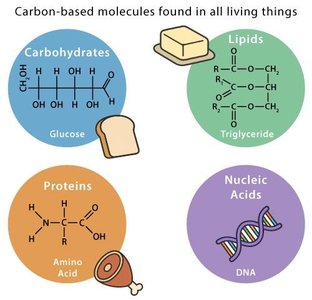
Organic compounds are covalent compounds containing carbon. They may also include hydrogen, oxygen, nitrogen, and other elements. Carbon's unique bonding properties allow for a vast diversity of organic molecules.
Key Elements: Carbon, Hydrogen, Oxygen, Nitrogen, etc.
Importance: Organic compounds are the basis of life and are found in all living things.
Valence Electrons and Bonding
Valence electrons are the outermost electrons of an atom and are responsible for chemical bonding. The periodic table can be used to determine the number of valence electrons for each element.
Valence Electrons: Electrons in the outer shell that participate in bonding.
Bond Formation: Atoms form bonds to achieve a stable electron configuration, often an octet.

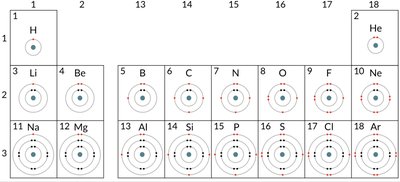
Lewis Dot Structures
Lewis structures show the arrangement of atoms and valence electrons in a molecule. They are useful for visualizing bonding and electron distribution.
Single Bonds: Carbon forms four single bonds (e.g., methane, CH4).
Double Bonds: Carbon can form double bonds (e.g., carbon dioxide, CO2).
Triple Bonds: Carbon can form triple bonds (e.g., hydrogen cyanide, HCN).
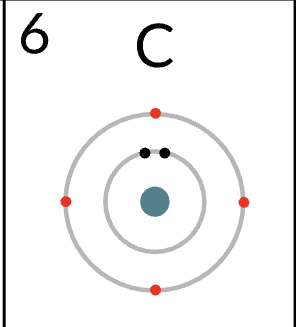
Strategy for Drawing Lewis Dot Structures
Drawing Lewis structures involves several steps to ensure all atoms have the correct number of electrons and satisfy the octet rule.
Count the total number of valence electrons.
Determine the central atom (usually the least electronegative).
Connect surrounding atoms to the central atom with single bonds.
Add remaining electrons to outer atoms first to satisfy the octet rule.
Distribute remaining electrons to the central atom if needed.
Check electron counts and form multiple bonds if necessary.
Practice Examples
Practice drawing Lewis structures for simple molecules such as HCl, C2H4, and H2O.
HCl: Single bond between H and Cl.
C2H4: Double bond between two carbons, each bonded to two hydrogens.
H2O: Oxygen bonded to two hydrogens, with two lone pairs.
Chapter 4.1: Molecular Representations
Condensed Structure
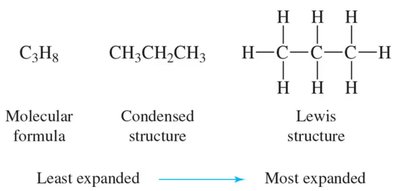
Condensed structures show all atoms in a molecule but do not illustrate all bonds. Hydrogen atoms are written next to the carbon atoms to which they are attached.
Molecular Formula: Shows only the number of each atom in the molecule.
Lewis Structure: Shows complete connectivity—all atoms and all bonds.

Skeletal Structures
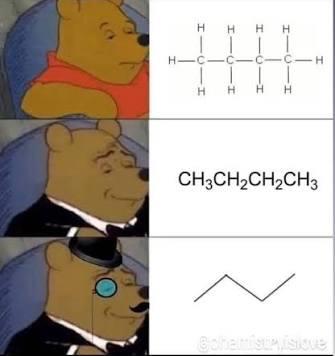
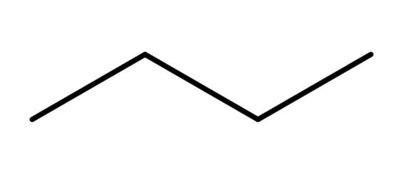
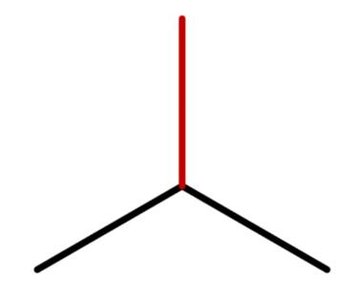
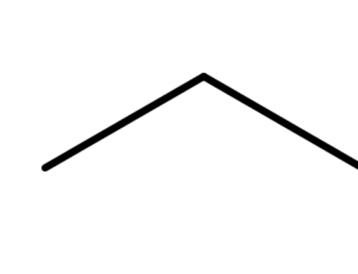
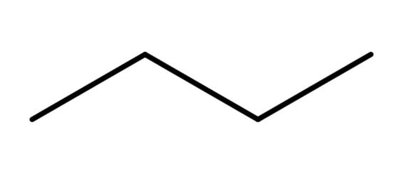
Skeletal structures are the most simplified representation, showing only the bonds between carbon atoms as lines. Hydrogens attached to carbons are implied and not shown.
Ultimate Condensed Formula: Skeletal structure is a "bare-bones" representation.
Hydrogen Atoms: Not shown; only carbon-carbon bonds are depicted.










Chapter 4.2: Alkanes and Cycloalkanes
Alkanes
Alkanes are the simplest group of organic compounds, consisting only of single-bonded carbon and hydrogen atoms. They are referred to as saturated hydrocarbons because they are bonded to the maximum number of hydrogen atoms.
Straight-Chain Alkanes: Made up of carbon atoms joined to form continuous, unbranched chains.
General Formula: for straight-chain alkanes.
Examples: Methane (CH4), Ethane (C2H6), Propane (C3H8), Butane (C4H10), etc.

Cycloalkanes
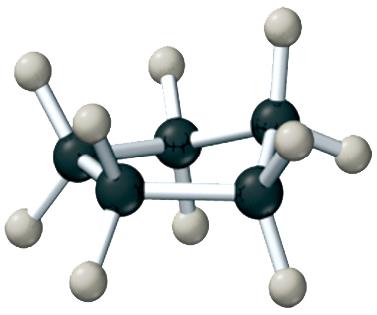
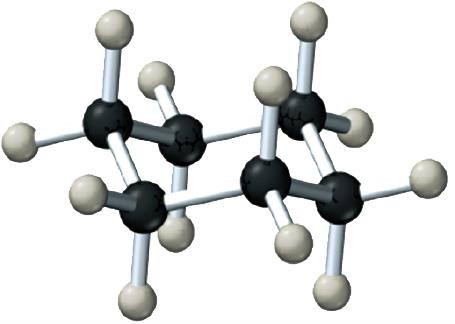
Cycloalkanes are alkanes in which carbon atoms are arranged in rings. The names are formed by adding the prefix "cyclo-" to the alkane name. Rings of five and six carbon atoms are most common in nature.
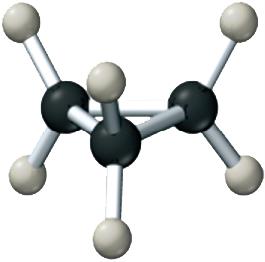
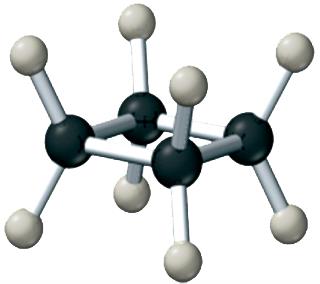
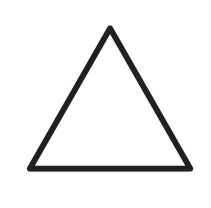
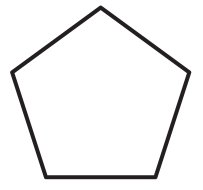
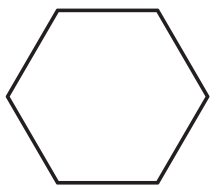
Common Cycloalkanes: Cyclopropane (C3H6), Cyclobutane (C4H8), Cyclopentane (C5H10), Cyclohexane (C6H12).
Skeletal Structures: Triangle (3 ring), Square (4 ring), Pentagon (5 ring), Hexagon (6 ring).
Properties of Alkanes
Alkanes are nonpolar molecules because the electronegativities of carbon and hydrogen are very similar, resulting in equal sharing of electrons in their covalent bonds.
Nonpolarity: Alkanes do not mix well with water and are used as fuels and solvents.
Summary Table: Straight-Chain Alkanes
The following table summarizes the names, molecular formulas, condensed structures, and skeletal structures of straight-chain alkanes from methane to decane.
Number of Carbon Atoms | Prefix | Name of Alkane | Molecular Formula | Condensed Structure | Skeletal Structure |
|---|---|---|---|---|---|
1 | Meth- | Methane | CH4 | CH4 | (none) |
2 | Eth- | Ethane | C2H6 | CH3CH3 | (none) |
3 | Prop- | Propane | C3H8 | CH3CH2CH3 | Zigzag 3 chain |
4 | But- | Butane | C4H10 | CH3CH2CH2CH3 | Zigzag 4 chain |
5 | Pent- | Pentane | C5H12 | CH3CH2CH2CH2CH3 | Zigzag 5 chain |
6 | Hex- | Hexane | C6H14 | CH3CH2CH2CH2CH2CH3 | Zigzag 6 chain |
7 | Hept- | Heptane | C7H16 | CH3CH2CH2CH2CH2CH2CH3 | Zigzag 7 chain |
8 | Oct- | Octane | C8H18 | CH3CH2CH2CH2CH2CH2CH2CH3 | Zigzag 8 chain |
9 | Non- | Nonane | C9H20 | CH3CH2CH2CH2CH2CH2CH2CH2CH3 | Zigzag 9 chain |
10 | Dec- | Decane | C10H22 | CH3CH2CH2CH2CH2CH2CH2CH2CH2CH3 | Zigzag 10 chain |
Additional Info
Organic chemistry is foundational for understanding biological molecules, pharmaceuticals, and materials science. Mastery of molecular representations and nomenclature is essential for further study in organic reactions and mechanisms.
