 Indietro
Ch 5: Stereochemistry: Chirality, Isomerism, and Optical Activity
Guida di studio - Note intelligenti
 Appunti personalizzati basati sui tuoi materiali, ampliati con definizioni chiave, esempi e contesto.
Stereochemistry
Introduction to Stereochemistry
Stereochemistry is the branch of chemistry concerned with the three-dimensional arrangement of atoms within molecules. It is crucial for understanding the properties and reactivity of organic compounds, especially those with chiral centers.
Classification of Isomers
Types of Isomers
Structural (Constitutional) Isomers: Compounds with the same molecular formula but different connectivity of atoms.
Stereoisomers: Compounds with the same connectivity but different spatial arrangements of atoms.
Conformational Isomers: Stereoisomers that can be interconverted by rotation around single bonds.
Configurational Isomers: Stereoisomers that cannot be interconverted without breaking bonds. Includes enantiomers and diastereomers.
Geometric (cis-trans) Isomers: A type of diastereomerism found in alkenes and cyclic compounds due to restricted rotation.
Chirality and Chirality Centers
Definition of Chirality
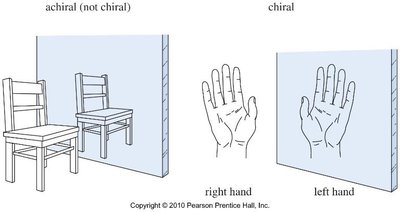
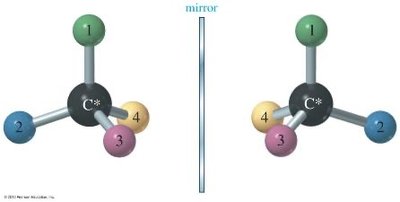
A molecule is chiral if it is not superimposable on its mirror image. Chirality is often compared to handedness: just as your left and right hands are mirror images but not superimposable, so are chiral molecules and their enantiomers.
Chirality Center (Asymmetric Carbon): A carbon atom bonded to four different groups. Its mirror image is a different compound (an enantiomer).
Achiral: Molecules that are superimposable on their mirror images, often due to a plane of symmetry.
Examples and Visualizations
Common examples of chirality include hands, shoes, and certain organic molecules. Achiral objects, like a chair, are superimposable on their mirror images.

Historical Perspective
Development of Stereochemistry
Jacobus H. van’t Hoff (1874): Proposed the tetrahedral structure of carbon, explaining the existence of optical isomers.
Louis Pasteur (1848): First separated enantiomers (mirror-image crystals of tartaric acid) and demonstrated their optical activity.
Enantiomers and Diastereomers
Enantiomers
Enantiomers are stereoisomers that are nonsuperimposable mirror images of each other. They have identical physical properties except for the direction in which they rotate plane-polarized light and their interactions with other chiral substances.
Properties: Same boiling/melting points, densities, and most spectroscopic properties. Rotate plane-polarized light in equal but opposite directions.
Biological Activity: Only one enantiomer is usually biologically active (e.g., only one form of alanine is metabolized by enzymes).
Diastereomers
Diastereomers are stereoisomers that are not mirror images of each other. They have different physical and chemical properties and can be separated more easily than enantiomers.
Cis-trans Isomers: A type of diastereomerism found in alkenes and cyclic compounds.
Meso Compounds: Achiral compounds with two or more chiral centers and an internal plane of symmetry.
Symmetry and Chirality
Planes and Centers of Symmetry
Plane of Symmetry (σ-plane): A molecule with a plane of symmetry is achiral.
Center of Symmetry (i): A point in a molecule such that any line drawn through it meets identical parts at equal distances in opposite directions.
Assigning Configuration: The Cahn–Ingold–Prelog (CIP) System
(R) and (S) Nomenclature
The absolute configuration of a chiral center is assigned as (R) or (S) using the Cahn–Ingold–Prelog priority rules:
Assign priorities to the four groups attached to the chiral center based on atomic number (higher atomic number = higher priority).
Orient the molecule so the lowest priority group is pointing away from you.
Trace a path from priority 1 → 2 → 3. If the path is clockwise, the configuration is (R); if counterclockwise, it is (S).
Note: If the lowest-priority group is toward you, apply the rule in reverse.
Optical Activity and Racemic Mixtures
Optical Activity
Plane-Polarized Light: Chiral compounds rotate the plane of polarized light. The direction and degree of rotation are characteristic of the compound.
Dextrorotatory (+): Rotates light to the right.
Levorotatory (–): Rotates light to the left.
Specific Rotation: , where is concentration (g/mL) and is path length (dm).
Racemic Mixtures
Equal amounts of both enantiomers (d and l forms).
Optically inactive because the rotations cancel each other.
May have different physical properties (e.g., melting point) from the pure enantiomers.
Optical Purity and Enantiomeric Excess
Optical Purity (o.p.):
Enantiomeric Excess (e.e.):
Fischer Projections
Rules for Fischer Projections
Vertical lines represent bonds going away from the viewer.
Horizontal lines represent bonds coming out toward the viewer.
180° rotation in the plane does not change the molecule; 90° rotation does.
Useful for visualizing multiple chiral centers and identifying enantiomers, diastereomers, and meso compounds.
Summary Table: Types of Isomers
Type | Definition | Example |
|---|---|---|
Constitutional Isomers | Same formula, different connectivity | Butane vs. isobutane |
Stereoisomers | Same connectivity, different spatial arrangement | cis-2-butene vs. trans-2-butene |
Enantiomers | Nonsuperimposable mirror images | (R)- and (S)-lactic acid |
Diastereomers | Not mirror images | cis- and trans-1,2-dichlorocyclohexane |
Meso Compounds | Achiral with chiral centers | meso-tartaric acid |
Key Learning Objectives
Draw and classify all stereoisomers of a given structure.
Identify chiral and achiral molecules, mirror planes, and symmetry elements.
Assign (R) and (S) configurations using the Cahn–Ingold–Prelog rules.
Calculate specific rotation, optical purity, and enantiomeric excess.
Use Fischer projections for molecules with multiple chiral centers.
Distinguish between enantiomers, diastereomers, and meso compounds.
Explain the separation of stereoisomers and their significance in biological systems.
